

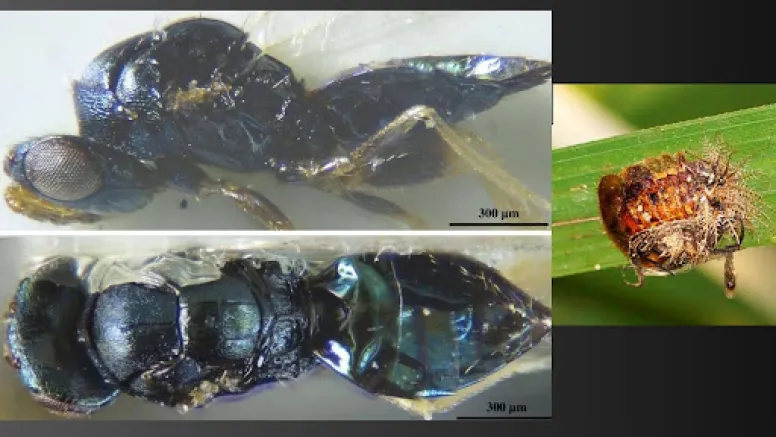
KOLKATA — In the sprawling, often overlooked aquatic ecosystems of the Rajarhat wetlands on the fringes of Kolkata, a team of international researchers has uncovered a biological breakthrough that highlights the intricate, invisible wars fought in the insect world. The discovery of a new species of parasitoid wasp, Tetrastichus narayandebnathi, offers more than just a new entry in the annals of taxonomy; it provides a potential breakthrough for sustainable agriculture and a poignant tribute to West Bengal’s cultural heritage.
This discovery, a collaborative effort between the University of Kalyani, iForNature—Nature Club, and Cairo University, Egypt, marks a rare entomological milestone. It is only the third time in recorded history that a wasp from the genus Tetrastichus has been found associated with tortoise beetles globally, and only the second such instance ever reported from the Indian subcontinent.
I. The Discovery: A Chronology of a Chance Encounter
The journey toward this discovery did not begin in a high-tech laboratory, but rather amidst the blades of grass and wild vegetation of the Rajarhat wetlands. During a routine biodiversity survey aimed at documenting the local insect fauna, researchers noticed a subtle irregularity in the micro-environment.
Field Observation and Suspicion
In late 2025, while surveying the greenery, the team observed a pupa of a tortoise beetle (family Chrysomelidae) attached to a grass blade. To the untrained eye, it appeared unremarkable. However, to the researchers, the specimen’s coloration was a red flag. Healthy tortoise beetle pupae typically exhibit a vibrant, translucent hue; this particular specimen was unusually dark, possessing a sickly yellowish-orange tint.
Recognizing this as a classic sign of parasitoid infestation—where a host is consumed from the inside out by the larvae of another insect—the team carefully collected the specimen. It was transported to the iForNature—Nature Club Research Laboratory in Kolkata for controlled observation.
Lab Emergence and Identification
Under the watchful eyes of the scientists, the dark pupa became a nursery for a new generation of predators. Within days, eight tiny wasps emerged from the single beetle casing. The group consisted of five females and three males. The fact that multiple wasps emerged from a single host confirmed that the species is a "gregarious primary parasitoid."

Following the emergence, the team began the painstaking process of morphological and molecular analysis. Through high-powered microscopic examination, they confirmed that while the wasp bore a resemblance to Tetrastichus tunicus, it possessed distinct physiological markers that set it apart as a species entirely new to science.
II. Supporting Data: The Anatomy of a Specialist
Measuring between a mere 1.4 and 1.7 millimeters, Tetrastichus narayandebnathi is an example of nature’s precision engineering. Despite its diminutive size, the wasp is a formidable predator within its ecological niche.
Physical Characteristics
The species is characterized by a sleek, black body that exhibits a distinct metallic bluish-greenish luster when caught in the light. This iridescent quality is a hallmark of many chalcid wasps, but the specific patterns found on T. narayandebnathi are unique.
Key differentiators identified by the team include:
- Size: Slightly larger than its closest relatives in the Tetrastichus genus.
- Leg Coloration: Noticeably darker legs compared to the pale or amber-hued limbs of similar species.
- Hypopygium: A longer and more pronounced structure on the underside of the abdomen, which is critical for taxonomic classification in Hymenoptera.
Wing Interference Patterns (WIP)
To cement their findings, the researchers employed a cutting-edge technique known as Wing Interference Pattern (WIP) imaging. Because the wings of these wasps are transparent, they do not have "colors" in the traditional sense. However, the microscopic thickness of the wing’s chitin layers causes light to reflect in specific, rainbow-like patterns.
These patterns are as unique as a human fingerprint. By mapping these digital "wingprints," the team was able to provide irrefutable evidence that T. narayandebnathi is a genetically and morphologically distinct entity, separating it from the dozens of other species within the Tetrastichus genus.

III. Cultural Significance: Honoring a Legend
In a move that bridges the gap between the rigid world of scientific nomenclature and the vibrant world of Bengali culture, the researchers named the species after the late Shri Narayan Debnath.
Debnath, a legendary cartoonist and illustrator who passed away in 2022, was a recipient of the Padma Shri, India’s fourth-highest civilian award. He is the creator of iconic characters such as Bantul the Great, Handa Bhonda, and Nonte Phonte, which have been staples of Bengali childhoods for generations.
"By naming this discovery after Narayan Debnath, we wanted to ensure that his legacy lives on not just in the pages of comic books, but in the very biodiversity of the land he loved," the researchers stated. The naming reflects a growing trend in "ethno-taxonomy," where scientists use the discovery of new species to highlight local history and cultural figures.
IV. Official Responses and Ecological Context
The discovery has drawn praise from both the scientific community and environmental advocates, particularly given the location of the find.
The Role of Wetlands
The Rajarhat wetlands, where the wasp was found, are part of a larger ecosystem that acts as the "lungs and kidneys" of Kolkata. However, these areas are under constant threat from urban expansion and land reclamation.
Dr. Amritendu Mukhopadhyay, a lead researcher on the project, emphasized that this discovery underscores how much we still have to learn about urban biodiversity. "We often assume that new species are only found in the deep Amazon or the Himalayas. To find a new parasitoid in a suburban wetland in Kolkata proves that our immediate environment is teeming with undocumented life that performs vital ecological services."

The Urban Greening Paradox
Interestingly, the discovery comes amidst broader research into the "urban greening paradox" in Indian cities. Recent studies across 138 cities have suggested that while trees are essential for cooling, dense canopies in humid, tropical cities like Kolkata can sometimes trap moisture, increasing the "perceived heat" or heat index for residents.
Scientists argue that the discovery of T. narayandebnathi highlights the need for a "balanced" approach to urban ecology. Rather than just planting trees for shade, urban planners must consider the entire ecosystem—including the insects that control pests—to maintain a healthy, functioning environment that can withstand climate change.
V. Implications: A Natural Weapon for Agriculture
The most significant long-term impact of this discovery lies in the field of biological pest control.
Moving Away from Chemicals
Tortoise beetles, the primary hosts for this new wasp, are known to feed on a wide variety of plants, including several sweet potato varieties and other members of the Convolvulaceae family. In many parts of the world, these beetles can become significant agricultural pests, defoliating crops and reducing yields.
The Tetrastichus genus is renowned for its host specificity. Because these wasps only target specific beetle pupae, they represent a "surgical" alternative to broad-spectrum chemical pesticides.
- Safety: Unlike chemicals, these wasps do not harm humans, pets, or beneficial insects like bees.
- Sustainability: Once a population of these wasps is established in a field, they provide ongoing, self-sustaining pest management.
- Resistance: While insects often develop resistance to chemical sprays, the evolutionary arms race between a parasitoid and its host ensures long-term efficacy.
Future Research Directions
The team from the University of Kalyani and Cairo University plans to conduct further studies to determine the exact "host range" of T. narayandebnathi. If the wasp is found to be effective against a variety of crop-destroying beetles, it could eventually be mass-reared and released by agricultural departments as a form of "green" technology.

Conclusion
The discovery of Tetrastichus narayandebnathi is a reminder of the complexity of the natural world. In a single, 1.5-millimeter insect, we find a story of international cooperation, a breakthrough in microscopic imaging, a tribute to a cultural icon, and a potential solution for sustainable farming.
As Kolkata continues to grow, the survival of this tiny wasp depends on the preservation of the wetlands it calls home. This find serves as a clarion call to protect the "wastelands" of the city, which, as it turns out, are not wastes at all, but vibrant laboratories of evolution.
