

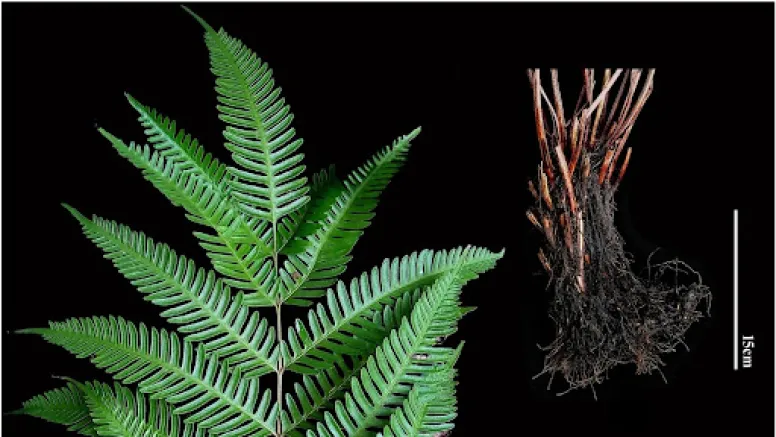
KOLLI HILLS, TAMIL NADU — In a discovery that highlights both the incredible biodiversity of the Indian subcontinent and the precarious state of its remaining wilderness, a team of botanists has identified a new species of fern in the Eastern Ghats. The species, named Pteris madhusoodananii, was found clinging to life within the fragile ecosystem of the Kolli Hills. However, the triumph of its discovery is tempered by an immediate and somber classification: the plant has been declared "Critically Endangered" from the moment of its scientific debut.
The discovery, led by researchers from Government Victoria College and Sri Vyasa NSS College in Kerala, underscores the urgent need for expanded conservation efforts in the Eastern Ghats—a mountain range often overshadowed by the more famous Western Ghats but equally vital to India’s ecological heritage.
The Discovery: A Rare Find in the Puliansolai Shola
The journey to identifying Pteris madhusoodananii began during a comprehensive taxonomic revision of ferns across southern India. While the Western Ghats are frequently the focus of such expeditions, the research team turned their attention to the Kolli Hills in Tamil Nadu, a region known for its "shola" forests—high-altitude patches of stunted tropical montane forest separated by grasslands.
During an expedition near the outskirts of the Puliansolai shola forest, the botanical team noticed a population of ferns that defied immediate categorization. While it bore a superficial resemblance to other members of the Pteris genus—commonly known as brake ferns—its structural nuances suggested something entirely new to science.
“In the field, you develop an intuition for the subtle differences in leaf texture and growth patterns,” noted one of the lead researchers. “This particular population in the Kolli Hills stood out because of its unique architecture and the deep, lustrous green of its foliage, which didn’t match the descriptions of known Pteris species in the region.”

To move beyond mere observation, the team collected samples for rigorous laboratory analysis. The subsequent investigation employed a multi-disciplinary approach, combining traditional morphology with cutting-edge technology.
Methodology: From Field Observation to DNA Sequencing
The identification of a new species in the 21st century requires more than a keen eye; it demands a "botanical trial" involving three distinct layers of evidence.
1. Morphological Analysis
The researchers first conducted a detailed physical comparison. Pteris madhusoodananii is distinguished by its stiff, leathery (coriaceous) leaves. A defining characteristic is the presence of a very prominent lobe at the base of its lower segments. Furthermore, the "pinna-pinnule" architecture—the way the smaller leaflets are arranged along the central stem—showed a geometric configuration distinct from its closest relatives.
2. Scanning Electron Microscopy (SEM)
To look even deeper, the team utilized Scanning Electron Microscopy to examine the plant’s spores. Spores are the reproductive units of ferns and often hold the "fingerprint" of a species. Under the microscope, the researchers discovered that the spores of Pteris madhusoodananii possess a narrow, wavy-edged belt known as a cingulum. This feature provided a clear divergence from similar species, which typically feature smooth or much wider belts.
3. Molecular Phylogenetics
Finally, the team turned to DNA sequencing. By mapping the genetic family tree of the specimen, the researchers were able to confirm that the fern was genetically distinct from other Pteris species found in India and Southeast Asia. This genetic data provided the "smoking gun" needed to officially declare it a new species.

Honoring a Titan of Indian Botany
The naming of the species carries significant weight within the scientific community. The specific epithet, madhusoodananii, was chosen to honor Professor Dr. P. V. Madhusoodanan, the former Head of the Department of Botany at the University of Calicut.
Dr. Madhusoodanan is widely regarded as a titan of Indian pteridology (the study of ferns). Over a career spanning decades, he has mentored generations of botanists and contributed extensively to the documentation of India’s flora. By naming this rare fern after him, the researchers sought to create a living tribute to his dedication to the natural world.
“Professor Madhusoodanan’s work laid the foundation for modern fern studies in India,” the authors stated in their report. “It is only fitting that a species discovered in the heart of the Eastern Ghats—a region he urged us to protect—should bear his name.”
Supporting Data: A Habitat Under Siege
The excitement of the discovery is shadowed by the grim reality of the fern’s habitat. According to the research data, Pteris madhusoodananii is currently known to exist in only two small sites. The total area of its known habitat covers a mere eight square kilometers.
This extremely limited distribution is the primary reason for its "Critically Endangered" status under the criteria set by the International Union for Conservation of Nature (IUCN). For a species to be classified this way, it must face an extremely high risk of extinction in the wild.

The data gathered during the expedition highlighted several immediate threats:
- Infrastructure Development: Road construction in the Kolli Hills is fragmenting the remaining forest patches, making it difficult for the fern populations to remain genetically viable.
- Logging and Encroachment: Illegal logging and the gradual expansion of agricultural land into the shola forests are shrinking the fern’s already minuscule footprint.
- Invasive Species: As human activity increases, invasive plants are moving into the area, outcompeting native flora like the Pteris madhusoodananii for nutrients and sunlight.
Official Responses and Conservation Imperatives
While official government responses from the Tamil Nadu Forest Department are still pending a full review of the published study, the scientific community has been vocal. The researchers are calling for an immediate "Conservation Action Plan" for the Kolli Hills.
"The discovery of Pteris madhusoodananii is a wake-up call," said a spokesperson for the botanical team. "We are finding new species at the same time we are losing the ecosystems that house them. This fern exists on a knife’s edge. Without official protection of these specific sites, we could lose this species within a decade of finding it."
Conservationists are advocating for the designation of the Puliansolai shola outskirts as a "Biodiversity Heritage Site." This status would provide a legal framework to limit construction and agricultural expansion in the areas where the fern is known to grow.
Broader Implications: The Eastern Ghats and Climate Change
The discovery also brings renewed attention to the Eastern Ghats. Historically, conservation funding and research in India have been heavily weighted toward the Western Ghats and the Himalayas. However, the Eastern Ghats serve as a crucial "climate corridor" and a reservoir of unique genetic diversity.

The plight of Pteris madhusoodananii also intersects with broader environmental trends in India. Recent research across 138 Indian cities has highlighted the "urban greening paradox," where dense canopies in humid regions can actually trap moisture and increase perceived heat levels. While this study focuses on urban areas, it underscores the complexity of plant-environment interactions. In the wild, ferns like Pteris madhusoodananii play a vital role in maintaining the microclimate of the forest floor, acting as natural sponges that regulate moisture. The loss of such species could have a "trickle-up" effect on the entire shola ecosystem.
Conclusion: A Race Against Time
The discovery of Pteris madhusoodananii is a testament to the fact that the age of discovery is far from over. Even in a country as densely populated as India, the deep ravines and misty peaks of the Eastern Ghats still hold secrets.
However, the story of this fern is also a cautionary tale. It represents the "silent extinction" of species that are disappearing before they are even named. For Pteris madhusoodananii, the clock is ticking. The botanical world has given it a name and a place in the records of life; it is now up to policymakers and conservationists to ensure that it has a future.
As the researchers conclude in their study: "Every species is a masterpiece of evolution. To allow Pteris madhusoodananii to vanish because of a road or a farm would be to tear a page out of the book of life that we have only just begun to read."
