

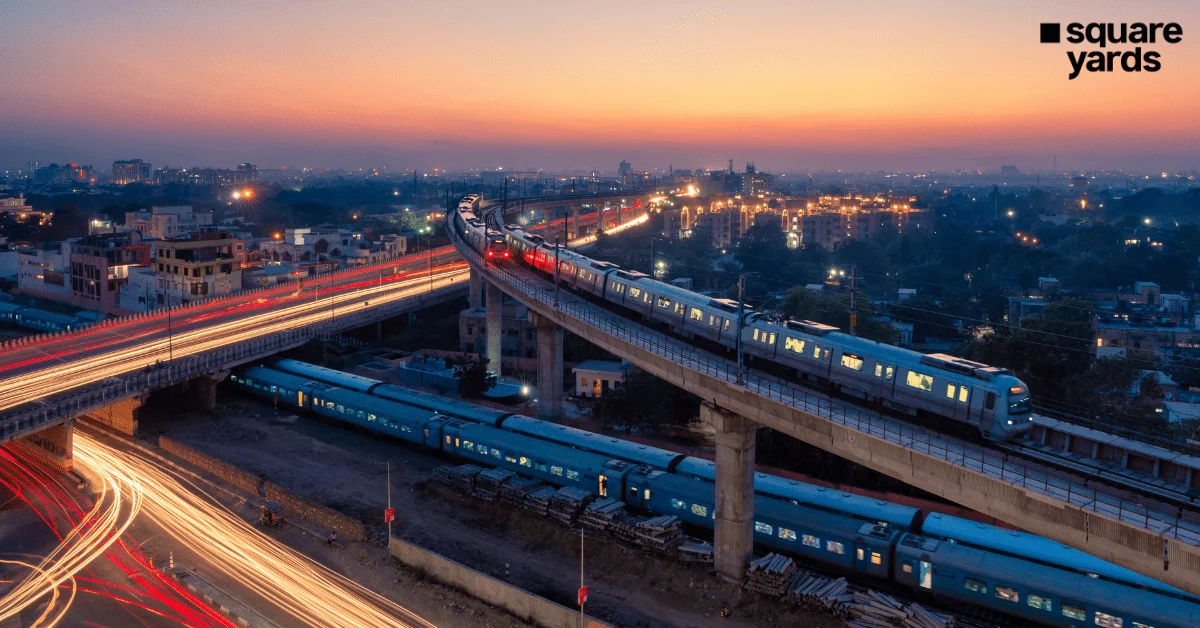
NEW DELHI – In a move set to redefine the urban landscape of the National Capital Region (NCR), the Ministry of Housing and Urban Affairs (MoHUA) has officially confirmed the notification of Transit-Oriented Development (TOD) zones along India’s inaugural Namo Bharat Regional Rapid Transit System (RRTS) corridor. This legislative milestone, integrated into the master plans of Ghaziabad and Meerut, marks a transition from visionary planning to enforceable urban law, fixing the parameters for high-density residential and commercial growth around key transit nodes.
The announcement comes amidst a period of high-stakes evaluation for the future of the network. While the Delhi-Ghaziabad-Meerut line is already transforming commuter behavior, the central government remains in a phase of "intensive examination" regarding four additional corridors, including the highly anticipated link between Ghaziabad and the Noida International Airport at Jewar.
1. Main Facts: Redrawing the Map of the NCR
The notification of TOD zones is the most significant regulatory development for the RRTS project since its inception. By delineating these zones in the statutory master plans of Ghaziabad and Meerut, the government has created a "special area" status for land adjacent to the 82.15 km corridor.
The TOD Mandate
Transit-Oriented Development is a planning strategy that prioritizes high-density, mixed-use development—comprising housing, office spaces, and retail—within a 500-meter to 1.5-kilometer radius of a mass transit station. The objective is to create "walkable" urban hubs where residents can live, work, and shop without relying on private vehicles.
With the formal notification in the Ghaziabad and Meerut Master Plans, the following changes take immediate effect:
- Enforceable Density Rules: Developers are now permitted higher Floor Area Ratio (FAR), allowing for taller buildings and more units per acre within the station catchments.
- Mixed-Use Liberalization: Land that was previously zoned strictly for residential or industrial use can now be converted into mixed-use plots, facilitating the "work-live-play" model.
- Infrastructure Prioritization: Local authorities are now mandated to upgrade last-mile connectivity and pedestrian infrastructure within these notified zones.
2. Chronology: From Blueprint to Operational Success
The journey of the Namo Bharat RRTS has been one of rapid execution compared to traditional Indian infrastructure timelines.
- Initial Conceptualization: The RRTS was conceived as part of the 2005 functional plan for the NCR to decongest Delhi and provide high-speed connectivity to satellite towns.
- Phase I Prioritization: Three corridors were identified for the first phase: Delhi-Meerut, Delhi-Alwar, and Delhi-Panipat.
- Construction and Launch: The 17-km "Priority Section" in Ghaziabad was inaugurated in late 2023, followed by the full operationalization of the 82.15 km Delhi-Ghaziabad-Meerut corridor by February 2024.
- August 6, 2026 (Lok Sabha Disclosure): Tokhan Sahu, Minister of State for Housing and Urban Affairs, provided a written reply to the Lok Sabha confirming the TOD notifications and the status of pending Detailed Project Reports (DPRs).
- August 12, 2026: Official updates from the Press Information Bureau (PIB) corroborated the ridership data and the government’s cautious stance on funding future phases.
3. Supporting Data: Performance Metrics and Technical Innovation
The National Capital Region Transport Corporation (NCRTC), the agency managing the project, has released figures that underscore the system’s operational viability and environmental footprint.
Ridership and Reliability
Since operations began, the Namo Bharat service has moved over 3.8 crore (38 million) commuters. Perhaps more impressive than the volume is the reliability; the agency reports a punctuality rate exceeding 99%. For a region accustomed to the unpredictability of road traffic on the Delhi-Meerut Expressway, this level of precision represents a fundamental shift in daily life.
Multi-Modal Integration
The RRTS is not an isolated track but a hub-and-spoke model. The corridor currently integrates with:
- 3 Metro Lines: Providing seamless transfers to the Delhi Metro network.
- 2 Major Railway Stations: Connecting regional commuters to the national rail grid.
- 4 Bus Terminals: Ensuring the "last mile" is covered by state and local bus services.
The "Meerut Model" of Infrastructure Sharing
In a world-first technical arrangement, the 23-km Meerut Metro network operates on the same infrastructure as the RRTS. By using the same viaducts and stations for both high-speed regional trains and local city metro services, the project has significantly reduced the capital expenditure and land acquisition requirements that would have been necessary for two separate systems.
Sustainability Initiatives
The NCRTC has moved toward green energy by installing 7.8 MWp of rooftop solar capacity across its stations and depots. This is part of a broader strategy to offset the carbon footprint of the high-speed electric units.
4. Official Responses: A Cautious Path Forward
Despite the success of the first corridor, the central government is maintaining a measured tone regarding expansion. Minister of State Tokhan Sahu’s reply to the Lok Sabha was described by analysts as "blunt" regarding the financial hurdles.
The DPR Examination
The Ministry confirmed it has received Detailed Project Reports for four new extensions:
- Delhi to Karnal (Extending the Panipat line)
- Delhi to Bawal
- Bawal to Behror
- Ghaziabad to Noida International Airport (Jewar)
The Ministry stated that these projects are "cost-intensive" and must undergo "intensive examination at several levels." The official stance remains that financial assistance is contingent upon the feasibility of the proposal and the availability of resources. This indicates that while the planning is complete, the "green light" for construction is not yet a certainty.
The Delhi TOD Policy 2026
In the capital, the approach has evolved. Under the Delhi TOD Policy of 2021, specific plans were made for Jangpura and Sarai Kale Khan. However, the 2026 version of the policy introduces an automaticity clause: any new RRTS corridor approved in Delhi will now automatically fall under TOD regulations. This eliminates the need for corridor-by-corridor negotiations with the Delhi Development Authority (DDA), streamlining the development of future alignments.
5. Implications: The Future of Real Estate and Commuting
The notification of TOD zones and the potential expansion of the network carry profound implications for the socio-economic fabric of Northern India.
For Real Estate and Urban Sprawl
Until now, property markets in Ghaziabad and Meerut were governed by antiquated zoning laws that did not account for high-speed transit. The TOD notification changes the "highest and best use" of land. For buyers and investors, this means:
- Appreciation in Station Catchments: Areas like Modinagar, Muradnagar, and Meerut South are expected to see a surge in organized retail and premium housing.
- Curbing Sprawl: By encouraging vertical growth around stations, the policy aims to prevent the horizontal "urban sprawl" that consumes agricultural land on the fringes of the NCR.
The Jewar Airport Connection: A Strategic Pivot
The proposed 72-km link from Ghaziabad to the Noida International Airport (NIA) is arguably the most critical of the pending DPRs. This corridor would connect the Yamuna Expressway industrial belt directly to the RRTS network. If approved, it would allow a passenger from Meerut or North Delhi to reach the Jewar airport in under an hour, fundamentally altering the logistics and hospitality landscape of the region.
The Psychology of the "Search Radius"
The NCRTC is currently employing aggressive pricing strategies to cement the RRTS as a daily habit. A 35% discount on base fares and a loyalty points program have been introduced to lower the barrier to entry.
In urban economics, the "commute cost" determines how far a household is willing to live from the city center. By offering a 99% punctual service at a discounted rate, the RRTS is effectively widening the "search radius" for home buyers. A professional working in Central Delhi can now realistically consider Meerut as a place of residence—a choice that was previously an "endurance test" but is now a "defensible lifestyle decision."
Conclusion: The Infrastructure Gap
While the notified TOD zones provide a firm trigger for development on the ground, the future of the broader network remains suspended in the halls of the central government. For stakeholders—from real estate developers to daily commuters—the message from the Ministry is clear: the model works, the rules are in place, but the expansion will only move as fast as the treasury allows.
As the NCR continues to swell, the Namo Bharat corridor stands as a test case for whether India can successfully marry high-speed transit with disciplined, density-driven urban planning. For now, the eyes of the region remain on the pending DPRs, which hold the key to whether this "transit revolution" remains a single-corridor success or becomes the backbone of a truly integrated mega-region.
