

Introduction: A Legacy of Unseen Guardianship
Long before the scientific discipline of biodiversity emerged, Indigenous communities across the globe possessed an intrinsic understanding of the natural world, a knowledge honed over centuries of cohabitation. Their deep-seated connection with forests, grasslands, medicinal plants, and wildlife, passed down through generations, has positioned them as the primary custodians of some of Earth’s most vital ecosystems and its dwindling biodiversity. On World Indigenous Peoples’ Day, the crucial role of these communities, often unsung heroes dedicated to the welfare of animals, warrants profound recognition. Supriya Sahu, Additional Chief Secretary, Government of Tamil Nadu, aptly highlighted this sentiment, emphasizing the need to honour their wisdom, amplify their voices, protect their rights, and, most importantly, learn from their sustainable living practices. This World Elephant Day, we delve into the remarkable contributions of mahouts and cavadies from tribal communities in Tamil Nadu, the very backbone of captive elephant care in some of the nation’s oldest elephant camps, particularly those dedicated to rehabilitating rescued conflict animals.
The Heart of Elephant Care: Theppakadu and Kozhikamuthi Camps
Tamil Nadu stands as a testament to the profound and enduring relationship between Indigenous communities and elephants. Two of the state’s most historic elephant camps, Theppakadu in the Mudumalai Tiger Reserve and Kozhikamuthi within the Anamalai Tiger Reserve, exemplify this deep-rooted connection. These are not mere holding facilities; they are living embodiments of generations of knowledge, compassion, and an unwavering commitment to the well-being of these magnificent creatures.
Theppakadu Elephant Camp: A Sanctuary of Tradition and Compassion
Nestled amidst the verdant expanse of the Mudumalai Tiger Reserve (MTR), along the tranquil banks of the Moyar River, lies the Theppakadu Elephant Camp. With origins dating back to the 1920s, it is one of Asia’s oldest elephant sanctuaries, currently providing refuge and rehabilitation to 27 elephants. The camp’s legacy is inextricably linked to the Indigenous communities of Kaatunaickers, Kurumbas, and Malasars, who have served as its dedicated caretakers for generations.
The camp gained international acclaim through the Oscar-winning documentary The Elephant Whisperers. This poignant film captured the unbreakable bond between Bomman and Bellie, and their adopted orphaned elephant, Raghu, showcasing the profound human-animal connection that thrives within Theppakadu. The mahouts and their assistants, often drawn from local tribal communities such as the Malasars and Irulas, form the bedrock of the camp’s operations. Their expertise, deeply rooted in traditional knowledge, dictates the maintenance of the camp and the training of its resident elephants.
A remarkable aspect of Theppakadu is its pioneering approach to elephant training. It is the only camp in the country that eschews conventional tools like the ankush (a stick with a pointed hook). Instead, training relies on a foundation of trust, communication, and mutual respect. C. Mari, a mahout with three decades of experience at the camp, fondly recalls his charges, like the 65-year-old Kamatchi, who was brought from Pollachi, and elephants named Senthilvadivdu, Cheran, and Bama, whom he cared for as if they were his own children.

Forest officials frequently share insights into the traditional wisdom that tribal communities possess regarding elephant behaviour. This wisdom, a harmonious blend of scientific understanding and deep-seated compassion, has been meticulously passed down through generations. M. Maran, a retired mahout from the Nilgiris who now oversees training at Theppakadu after 38 years of dedicated service, elaborates on this symbiotic relationship: "Once the rescued elephants are placed inside stalls, we offer sugarcane and nurture our bond. We teach a few commands, pat them and treat them with love. They reciprocate." This approach fosters an environment of trust, where elephants, often rescued from challenging circumstances, learn to feel secure and connected.
The daily routines at Theppakadu are a testament to this philosophy. Elephants are bathed, fed, and given opportunities to interact, all guided by the mahouts’ intuitive understanding of their needs and temperaments. The image of a mahout offering food to a camp elephant at Theppakadu, amidst the serene backdrop of the Mudumalai Tiger Reserve, is more than just a photograph; it is a visual representation of a profound partnership built on trust and respect.
Kozhikamuthi Elephant Camp: A Living Heritage of the Malasar Tribe
Further south, within the picturesque Anamalai Tiger Reserve (ATR), lies the Kozhikamuthi elephant camp, another bastion of Indigenous elephant stewardship. The Malasar tribe, one of the oldest communities residing in the Anamalai Hills, spanning across Tamil Nadu and Kerala, holds a deep historical and cultural connection to this region and its elephants.
The film Malasar, a six-minute conservation piece narrated by actor Nasser, eloquently portrays the sacred bond between the Malasar tribes and elephants, while also underscoring the urgent need to preserve the tribe’s identity and their invaluable traditional wisdom. Actor Nasser’s voice, imbued with emotion and calm, echoes the sentiments of Mani, a 51-year-old Malasar caretaker of Kaleem, a 53-year-old elephant. Mani affectionately refers to Kaleem as his "older brother," illustrating the profound kinship that transcends mere caretaking.
The Malasar community dedicates their youth and their entire lives to the well-being of these gentle giants. Their knowledge extends beyond the mastery of approximately 60 commands that their elephants respond to; it encompasses an intricate understanding of their social structures, emotional states, and individual personalities. This conventional wisdom is irreplaceable, forming the cornerstone of their daily care for the largest land mammal on Earth.
Kozhikamuthi, recognized as one of the country’s oldest elephant camps, houses over 20 elephants under the care of tribal mahouts. The camp has evolved to incorporate modern amenities, including an elephant viewing gallery and a visitor walkway, allowing for controlled engagement with these animals. Crucially, an exclusive Mahout Village has been established, providing accommodation for over 47 mahouts and cavadies from the Kozhikamuthi Malasar tribal settlement, ensuring their continued presence and contribution to the camp.
Historically, the Malasar community’s exceptional tracking skills and intimate knowledge of wild elephants made them indispensable to British forest authorities. They were instrumental in transporting heavy timber and clearing forest paths, a testament to their deep understanding of the terrain and its inhabitants. Today, this legacy continues as the community plays a vital role in wildlife management, earning national accolades such as the prestigious Gaj Gaurav Award for elephant conservation.

Similar to Theppakadu, Kozhikamuthi also emphasizes training methods that prioritize compassion and understanding over coercion. The mahouts, through decades of practice and inherited knowledge, have cultivated a language of respect with the elephants. As retired mahout M. Maran, who now oversees training at the camp, reiterates, the process begins with offering comfort and building trust. "Once the rescued elephants are placed inside stalls, we offer sugarcane and nurture our bond. We teach a few commands, pat them and treat them with love. They reciprocate." This philosophy of gentle guidance and positive reinforcement is the hallmark of their approach.
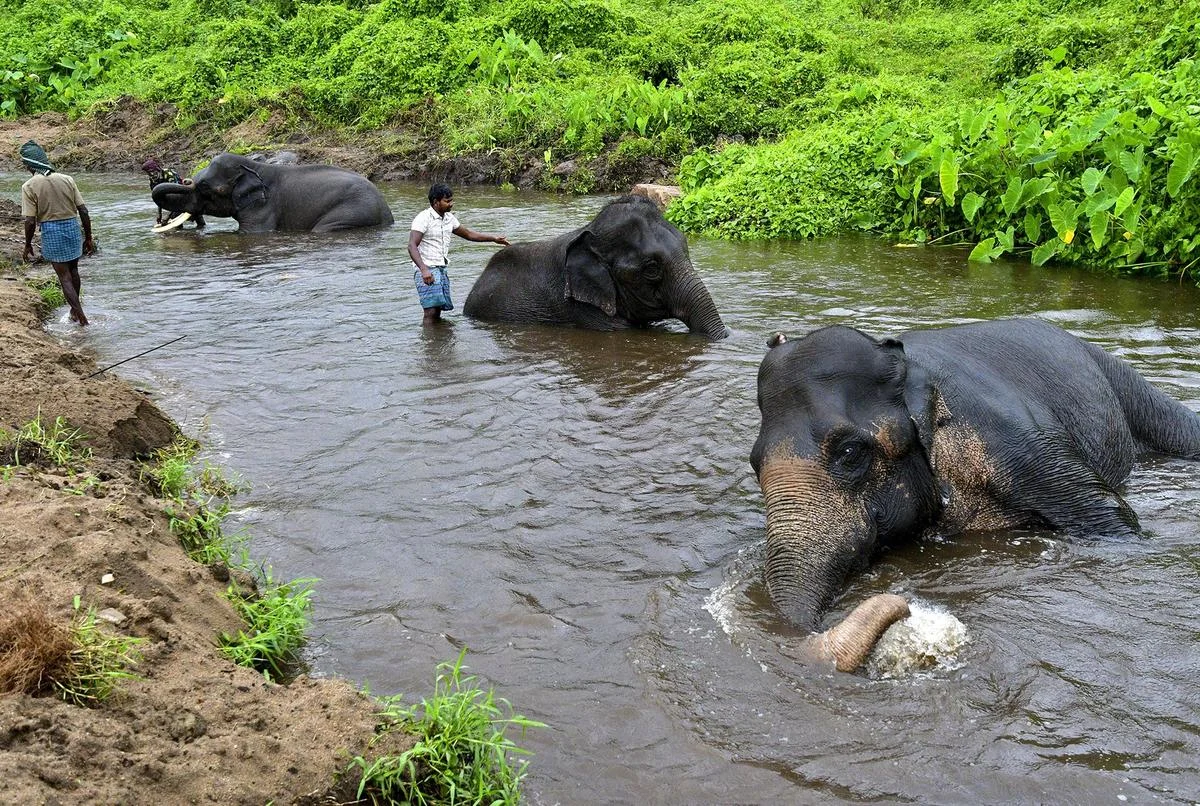
The sight of mahouts bathing camp elephants in a stream at Kozhikamuthi, within the serene embrace of the Anamalai Tiger Reserve, is a powerful symbol of their integrated existence with nature. Similarly, images of camp elephants awaiting their breakfast as visitors arrive to witness the feeding at Kozhikamuthi, highlight the delicate balance between conservation, tradition, and responsible tourism.
The Shadow of Conflict: Man-Elephant Encounters and Technological Interventions
Despite the profound efforts in elephant conservation and the dedication of Indigenous communities, the specter of human-elephant conflict continues to cast a long shadow over wildlife coexistence. The period around World Elephant Day (August 12) tragically underscored this persistent challenge. On the early morning of August 13, a mother elephant and her calf were fatally struck by the Mangaluru-Chennai Superfast Express on the Walayar-Palakkad forest stretch, bordering Tamil Nadu and Kerala. This incident followed a similar tragedy in February, when a young elephant was run over by the Yesvantpur-Kannur Express in the same vicinity.
These unfortunate events highlight the urgent need for effective strategies to mitigate human-elephant conflict, a priority area for Project Elephant, an initiative by the Ministry of Environment, Forest and Climate Change. This flagship program by the Government of India provides crucial funding and technical support to various states, increasingly focusing on technology-driven solutions.
AI and Early Warning Systems: A Double-Edged Sword?
In response to the escalating conflict, AI-enabled monitoring and early warning systems are being deployed. Coimbatore, a region frequently in the news for negative human-elephant interactions, has seen the installation of such AI-based systems along railway tracks in the Madukkarai forest range. Initial reports suggest a potential reduction in elephant deaths due to these technological interventions.
However, scientists caution that technology, while promising, is not a panacea. M. Ananda Kumar, a scientist at the Nature Conservation Foundation, points to the August 13 tragedy as a stark reminder that "Elephant deaths do occur despite these AI systems." He emphasizes that "Technology is just a tool. It has to be used in conjunction with constant monitoring of elephant movement."

The effectiveness of technological solutions is further debated when considering their ecological impact. Ananda Kumar argues that solutions like fencing across forest fragments, while intended to deter elephants, can inadvertently "deflect elephant movement into roads, leading to more conflict." He raises a critical concern: many technology-driven solutions are designed with a human-centric perspective, focusing on man-made structures and human convenience, often overlooking the elephant’s perspective. "Mitigating human-elephant conflict will be possible only if there is an understanding of both species," he asserts.
Tailored Solutions for a Diverse Landscape
The vast and varied landscape of India necessitates a nuanced approach to conflict mitigation. A one-size-fits-all monitoring system is unlikely to be effective. Instead, solutions must be tailored to suit the unique ecological characteristics of each region. Ananda Kumar provides the example of Valparai, where a mosaic of forest fragments, eucalyptus plantations, tea estates, and a river creates a distinct landscape.
In Valparai, years of meticulous planning and the collaborative involvement of all stakeholders – including local communities, plantation companies, and the Forest Department – have led to the successful implementation of alert systems. This integrated approach has significantly reduced human-elephant conflict to a bare minimum. The success is evident in the local sentiment; residents of Valparai reportedly attribute their problems more to bears and leopards than to elephants, a testament to the effectiveness of their localized strategies.
Conclusion: Embracing Indigenous Wisdom for a Sustainable Future
The narrative of elephant conservation in Tamil Nadu is a powerful illustration of the symbiotic relationship that can exist between humans and wildlife when guided by deep respect and traditional knowledge. The Kaatunaickers, Kurumbas, Malasars, and other Indigenous communities are not merely caretakers; they are living repositories of wisdom that offers invaluable lessons for sustainable coexistence.
While technological advancements offer potential tools in the fight against human-elephant conflict, they must be integrated with, rather than replace, the profound understanding and ethical frameworks developed by Indigenous peoples over millennia. The wisdom of these guardians of the wild, passed down through generations, holds the key to not only protecting elephants but also to fostering a more harmonious future for all life on Earth. As we continue to observe World Elephant Day and World Indigenous Peoples’ Day, let us recommit to amplifying their voices, safeguarding their rights, and, most importantly, learning from their enduring legacy of living in balance with nature. Their intimate knowledge of the forests, their empathy for its inhabitants, and their sustainable practices are not just relics of the past; they are essential blueprints for a resilient and thriving planet.
