

The Indian automotive landscape in 2026 remains a battlefield of shifting technologies and evolving consumer preferences. At the heart of this transformation is Toyota Kirloskar Motor (TKM), a manufacturer that has successfully pivoted from a diesel-heavy portfolio to becoming a champion of electrification through strong-hybrid technology. However, the latest sales data for August 2026 suggests that even industry titans are not immune to market corrections and intensifying competition. While the brand continues to show robust year-to-date (YTD) growth, the month of August provided a sobering look at the challenges ahead.
Main Facts: August 2026 Sales Analysis
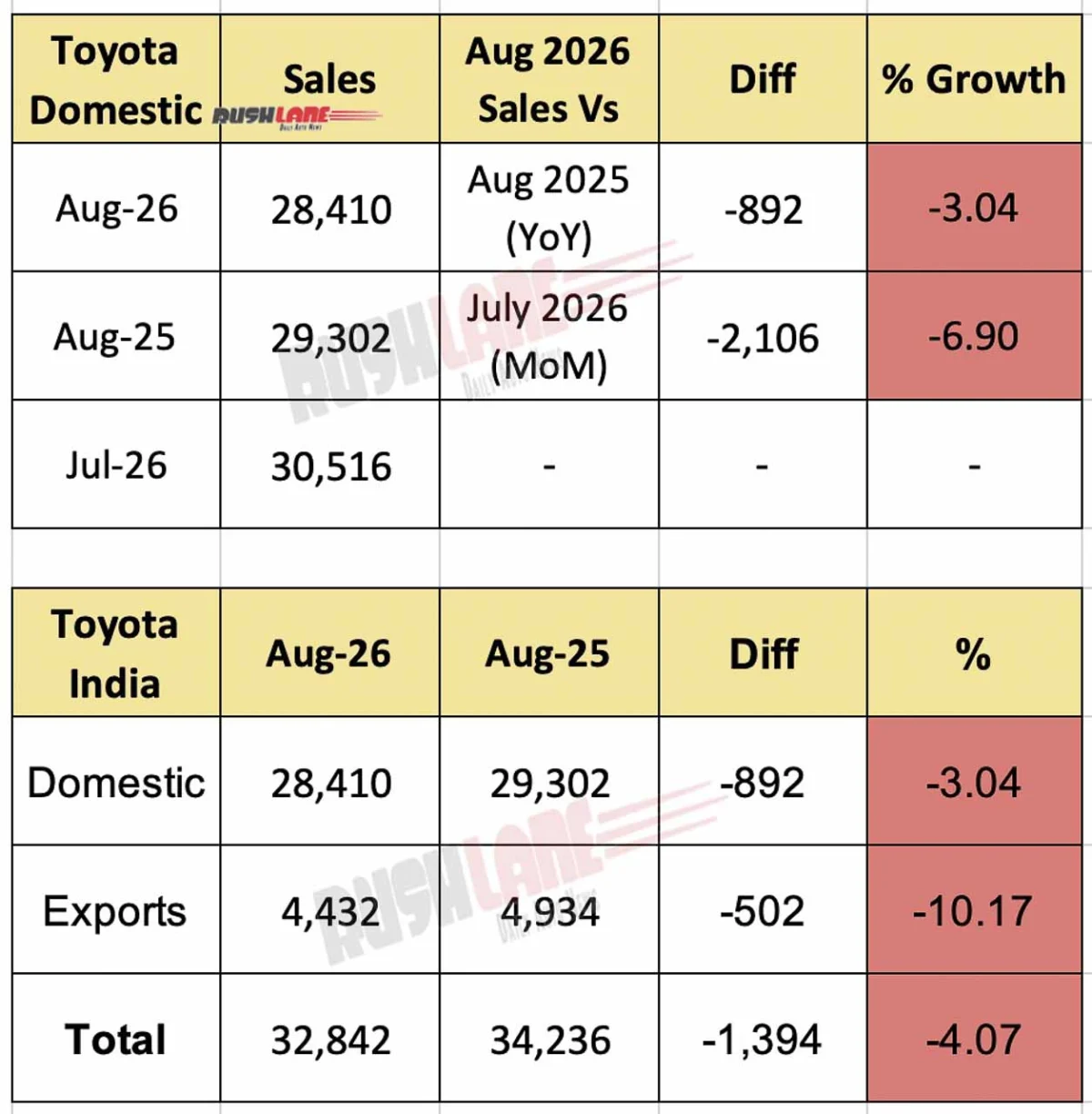
Toyota Kirloskar Motor reported total sales of 32,842 units in August 2026. This figure encompasses both domestic dispatches and exports, providing a holistic view of the company’s manufacturing output. When compared to the 34,236 units sold during the same month in 2025, the company experienced a year-on-year (YoY) decline of 4.07%, amounting to a loss of 1,394 units.
The domestic market, which remains Toyota’s primary focus, saw sales of 28,410 units. This represents a 3.04% decline compared to the 29,302 units sold in August 2025. Perhaps more concerning for analysts is the sequential or month-on-month (MoM) performance. In July 2026, Toyota had achieved domestic sales of 30,516 units, meaning August witnessed a 6.90% dip in momentum.
The export sector also faced headwinds. Toyota shipped 4,432 units to international markets in August 2026, a double-digit decline of 10.17% compared to the 4,934 units exported in August 2025. Despite these monthly contractions, Toyota’s broader portfolio—which includes the Glanza, Taisor, Rumion, Hyryder, Innova Crysta, Innova Hycross, Hilux, Fortuner, Camry, Vellfire, and Land Cruiser 300—remains one of the most diverse and resilient in the Indian premium and mass-premium segments.

Chronology: The 2026 Growth Trajectory
To understand the August dip, one must look at the trajectory of the 2026 calendar year. Toyota began the year with significant momentum, buoyed by the continued success of the Innova Hycross and the high-volume contributions from its partnership with Maruti Suzuki.
- January – July 2026: This period was characterized by aggressive growth. The company leveraged its "Strong Hybrid" messaging to capture buyers looking for fuel efficiency without the range anxiety associated with pure Electric Vehicles (EVs).
- August 2026: A cooling-off period occurred. This can be attributed to several factors, including a high base effect from the previous year, a temporary saturation in the premium MPV segment, and consumers potentially holding back purchases in anticipation of the festive season.
- Late August 2026: Competition intensified. The launch of the JSW MG Hector Tomahawk PHEV (Plug-in Hybrid Electric Vehicle) marked a significant shift in the competitive landscape, prompting Toyota to launch a counter-offensive in the form of a massive marketing campaign.
- September 2026 (Projected): With the Kia Sorento launch scheduled for September 4 and the Maruti Baleno (and subsequent Glanza) update on September 5, Toyota is entering a critical phase of product refreshment.
Supporting Data: YTD Performance and Portfolio Dynamics
While the August numbers show a slight retreat, the cumulative data for 2026 paints a much more optimistic picture for Toyota Kirloskar Motor. Between January and August 2026, the company sold a total of 2,66,696 units. This is a substantial increase from the 2,41,733 units sold during the same period in 2025, representing a healthy growth rate of 10.33% YoY.
Domestic vs. Export Cumulative Breakdown (Jan-Aug 2026):
- Domestic Sales: 2,44,592 units (up 11.18% from 2,19,992 units in 2025).
- Exports: 22,104 units (up 1.67% from 21,741 units in 2025).
The data suggests that Toyota’s core strength lies in its domestic resilience. The 11.18% growth in the Indian market is significantly higher than the industry average, driven largely by the "Maruti-sourced" models like the Glanza, Taisor, and Hyryder, which have allowed Toyota to tap into lower price points and higher volumes.
However, the reliance on these models also means Toyota is susceptible to the same market pressures facing the hatchback and compact SUV segments. The upcoming update to the Glanza, following the facelift of the Maruti Baleno, is a strategic necessity to maintain this volume-led growth.

Official Responses and Strategic Positioning
Toyota’s official stance remains one of "cautious optimism." While the company has not issued a formal statement on the August dip, its marketing actions speak volumes. Following the entry of JSW MG into the hybrid space with a Plug-in Hybrid (PHEV), Toyota immediately doubled down on its "India Hai Hybrid, Hybrid Hai Toyota" campaign.
The strategic messaging is clear: Toyota is positioning its Strong Hybrids (HEVs) as the superior choice for the Indian infrastructure. By highlighting that their hybrids do not require external charging, Toyota is targeting the convenience-seeking premium buyer. This defensive marketing, including full-page national advertisements, indicates that Toyota views the entry of PHEVs as a direct threat to its "hybrid leadership" narrative.
Furthermore, Toyota is gearing up for the festive season with a focus on inventory management and customer engagement. The company expects the "Shradh" period (traditionally a slow buying period in parts of India) to give way to a massive surge in demand during Navratri and Diwali.
Implications: The Competitive Landscape and Future Outlook
The slight decline in August 2026 is a precursor to a much more complex competitive environment. Toyota is currently facing a "pincer movement" from two different directions:
1. The Technology Challenge (MG and Kia)
The launch of the MG Hector Tomahawk PHEV introduces a new tech-spec to the Indian consumer. While Toyota’s HEVs are simpler to use, PHEVs offer the allure of short-distance pure-electric driving with a plug-in option. Additionally, the arrival of the Kia Sorento on September 4 poses a direct threat to the Innova Hycross and the lower variants of the Fortuner. The Sorento, confirmed to feature both diesel and hybrid powertrains, offers a fresh alternative in the three-row premium SUV space, a segment Toyota has dominated for decades.

2. The Product Refresh Cycle
To counter these threats, Toyota is accelerating its own product updates.
- Innova Hycross Facelift: Test mules have already been spotted on Indian roads. While a 2026 launch is unlikely, the "leak" of sportier design elements suggests that Toyota is ready to refresh its flagship MPV to keep it relevant against newer entrants like the Sorento.
- Next-Gen Fortuner (2027): The legendary SUV is due for a complete overhaul. With the premium SUV segment becoming more crowded, the 2027 Fortuner is expected to lean heavily into electrification, likely featuring a mild-hybrid or strong-hybrid diesel powertrain.
- Long-term Aspirations: The confirmed launch of a new SUV in 2029 (likely the FJ Cruiser) shows that Toyota is committed to maintaining its "SUV specialist" image even as the market moves toward softer crossovers.
Conclusion: A Pivotal Festive Season Ahead
For Toyota Kirloskar Motor, the August 2026 sales figures are a "speed bump" rather than a roadblock. The 10.33% YTD growth proves that the brand’s fundamental strategy—combining Maruti-partnered volumes with Toyota-engineered hybrid premiumness—is working.
However, the road ahead is getting steeper. The entry of PHEVs and sophisticated three-row SUVs from Kia and MG means that Toyota can no longer rely solely on its reputation for reliability. The upcoming festive season will be a litmus test for the brand. If the updated Glanza and the aggressive "India Hai Hybrid" campaign can successfully fend off the new competition, Toyota will likely end 2026 with record-breaking numbers. If the decline persists into the festive months, it may signal a need for Toyota to accelerate the launch of its own PHEV or battery-electric (BEV) models to stay ahead of the curve.
As the industry watches the September 4 and 5 launches from Kia and Maruti/Toyota, one thing is certain: the battle for the Indian driveway in 2026 is no longer just about who has the best engine, but who has the smartest electrification strategy.
