

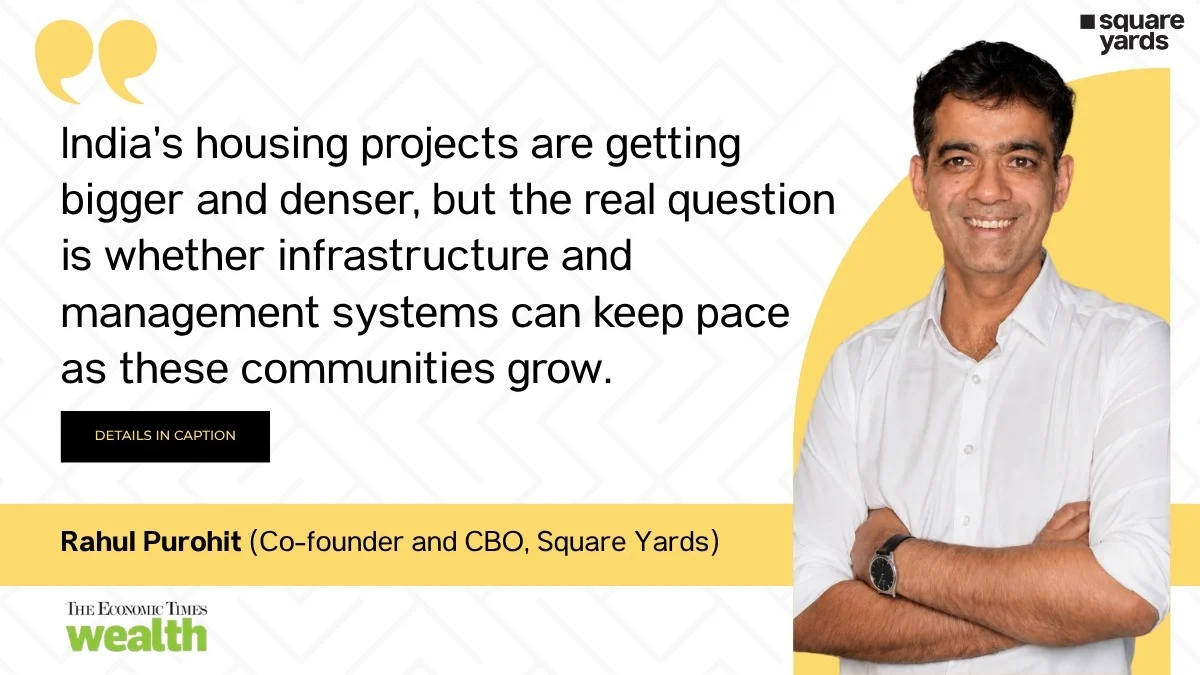
NEW DELHI — As India’s urban centers grapple with an unprecedented influx of residents and a dwindling supply of developable land, the nation’s real estate landscape is undergoing a fundamental transformation. The traditional mid-sized apartment complex is being rapidly superseded by "mega-housing" projects—gargantuan residential developments designed to house thousands of families within a single gated perimeter.
Recent data as of September 2026 reveals a startling trend: 265 large-scale housing projects, each comprising 1,000 units or more, have been launched across India’s top seven metropolitan cities. These developments represent a staggering 4.8 lakh (480,000) residential units, signaling a paradigm shift toward high-density living that mimics the "vertical city" models of Hong Kong and Singapore. However, as the scale of these projects reaches new heights, urban planners, residents, and policymakers are raising urgent questions about the long-term sustainability of the infrastructure supporting them.
I. Main Facts: The Scale of the High-Density Shift
The move toward mega-projects is driven by the economic necessity of "economies of scale." For developers, larger projects allow for better amortization of land costs and the ability to offer luxury amenities—such as Olympic-sized pools, massive clubhouses, and integrated retail spaces—that would be financially unfeasible in smaller developments.
According to the latest industry reports, the distribution of these 265 projects is concentrated in India’s most prominent tech and commercial hubs:
- Hyderabad: Leading the nation with 73 mega-projects.
- Delhi-NCR: Following closely with 55 projects.
- Bengaluru: Accounting for 51 projects.
The remaining projects are spread across Mumbai Metropolitan Region (MMR), Pune, Chennai, and Kolkata. Together, these developments are not merely housing complexes; they are self-contained ecosystems. With an average of four persons per household, a single 1,000-unit project can house a population of 4,000 to 5,000 people—larger than many rural villages in India. This concentration of humanity within a few acres of land places an extraordinary burden on shared resources and local municipal networks.
II. Chronology: From Independent Bungalows to Vertical Townships
The evolution of Indian housing has moved through distinct phases over the last four decades:
- The Pre-Liberalization Era (Pre-1990s): Urban housing was dominated by independent houses and government-built low-rise colonies. Land was relatively available, and the "apartment culture" was restricted to Mumbai.
- The Rise of the Standalone Apartment (1990s–2000s): Following the economic liberalization, the middle class grew. Small-scale developers began building standalone 5-to-10-unit apartment blocks on subdivided residential plots.
- The Gated Community Boom (2005–2015): As the IT sector exploded, particularly in Bengaluru and Hyderabad, developers began creating gated communities with 100 to 500 units. These offered security and basic amenities like a gym and a small park.
- The Era of the Mega-Project (2018–Present): Fueled by the Real Estate (Regulation and Development) Act (RERA) and the entry of institutional capital, the industry consolidated. Large corporate developers began launching "townships" and mega-projects with 1,000 to 5,000+ units, utilizing advanced Mivan construction technology to build taller and faster.
By September 2026, this evolution has reached a critical juncture where the "mega-project" is no longer the exception but the standard for new launches in suburban peripheries.
III. Supporting Data: The Infrastructure Pressure Points
While the marketing brochures for these projects promise a "resort-style life," the underlying data suggests significant pressure points in three core areas: water, mobility, and maintenance.
1. The Water Crisis and Tanker Dependency
A project with 1,000 units requires approximately 500,000 to 700,000 liters of water per day for domestic use and landscaping. Data suggests that in nearly 40% of mega-projects launched in the last five years in Delhi-NCR and Bengaluru, municipal water connections are either non-existent or insufficient. This has led to a heavy reliance on groundwater extraction and private water tankers. In some high-density clusters in Bengaluru, residents report that up to 15% of their monthly maintenance budget is spent solely on procuring water from external vendors.
2. Vertical Mobility and the Lift-to-Unit Ratio
In high-rise towers exceeding 30 floors, elevators are the lifeblood of the building. Industry standards suggest a ratio of one high-speed elevator for every 60–75 units for optimal wait times. However, in an effort to maximize "saleable area," some developers have pushed this ratio to 1:100. In a 1,000-unit project spread across four towers, a single lift failure during peak morning hours can result in wait times exceeding 15 minutes, severely impacting the quality of life for office-goers and students.
3. The Maintenance Escalation
The cost of maintaining a mega-project is exponential, not linear. Managing a 10,000-square-foot clubhouse, multiple swimming pools, industrial-grade sewage treatment plants (STPs), and 24/7 security for a population of 5,000 requires a professional facility management workforce.
- Average Maintenance Cost (2026): ₹4 to ₹7 per square foot.
- Projected Increase: Costs are rising at 8-10% annually due to energy prices and labor costs.
For a 2,000-square-foot apartment, a resident might pay upwards of ₹12,000 per month just in maintenance, a figure that many middle-class homeowners find difficult to sustain over decades.
IV. Official Responses and Regulatory Perspectives
Government bodies and industry experts are beginning to acknowledge that "bigger" does not always mean "better" in the context of urban planning.
Urban Planning Experts:
"We are seeing a trend where private developers are creating ‘islands of luxury’ surrounded by ‘seas of infrastructure neglect,’" says Dr. Anirudh Vats, a senior urban consultant. "A developer can build a 2,000-unit project, but if the municipal road leading to it is only 30 feet wide, the resulting traffic congestion neutralizes the benefits of the gated community. We need ‘Integrated Impact Assessments’ before such large-scale approvals are granted."
RERA Authorities:
State RERA officials have increased scrutiny on the "Declaration of Services." In recent rulings, authorities in Maharashtra and Karnataka have emphasized that developers must provide a clear roadmap for the handover of STPs and WTPs (Water Treatment Plants) to Resident Welfare Associations (RWAs). There is a growing push to mandate that developers manage the maintenance for at least five years post-completion to ensure the systems are robust.
Developer Associations (CREDAI/NAREDCO):
Spokespersons for developer bodies argue that high-density projects are the only solution to India’s housing shortage. "To keep housing affordable, we must build vertically and at scale," says a representative from a leading developer body. "The challenge is not the size of the project, but the speed at which municipal bodies provide ‘external’ infrastructure like trunk sewers and water mains."
V. Implications: The Long-Term Outlook for Homebuyers
The shift toward mega-housing projects carries profound implications for the future of Indian society and the real estate market.
1. The Sustainability of Resident Welfare Associations (RWAs)
The most significant long-term risk involves the transition of power from the developer to the RWA. Managing a project with 1,000+ owners is a monumental task. Internal politics, fee defaults, and the technical complexity of maintaining heavy machinery (elevators, fire pumps, STPs) can lead to the rapid deterioration of a project if the RWA is not professionally managed. We are likely to see the emergence of "Professional Community Management" firms that take over these duties entirely, moving away from the volunteer-led RWA model.
2. Property Appreciation vs. Depreciation
In the past, real estate was seen as an asset that always appreciated. However, in the era of mega-projects, "brand fatigue" and "infrastructure decay" can lead to stagnation in prices. A 15-year-old mega-project with poorly maintained lifts and a failing facade will struggle to compete with a brand-new project next door, potentially leading to a faster depreciation cycle for high-density buildings.
3. Social Impact: The Gated Silo
Socially, mega-projects risk creating "siloed" communities. While they offer safety and amenities, they often reduce the residents’ engagement with the broader city. The "walkable neighborhood" is replaced by a "driveable complex," contributing to the very traffic and environmental issues these projects seek to escape.
Conclusion: The Buyer’s Checklist for 2026 and Beyond
As India’s skyline continues to grow taller and denser, the burden of due diligence has shifted heavily toward the consumer. The sheer number of units in a project should no longer be viewed as a sign of prestige, but as a metric of the infrastructure required to sustain it.
Prospective buyers are now advised to look beyond the model flat and investigate the "invisible" infrastructure:
- The Lift-to-Unit Ratio: Demand high-speed, branded elevators with a ratio of at least 1:70.
- Water Security: Verify the primary water source. If it is 100% tanker-dependent, the long-term financial viability is at risk.
- Energy Efficiency: Look for solar-powered common areas and energy-efficient pumping systems to keep maintenance costs low.
- Fire Safety: In projects with thousands of residents, fire evacuation protocols and advanced suppression systems are non-negotiable.
India’s mega-housing projects are an inevitable response to the country’s demographic shifts. They offer a glimpse into a future of integrated, modern living. However, the success of this urban experiment will not be measured by the height of the towers or the grandiosity of the gates, but by the efficiency of the pipes, the reliability of the lifts, and the resilience of the communities living within them decades after the developer has moved on.
