

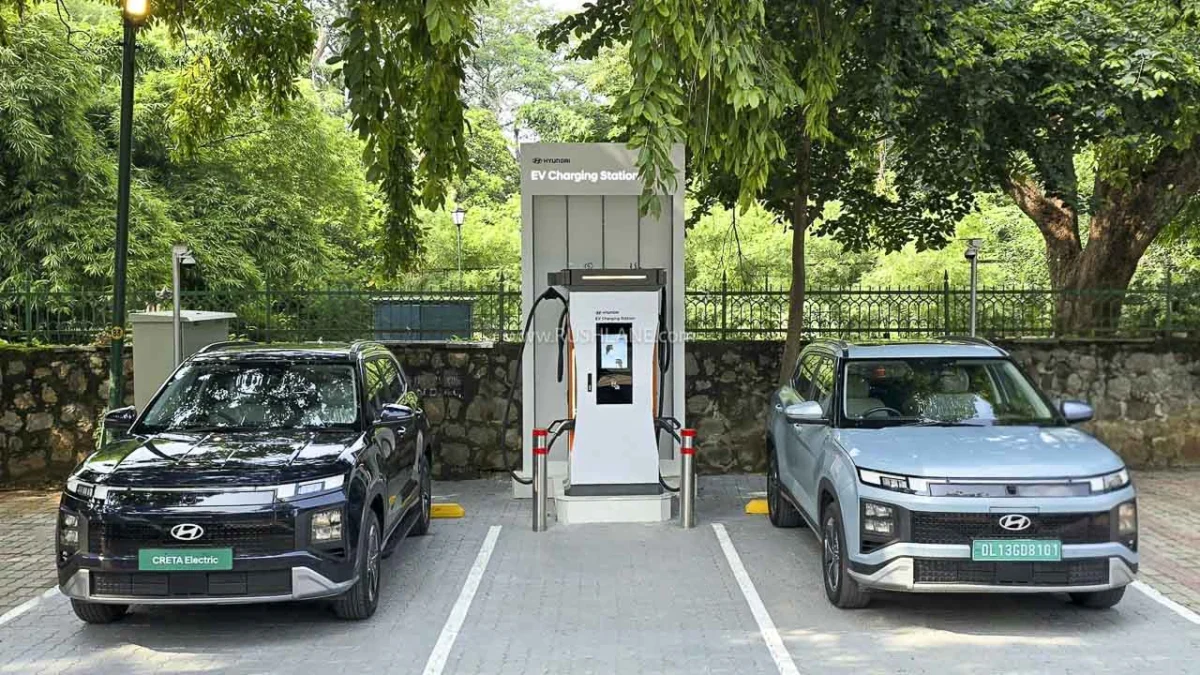
NEW DELHI – In a decisive move to solidify its position in India’s rapidly evolving electric vehicle (EV) landscape, Hyundai Motor India Limited (HMIL) has unveiled a comprehensive suite of initiatives to commemorate World EV Day 2026. The announcement, which spans infrastructure development, consumer incentives, and a robust roadmap for localized manufacturing, underscores the South Korean automaker’s commitment to transitioning from a traditional internal combustion engine (ICE) powerhouse to a leader in sustainable mobility.
The cornerstone of the announcement includes a three-day complimentary charging window for Hyundai EV owners, the inauguration of ultra-fast charging hubs in the national capital, and a strategic update on the company’s upcoming mass-market electric SUV.
I. Main Facts: Incentivizing the Transition
Hyundai’s strategy for World EV Day 2026 is built on three pillars: accessibility, infrastructure, and human capital. To drive immediate engagement, the company has announced that from September 9 to September 11, 2026, all Hyundai EV owners—including those driving the Ioniq 5 and the Creta EV—can access free charging at any HMIL-owned public charging station.
This initiative is facilitated exclusively through the myHyundai app, which has been redesigned to serve as a unified gateway for the Indian EV ecosystem. Beyond the free charging period, the app now provides access to an aggregated network of over 38,000 charging points across the country, thanks to interoperability agreements with various third-party Charge Point Operators (CPOs).
Key highlights of the announcement include:
- Infrastructure Growth: The launch of new 120 kW DC fast-charging stations in New Delhi.
- Expansion Targets: A goal to establish 600 proprietary ultra-fast charging stations by 2030.
- Workforce Readiness: A massive upskilling program targeting 17,000 sales personnel and 7,600 service staff by the end of FY26-27.
- Product Pipeline: Confirmation of a localized mass-market EV built on a dedicated electric platform, scheduled for a late 2026 launch.
II. Chronology of Expansion: From Premium to Mass Market
Hyundai’s journey in the Indian EV space began with the Kona Electric, followed by the flagship Ioniq 5, which established the brand’s technical prowess. However, 2026 marks a pivotal shift toward the "democratization" of electric mobility.
The 2026 Infrastructure Push
In early September 2026, Hyundai accelerated its partnership with Statiq, one of India’s leading charging network providers, to install 120 kW DC fast chargers in strategic locations across New Delhi. These chargers are designed to cater to the increasing density of EVs in the National Capital Region (NCR), where range anxiety is being replaced by "queue anxiety" at slower charging points.
The FY26-27 Workforce Milestone
Throughout the current fiscal year, Hyundai has been quietly overhauling its human resource capabilities. As of September 2026, 10,000 sales consultants have completed "EV Excellence" training. By March 2027, this number is expected to swell to 17,000, ensuring that every Hyundai touchpoint in India—from Tier 1 cities to rural outposts—is equipped to handle EV-specific customer queries.
The 2030 Vision
The roadmap leading to 2030 involves a staggered rollout of 600 proprietary stations. Unlike the current trend of 25 kW or 50 kW chargers, Hyundai is focusing on high-capacity units ranging from 60 kW to 240 kW, significantly reducing the "dwell time" for travelers on major highways like the Delhi-Mumbai Expressway and the Bengaluru-Chennai corridor.
III. Supporting Data: Building the Ecosystem
The scale of Hyundai’s investment is reflected in the technical specifications and network data released by the company.
Charging Infrastructure Breakdown
| Feature | Current Status (Sept 2026) | 2030 Target |
|---|---|---|
| Proprietary DC Fast Stations | 185 | 600 |
| Cities Covered | 105 | 250+ |
| Charging Capacity | 60 kW – 240 kW | Up to 350 kW (planned) |
| Third-Party Access (App) | 38,000+ points | 100,000+ points |
Service and Sales Readiness
To support the upcoming mass-market EV, Hyundai is expanding its physical footprint. The company aims to have 820 sales touchpoints and 650 specialized EV workshops operational by the end of FY26-27.
These workshops are not merely standard service centers; they are being outfitted with:
- High-Voltage Safety Kits: Specialized gear for technicians handling 400V and 800V systems.
- Advanced Diagnostics: Proprietary software to monitor battery health and cell balancing.
- Battery Management Systems (BMS) Repair Units: Capability to perform modular repairs on battery packs rather than total replacements, lowering the cost of ownership.
IV. Official Responses and Brand Alignment
In a statement regarding the World EV Day initiatives, Hyundai Motor India leadership emphasized that the goal is to create a "worry-free" environment for first-time EV buyers.

"Our objective is to ensure that the transition to electric mobility is seamless. By offering three days of free charging and expanding our ultra-fast charging network, we are rewarding our early adopters while building the infrastructure necessary for the next million EV users," a company spokesperson noted.
Brand Ambassadorship: Sheetal Devi
In a move that aligns with Hyundai’s global "Progress for Humanity" vision, the company has signed world-renowned para-archer Sheetal Devi as its brand ambassador. Devi, an Arjuna Awardee and Paralympic medalist, embodies the spirit of overcoming barriers—a metaphor Hyundai is using to describe its efforts in overcoming the barriers to EV adoption in India. Devi will be the face of Hyundai’s upcoming "Beyond Mobility" campaigns, focusing on inclusivity and sustainable technology.
V. The Upcoming "Mass-Market" Game Changer
Perhaps the most anticipated part of the announcement was the reiteration of a localized, mass-market electric SUV. While the Creta EV currently serves the mid-size SUV segment, the upcoming model is expected to be built on a dedicated EV platform (likely a localized version of the E-GMP architecture).
Why a Dedicated Platform Matters
Unlike "converted" EVs (ICE vehicles with batteries fitted into existing frames), a dedicated platform allows for:
- Flat Floors: Enhancing interior cabin space.
- Optimized Weight Distribution: Improving handling and range efficiency.
- Frunk Space: Additional storage at the front of the vehicle.
- Faster Charging: Better integration of thermal management systems for the battery.
Industry analysts expect this new model to compete directly with the Tata Nexon EV and the Mahindra XUV400, targeting a price bracket that appeals to the Indian middle class. The launch is slated for the final quarter of 2026, with production localized at Hyundai’s Chennai plant to benefit from PLI (Production Linked Incentive) schemes.
VI. Implications for the Indian Automotive Market
Hyundai’s aggressive strategy has significant implications for the broader Indian automotive sector and the country’s "Net Zero" goals.
1. Pressure on Competitors
Hyundai’s focus on high-capacity chargers (120 kW and above) sets a new benchmark. While competitors have larger total networks, many are comprised of slower AC chargers. By focusing on "Flash Charging" on highways, Hyundai is positioning itself as the preferred brand for long-distance EV travel.
2. Standardization of the Charging Experience
The myHyundai app’s ability to aggregate 38,000 charging points across different brands (Statiq, ChargeZone, etc.) is a major step toward solving the "fragmented app" problem. If Hyundai can successfully position its app as the "Google Maps of Charging," it gains a massive data advantage over other OEMs.
3. Economic Impact of Localization
By aiming for a localized mass-market SUV, Hyundai is investing heavily in the local supply chain. This includes tie-ups for battery cell manufacturing and motor assembly within India, which will likely drive down the total cost of EVs across the industry due to economies of scale.
4. Consumer Confidence
The training of 17,000 sales staff is a direct response to the "information gap" that often plagues EV showrooms. By ensuring that sales consultants can explain complex topics like "lithium-ion degradation," "regenerative braking," and "home load management," Hyundai is building the institutional trust required to convert skeptical ICE owners into EV enthusiasts.
Conclusion
As World EV Day 2026 concludes, Hyundai Motor India has sent a clear message to the market: they are no longer just participating in the EV race—they are attempting to define its pace. Through a combination of tactical consumer rewards, massive infrastructure investment, and a "people-first" approach to service, Hyundai is preparing the ground for what it expects to be its most successful era in the Indian market.
The success of the upcoming dedicated-platform SUV will be the ultimate litmus test for this strategy. However, by building the "pipes" (charging stations) and training the "plumbers" (service technicians) before the "water" (mass-market EVs) arrives, Hyundai is taking a holistic approach that could very well reshape the Indian automotive landscape for decades to come.
