

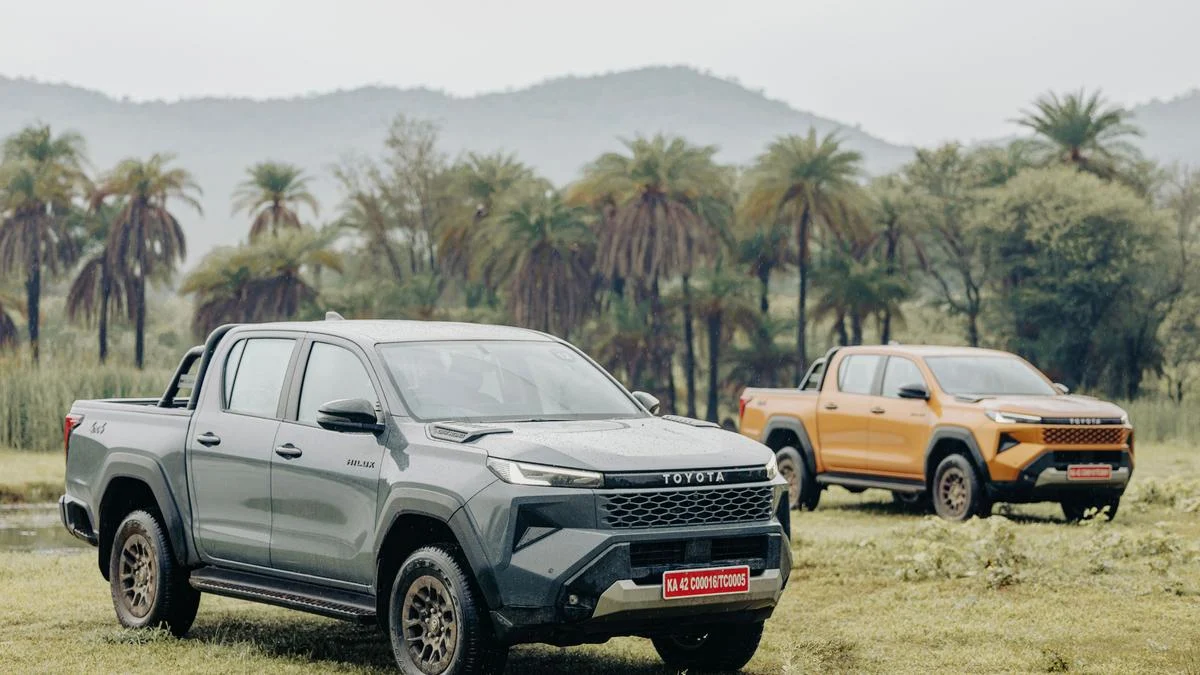
The Toyota Hilux occupies a space in the Indian automotive landscape that is, quite literally, occupied by nothing else. While the industry frequently uses the term "lifestyle vehicle" to describe everything from sub-compact crossovers to luxury SUVs, the Hilux is perhaps the only vehicle currently on sale that embodies the raw, unfiltered definition of the term.
Around the globe, the Hilux is not merely a pickup truck; it is a cultural phenomenon. It is the vehicle that survived a building demolition on Top Gear, the workhorse that has crossed the Antarctic, and the machine that has served as the backbone of industries and conflicts alike for over five decades. In India, where the pickup segment has historically been relegated to the commercial sector, the Hilux arrives as a symbol of resilience, adventure, and an almost mythical level of durability.
The latest update to the Hilux in India represents a strategic refinement. Toyota has not sought to reinvent a formula that has sold over 18 million units globally since 1968. Instead, the Japanese automaker has focused on sharpening the truck’s visual identity, enhancing its on-board technology, and streamlining its mechanical offerings to better suit the evolving expectations of the Indian premium buyer.

I. Main Facts: The "Cyber Sumo" Evolution
The most striking aspect of the updated Hilux is its departure from the understated, utilitarian aesthetics of its predecessor. Toyota’s design team has implemented what they term the "Cyber Sumo" philosophy—a bold, angular, and futuristic approach that has immediately sparked debate among enthusiasts.
Exterior Redesign
The front fascia is now dominated by a flatter, more aggressive bonnet line that gives the vehicle a more commanding "nose-up" attitude. This is complemented by a redesigned hexagonal grille and revised LED headlamp clusters that provide a sharper, more modern "face." The "Cyber Sumo" influence is most evident in the way the body lines have been creased to look more muscular and "armored."
Key exterior features include:

- 17-inch Alloy Wheels: Finished in a sleek black, these wheels are wrapped in high-profile rubber designed to balance highway stability with off-road cushion.
- Integrated Side Step: A practical addition to the rear cargo bed, allowing owners to access the load area without having to lower the tailgate—a small but significant nod to daily usability.
- Massive Proportions: Standing at over 5.3 meters in length, the Hilux remains a behemoth, built on a heavy-duty ladder-frame chassis that prioritizes structural integrity over lightweight agility.
Interior and Technology
Inside, the Hilux has moved closer to the premium feel of its sibling, the Toyota Fortuner, though with a distinct focus on durability. The centerpiece is a significantly larger touchscreen infotainment system. Critically, this system now supports wireless Apple CarPlay and Android Auto, addressing a major grievance of previous owners.
However, the update is a "give-and-take" scenario. To maintain a competitive price point in a niche segment, Toyota has made several strategic omissions:
- Upholstery: Premium leather has been replaced with high-grade, durable fabric.
- Climate Control: The previous automatic climate control system has been swapped for a high-throw manual air conditioning unit.
- Seating: The electrically adjustable driver’s seat has been replaced with a manual adjustment mechanism.
- Omissions: There are still no dedicated rear AC vents, and ventilated seats remain absent.
II. Chronology: The Journey of a Global Legend
To understand the significance of the 2024 update, one must look at the timeline of the Hilux’s presence both globally and within the Indian market.

- 1968: The first-generation Hilux (N10) is launched globally as a compact pickup developed by Hino Motors for Toyota. It quickly gains a reputation for being over-engineered.
- 2005: The Seventh Generation Hilux (AN10/AN20) launches as part of the IMV (Innovative International Multi-purpose Vehicle) project, sharing a platform with the Fortuner and Innova. This cements the Hilux as a global platform.
- March 2022: After years of anticipation, Toyota Kirloskar Motor (TKM) officially launches the Hilux in India. It enters a market with almost no direct competition outside of the Isuzu D-Max V-Cross.
- 2023: Toyota introduces the "Hilux Extreme Off-Road" concept and various accessory packs in India to gauge consumer interest in heavy customization.
- 2024/2025 Update: Toyota introduces the current refresh, featuring the "Cyber Sumo" design and a streamlined powertrain lineup, moving exclusively to an automatic transmission for the 4×4 variants to reflect the preferences of the premium lifestyle buyer.
III. Supporting Data: Performance and Technical Specifications
Under the hood, the Hilux retains the legendary 2.8-litre, four-cylinder turbo-diesel engine that powers the Fortuner. This engine is the heart of the Hilux’s "go-anywhere" capability.
Powertrain and Performance
- Engine: 2.8L D-4D Turbocharged Diesel
- Power Output: 201 PS @ 3,000–3,400 rpm
- Torque: 500 Nm @ 1,600–2,800 rpm
- Transmission: 6-Speed Torque Converter Automatic (Now the primary offering)
- Acceleration: 0–100 km/h in approximately 12.0 seconds.
Off-Road Geometry and Hardware
The Hilux is engineered to tackle terrain that would stop most monocoque SUVs in their tracks. Its mechanical hardware is focused on low-end grunt and articulation.
- Drive System: Part-time 4WD with Electronic Shift-on-the-Fly.
- Differential: Electronically locking rear differential and an Auto Limited Slip Differential (LSD).
- Wading Depth: 700mm, allowing for significant water crossings.
- Suspension: Double wishbone at the front and leaf-spring rigid axle at the rear—designed to carry a payload of up to 435–500kg while maintaining stability.
Refinement and NVH
One of the most notable improvements in the updated model is the reduction in Noise, Vibration, and Harshness (NVH). Toyota has added more sound-deadening material in the firewall and floor pans. At a steady 100 km/h cruise, the engine sits at a low RPM, and wind noise is surprisingly well-contained for a vehicle with the aerodynamics of a brick.

IV. Official Responses: The Toyota Philosophy
While official quotes regarding specific component removals (like leather seats) are rarely publicized, Toyota Kirloskar Motor’s broader strategy for the Hilux focuses on the concept of "Quality, Durability, and Reliability" (QDR).
Sources within the industry suggest that Toyota’s decision to simplify the interior features was a calculated move based on owner feedback. "The Hilux customer in India is different from the Fortuner customer," notes an industry analyst. "While the Fortuner owner often seeks a chauffeur-driven luxury experience, the Hilux owner is typically an enthusiast who intends to use the vehicle for overlanding, farming, or heavy customization. For these users, fabric seats are often preferred because they are cooler in the summer and more durable under rugged use."
Toyota’s official positioning of the Hilux remains centered on the "Life Is a Road Trip" campaign, emphasizing that the vehicle is an "Enabler of Dreams." By pricing the vehicle between INR 31.99 lakh and INR 36.69 lakh (ex-showroom), Toyota is positioning it as a premium alternative for those who find standard SUVs too restrictive for their adventurous lifestyles.

V. Implications: The Future of the Lifestyle Pickup in India
The update to the Toyota Hilux has several significant implications for the Indian automotive market and the "lifestyle" segment at large.
1. The Death of the Manual in the Premium Segment
By moving toward a predominantly automatic lineup, Toyota is acknowledging that even the most hardcore off-roaders in the premium space now prefer the ease of a torque converter. The 500 Nm of torque is managed more effectively by the automatic gearbox, particularly in technical rock-crawling situations where feathering a clutch can be cumbersome.
2. The Rise of "Overlanding" Culture
The Hilux is the perfect canvas for India’s burgeoning overlanding community. With its massive 435kg+ payload capacity, owners can easily fit roof-top tents, kitchen systems, and extra fuel tanks without exceeding the Gross Vehicle Weight (GVW). The Hilux isn’t just a car; it’s a platform for a mobile home.

3. Niche Dominance over Mass Appeal
Toyota is clearly comfortable with the Hilux remaining a niche product. Its size makes it impractical for the congested streets of Mumbai or Delhi, where parking is a premium. However, in regions like Himachal Pradesh, Kerala, and the Northeast, the Hilux is becoming the aspirational vehicle of choice. Its presence forces competitors like Isuzu to reconsider their feature sets and pricing.
4. Resale Value and Longevity
The "Toyota Tax"—the premium people are willing to pay for a used Toyota—is expected to be exceptionally high for the Hilux. Given that these vehicles are known to last 300,000 to 500,000 kilometers with basic maintenance, the Hilux represents a long-term investment rather than a depreciating asset.
Conclusion: The Purpose-Built Machine
The updated Toyota Hilux is a reminder that in an era of digital screens and soft-touch plastics, there is still a place for mechanical honesty. It demands compromises—you will have to park further away from the mall entrance, and you will have to manually adjust your seat—but in exchange, it offers a sense of invincibility.

Whether it is navigating the "Cyber Sumo" design through a rocky riverbed or cruising down the National Highway with a dirt bike in the back, the Hilux remains the gold standard for those who believe that the journey is more important than the destination. As the saying goes: You don’t buy a Hilux because you need a truck; you buy a Hilux because you need a Hilux.
