Introduction: A New Pillar in Hyundai’s SUV Fortress
For over a decade, Hyundai Motor India has maintained a vice-like grip on the mid-size SUV segment. The Hyundai Creta, often referred to as the "segment king," has consistently topped sales charts, defying market fluctuations and intensifying competition. However, as the Indian automotive landscape evolves, consumer preferences are diversifying. There is a growing demand for a vehicle that offers the premium feel and technological sophistication of a mid-size SUV but with a more agile footprint and a sharper price point.
Enter the Hyundai Bayon. Launched at a disruptive starting price of Rs 9.99 Lakh (Ex-showroom), the Bayon is not a replacement for the Creta. Instead, it is a strategic expansion of Hyundai’s portfolio, positioned precisely between the sub-four-meter Venue and the flagship Creta. As a global model that will be manufactured in India for both domestic consumption and international exports, the Bayon represents Hyundai’s commitment to making India a global hub for its "Art of Steel" design philosophy and high-tech engineering.
1. Main Facts: The Bayon at a Glance
The Hyundai Bayon enters the C-SUV segment with a clear mandate: to democratize luxury and advanced technology. The vehicle is built on a versatile platform that balances structural rigidity with weight efficiency.

Pricing and Variants
Hyundai has introduced the Bayon with a tiered pricing strategy designed to undercut several rivals while offering more features in the entry-level trims. The lineup consists of seven distinct variants:
- HX2 & HX3: Entry-level trims focused on value.
- HX3+: The mid-level bridge offering essential tech upgrades.
- HX5 & HX6: The "sweet spot" variants where automatic transmission (iVT) options begin.
- HX8 & HX10: The flagship trims featuring Level-2 ADAS, panoramic displays, and premium audio.
Global Manufacturing Strategy
One of the most significant aspects of the Bayon launch is its production origin. Hyundai has confirmed that the Bayon will be produced at its state-of-the-art facility in India. The plant will handle both Left-Hand Drive (LHD) and Right-Hand Drive (RHD) configurations, supplying the Bayon to markets across Europe, Latin America, and Southeast Asia. This move reinforces the "Make in India" initiative and ensures that the Indian spec remains world-class in terms of build quality.
2. Chronology: From Global Concept to Indian Roads
The journey of the Bayon began in the European market, where it was originally conceived as a crossover designed for urban environments. However, the Indian iteration is a significantly evolved version of that global concept.
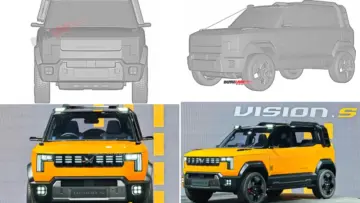
- Design Phase: Hyundai designers utilized the "Art of Steel" philosophy, moving away from the rounded "Fluidic" language of the past toward an angular, geometric aesthetic.
- Testing & Localization: Over the past 18 months, camouflaged test mules of the Bayon were frequently spotted across Indian terrains—from the high-altitude passes of Ladakh to the humid coastal roads of Chennai. This was done to calibrate the 1.5L naturally aspirated engine and the suspension for Indian road conditions.
- Launch: The official launch marks the beginning of a new era for Hyundai India, filling a crucial gap in their "SUV-first" strategy.
3. Supporting Data: Specifications and Aesthetics
The Hyundai Bayon is a masterclass in packaging. Despite sitting below the Creta, its dimensions and feature list suggest a vehicle that punches well above its weight class.

Dimensional Prowess
The Bayon offers a commanding road presence without being cumbersome in city traffic:
- Length: 4,245 mm
- Width: 1,810 mm
- Height: 1,605 mm
- Wheelbase: 2,600 mm
- Ground Clearance: 205 mm (Unladen)
- Boot Space: 505 Liters
- Fuel Tank: 43 Liters
The 205 mm ground clearance is particularly noteworthy, as it places the Bayon at the top of its class for navigating water-logged streets and broken rural roads.
Exterior Design Highlights
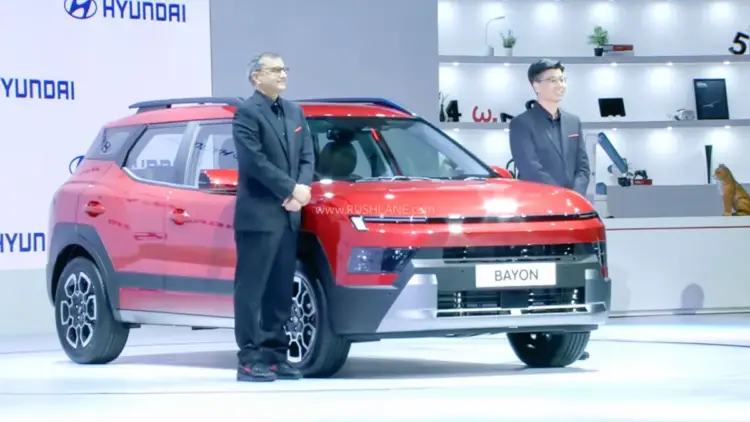
The Bayon’s exterior is defined by sharp creases and a "tech-forward" look. Key features include:
- H-Edge LED DRL Signature: A distinct lighting identity that separates it from the Venue and Creta.
- Projector LED Headlights: Positioned lower on the bumper to provide better illumination while reducing glare for oncoming traffic.
- Aero-Efficiency: The unique vertical "Aerolight" high-mount stop lamp and non-connecting tail lights are designed not just for style, but to optimize airflow.
- Footwear: 17-inch diamond-cut alloy wheels shod in 215-section tires provide a planted stance.
The "Software Defined Vehicle" (SDV) Interior
Inside, the Bayon debuts a layout inspired by the global-spec i20 but enhanced with premium materials. The cabin is available in two themes: a sophisticated All-Black or a Black & Olive Grey dual-tone.

The centerpiece is the Curved Panoramic Display, a massive glass housing that integrates two 12.3-inch screens. Powered by Nvidia hardware and featuring Perplexity and SoundHound AI, the infotainment system offers a level of responsiveness and voice-command accuracy previously reserved for luxury vehicles. With over 500 voice commands and 70+ Bluelink telematics features, the Bayon is truly a "connected car."
4. Performance and Safety: The Mechanical Backbone
Hyundai has opted for a "tried and tested" approach for the Bayon’s powertrain, ensuring reliability and ease of maintenance.
The Powertrain
Under the hood lies the familiar 1.5L Naturally Aspirated Petrol 4-cylinder engine.
- Power: 115 PS
- Torque: 144 Nm
- Transmission: 6-speed Manual or an Intelligent Variable Transmission (iVT/CVT).
- Fuel Efficiency: A claimed 18.6 km/l, making it one of the more frugal options in the C-SUV segment.
While a 1.0L Turbo Petrol has not been confirmed for the initial launch, Hyundai has officially confirmed a CNG variant for the near future, catering to the mileage-conscious Indian buyer.

Safety Engineering
Hyundai is aiming for the gold standard in safety. The Bayon is constructed with 69% High-Strength Steel (HSS) and is engineered to achieve a 5-Star BNCAP crash safety rating.
Standard safety features across all variants include:
- 6 Airbags
- Electronic Stability Control (ESC)
- All-four disc brakes (a rarity at this price point)
- Tyre Pressure Monitoring System (TPMS)
The higher trims feature Level-2 ADAS, encompassing 23 autonomous functions such as Forward Collision-Avoidance Assist, Lane Keeping Assist, and Smart Cruise Control. Additionally, the inclusion of a single-channel factory-fitted Dashcam highlights Hyundai’s attention to the specific needs of Indian drivers.
5. Official Responses and Industry Context
While official quotes from the launch event emphasized "redefining the urban SUV," industry analysts see the Bayon as a preemptive strike against emerging competition.
"Hyundai is playing a volume game with the Bayon," says an industry consultant. "By pricing it at Rs 9.99 lakh, they are directly challenging the top-end variants of sub-compact SUVs like the Brezza and Nexon, while simultaneously offering a legitimate alternative to the entry-level variants of the Honda Elevate and Maruti Grand Vitara."

Hyundai’s decision to include premium audio (8-speaker Bose system) and AI-integrated software suggests that the brand is pivoting toward "experience-led" sales rather than just "specification-led" sales.
6. Implications: A Shift in the SUV Landscape
The launch of the Hyundai Bayon has several long-term implications for the Indian automotive market:
1. The Democratization of ADAS and AI
By offering Level-2 ADAS and AI-powered voice assistants in a sub-15 lakh (mid-trim) bracket, Hyundai is forcing other manufacturers to accelerate their tech timelines. Features that were considered "luxury" two years ago are now becoming the baseline for the C-SUV segment.
2. India as an Export Powerhouse
The Bayon is a clear indicator that Hyundai views its Indian manufacturing hubs as being equal in quality to its Korean and European plants. Producing LHD models in India for the global market will improve economies of scale, eventually leading to more competitive pricing for the Indian consumer.

3. The Squeeze on Sub-4 Meter SUVs
As the price gap between premium sub-4 meter SUVs (which carry high tax burdens) and C-SUVs like the Bayon narrows, consumers are likely to gravitate toward the larger vehicle. The Bayon offers 505 liters of boot space and a 2,600 mm wheelbase—significantly more room than any sub-4 meter vehicle can offer.
4. The Future of Powertrains
The confirmation of a CNG variant for a C-SUV is a bold move. It acknowledges that while EVs are the future, the immediate transition for the Indian middle class involves finding a balance between petrol performance and CNG economy.
Conclusion
The Hyundai Bayon is more than just another SUV; it is a calculated move by a market leader to seal every possible crack in its armor. With its striking "Art of Steel" design, a cabin that feels like a tech laboratory, and a price tag that will make competitors sweat, the Bayon is poised to become a high-volume driver for Hyundai.
As it rolls out across dealerships this month, the Bayon doesn’t just sit below the Creta—it stands beside it, offering a different kind of sophistication for a new generation of Indian car buyers. Whether it can replicate the Creta’s legendary success remains to be seen, but on paper, the Bayon has all the ingredients of a blockbuster.