

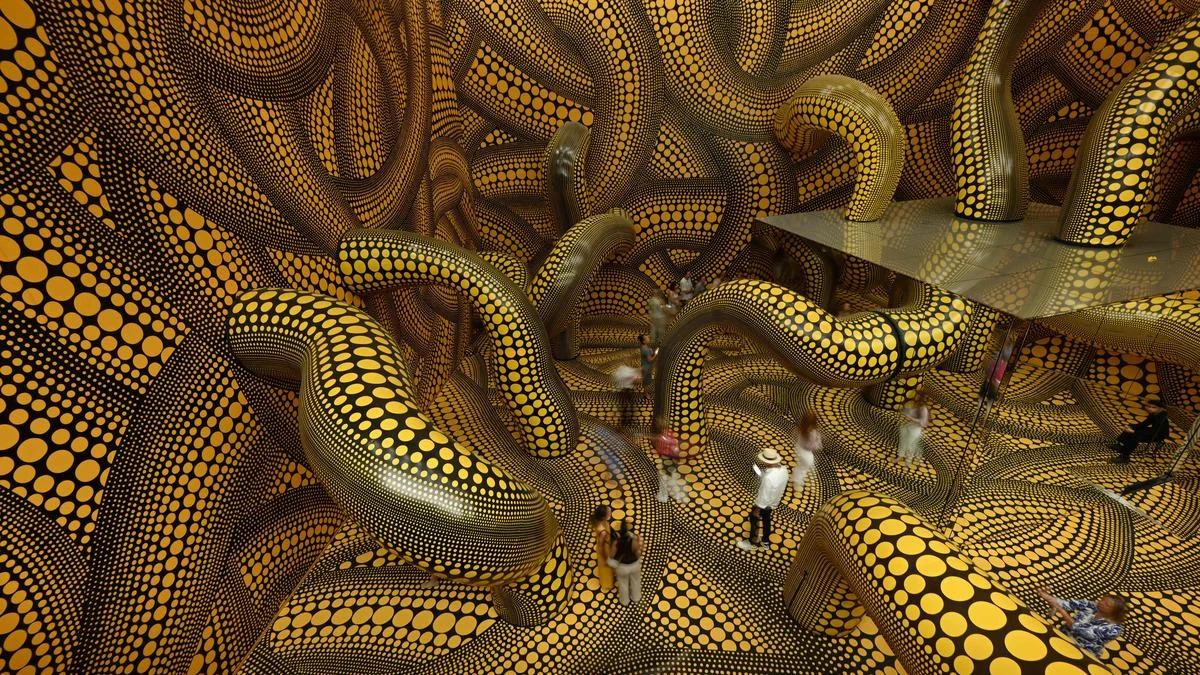
Introduction: A Cosmic Encounter in Mumbai
The memory is vivid: stepping into a Yayoi Kusama Infinity Mirror Room at Mumbai’s newly opened Nita Mukesh Ambani Cultural Centre (NMACC) in 2024. A nominal ticket, a patient queue, and then twenty minutes of sublime immersion. Surrounded by an endless constellation of glowing lights and mirrors, the boundaries between self and space dissolved. It felt like floating, a disembodied consciousness adrift between room, floor, mirror, and light. Emerging from this obsidian box, back into the tangible world, was akin to returning from a cosmic odyssey. This profound experience, echoing the artist’s own words – "Our earth is only one polka dot among a million stars. Polka dots are a way to infinity" – encapsulates the enduring power of Yayoi Kusama’s visionary art.
The Humble Polka Dot: A Gateway to the Infinite
What began as a seemingly innocuous, almost cheerful polka dot, evolved into the central motif of Kusama’s prolific career. This simple geometric shape became her lifelong preoccupation, a vehicle for exploring profound concepts of infinity, self-obliteration, and the boundless universe. Across her oeuvre, the polka dot transcended mere decoration. It exploded across canvases, cascaded over monumental pumpkins in public parks, adorned human bodies, enveloped entire rooms, and multiplied ad infinitude within her iconic mirrored installations. In Kusama’s artistic universe, the most elementary forms possessed the power to unfold into vast, conceptual landscapes, prompting introspection on the dissolution of the self and its porous boundary with the external world.
The dot, of course, is no stranger to the annals of art history. From the optical explorations of Pointillism to the meditative Bindu of S.H. Raza, the systematic proliferation of spots by Damien Hirst, and John Baldessari’s face-obscuring circles, the dot has been a recurring visual language. Closer to home, artists like Bharti Kher have masterfully employed the bindi, a culturally resonant dot, as a recurring motif, imbuing it with layered meanings. Kusama, however, elevated the polka dot to an unparalleled philosophical and experiential level, transforming it into a portal for collective introspection and individual transcendence.

A Lifetime of Obsession: From Personal Trauma to Universal Resonance
Over a career spanning more than seven decades, Kusama meticulously cultivated a distinct artistic language deeply rooted in her personal experiences and philosophical inquiries. "She explored them consistently across different mediums and decades," remarks Doryun Chong, Artistic Director and Chief Curator of M+ in Hong Kong. Chong, who co-curated the expansive exhibition Yayoi Kusama: From 1945 to Now (one of the largest retrospectives of the artist outside Japan), notes the profound Eastern philosophical undercurrents in her work. Central to these is the Buddhist concept of transcending the self, fostering a more open and inclusive connection with humanity and the cosmos.
Kusama’s predilection for these recurring motifs stemmed from her formative years and her intensely private interior world. Born in Matsumoto, Japan, in 1929, her childhood unfolded amidst her family’s plant nursery. It was during this period that she began experiencing vivid childhood hallucinations, where flowers, patterns, and dots seemed to spill beyond their perceived boundaries. These early sensory distortions laid the groundwork for her unique visual vocabulary.
The artist’s life was also marked by significant personal turbulence. Her writings and public statements often alluded to a complicated home life, including her father’s infidelities and her mother’s volatile temperament. Furthermore, an early discomfort with sexuality later manifested in her art, notably in her soft sculptures adorned with phallic forms. Plagued by anxiety and depression throughout her life, the act of creation became a potent therapeutic mechanism. From sewing military parachutes during wartime Japan to sketching her mother at the tender age of ten, and later, adorning bodies, animals, and her signature nets and pumpkins, the relentless urge to apply circles was her method of navigating and ultimately overcoming her anxious mind.
Yet, in her profound exploration of intimate fears and obsessions, Kusama demonstrated an extraordinary gift for shaping these private experiences into forms that resonated universally. "I think the more personal an artist is, the more universal the work can become," observes designer Vikram Goyal, an ardent admirer of Kusama’s art. "When an artist creates from a place of honesty rather than trying to appeal to everyone, the work often finds a much wider audience." This authenticity is precisely what allowed Kusama’s art to permeate both the hallowed halls of high art and the vibrant landscape of mass culture.

The Artist as Image: Self-Fashioning and Cultural Proliferation
Kusama’s artistic vision refused to be contained by any single medium, compelling her to move restlessly across painting, sculpture, installation, performance, film, literature, and fashion. Her collaborations with luxury fashion house Louis Vuitton, first in 2012 and again in 2023, saw her signature dots adorning iconic handbags and transforming flagship stores into immersive polka-dotted worlds. In the 1960s, she even established a fashion company in New York, offering radical garments, including hand-painted nets and daringly cut dresses. Her early career was also marked by poetry, filmmaking, and performance art, showcasing her multifaceted creative spirit.
What is particularly striking about Kusama’s career is her unapologetic pursuit of visibility. Her early correspondence with Georgia O’Keeffe, a fellow female artist, highlights Kusama’s journey to the United States, facilitated by O’Keeffe’s introductions. New York presented significant challenges; Kusama recounts surviving on a meager diet of potatoes, onions, and black coffee, often finding herself as the sole woman in artistic circles, and notably, the only woman of color.
"I think we underestimate how much scope sits in the simplicity of a circle, and how it can become a signifier based on what context it is placed in," reflects Gursi Singh, co-founder of the contemporary fashion label Lovebirds, which also draws inspiration from polka dots. "For her [Kusama], the polka as form was like a challenge to see the possibilities of what can be done with it, and how a whole world can be created from it. For us, it began as a graphic decision and turned into a value."
Kusama’s deliberate self-fashioning into an iconic image – her signature red wig and polka dots – was remarkably prescient in an era where self-branding is commonplace. This instinct for self-promotion, coupled with her artistic genius, likely contributes to her resonance with younger generations, particularly Gen Z, who have embraced her as one of Instagram’s favorite artists. Her audacious stunt at the 1966 Venice Biennale, where she unofficially exhibited Narcissus Garden – 1,500 mirrored spheres scattered on the lawn – and sold them under the provocative banner "Your Narcissism for Sale," was a masterful fusion of self-promotion and a critical commentary on the art market. By 2019, Kusama had ascended to become the world’s top-selling living female artist, a testament to her enduring cultural impact.

Bridging Art and Phenomenon: The "Viral" Before Viral
Kusama’s work has consistently occupied the intriguing nexus between serious contemporary art and widespread cultural phenomena. "It’s a tension I find genuinely interesting rather than uncomfortable," states Fatema Oomerbhoy, an art advisor and cultural strategist who was instrumental in bringing Kusama’s exhibition to Mumbai’s NMACC. "The work has always possessed a fantastical, almost hallucinatory quality – one reason it can be so compelling on a phone screen."
This sentiment is echoed by Jaya Asokan, Director of the India Art Fair. She emphasizes that experiencing Kusama’s art is paramount. At the 2026 India Art Fair, where her work was presented through international gallery partner David Zwirner, it captivated a diverse audience, from seasoned collectors to students and families. The monumental, polka-dotted pumpkin, visible from across the hall, drew people in almost instinctively. "There is an accessibility to her work that I think is very powerful," Asokan notes. "I don’t think we should underestimate the importance of that immediate visual connection."
Implications: Redefining the Art Experience
As Doryun Chong observes, Kusama’s art possesses an extraordinary ability to challenge and redefine traditional notions of art, the viewer, and the space they inhabit. The very boundaries between artwork and spectator are deliberately blurred, prompting a fundamental shift in how we perceive and interact with art. Walking towards a colossal yellow pumpkin in London’s Regent’s Park, one can feel oneself becoming part of the artwork, a mere polka dot in a vast composition. The perspective shifts dynamically, transforming the pumpkin from a solitary object in a park setting to an entity seemingly meeting the vast expanse of the sky.

"A Kusama has an extraordinary ability to create that first moment of connection," concludes Chong. "The colour, repetition, scale, and recognizable forms draw people towards the work, and then there is an opportunity to discover the much longer and more complex practice behind it." This layered approach, beginning with an immediate, visceral engagement and unfolding into a deeper appreciation of her artistic journey, is perhaps the most profound legacy of Yayoi Kusama – the artist who, through the humble polka dot, invited us all to glimpse the infinite within ourselves and the universe.
Chronology of a Visionary Career:
- 1929: Born in Matsumoto, Japan.
- Childhood: Experiences early hallucinations and begins drawing flowers and patterns.
- 1940s: Learns sewing and makes military parachutes during wartime.
- 1950s: Moves to Tokyo and begins her artistic career, experimenting with painting and sculpture.
- 1957: Moves to New York, encouraged by Georgia O’Keeffe.
- 1960s: Becomes a prominent figure in the avant-garde art scene, pioneering happenings and performance art. Establishes a fashion company and creates radical garments.
- 1966: Unofficial exhibition of Narcissus Garden at the Venice Biennale.
- 1970s: Returns to Japan, continuing her prolific artistic output and grappling with mental health challenges.
- 1980s-1990s: Gains renewed international recognition with major exhibitions and retrospectives.
- 2000s-Present: Her work achieves global phenomenon status, with numerous exhibitions and collaborations, including Louis Vuitton. She is celebrated as one of the world’s most influential and commercially successful living artists.
Supporting Data and Global Impact:
- Exhibitions: Kusama’s works have been exhibited in major museums and galleries worldwide, including the Museum of Modern Art (MoMA) in New York, the Tate Modern in London, and the National Gallery of Victoria in Melbourne.
- Sales: Her artworks consistently fetch high prices at auction, cementing her status as a commercially successful artist. By 2019, she was recognized as the world’s top-selling living female artist.
- Cultural Influence: Her distinctive style has permeated popular culture, influencing fashion, design, and social media trends. Her Infinity Mirror Rooms are particularly sought after for their "Instagrammable" nature, drawing massive crowds.
- Academic Interest: Kusama’s work is a subject of significant art historical and critical discourse, exploring themes of psychedelia, feminism, post-war Japanese art, and the intersection of art and mental health.
Official Responses and Critical Acclaim:
Curators, critics, and art historians consistently laud Kusama’s unique ability to bridge personal experience with universal themes. Doryun Chong emphasizes her "consistent exploration across different mediums and decades," highlighting the depth and coherence of her artistic vision. Art advisors like Fatema Oomerbhoy and Jaya Asokan underscore the "accessibility" and "immediate visual connection" her work offers, while also acknowledging the profound conceptual layers beneath the surface. The engagement of international galleries like David Zwirner further solidifies her position within the global art market and cultural landscape. James Green of David Zwirner notes the strong resonance of Kusama’s work with Indian audiences, attributing it to its exploration of "infinity, repetition, spirituality and the relationship between the individual and the universe."

Implications and Legacy:
Yayoi Kusama’s enduring legacy lies in her groundbreaking ability to transform deeply personal struggles into universally accessible and profoundly moving artistic experiences. She challenged the boundaries of art, inviting viewers to become active participants in her conceptual worlds. Her fusion of high art with mass culture, her fearless self-promotion, and her unwavering dedication to her singular vision have cemented her as a pivotal figure of 20th and 21st-century art. Kusama’s work continues to inspire, provoke, and connect, proving that even the simplest of forms, when imbued with profound meaning and executed with relentless passion, can open pathways to the infinite. Her art serves as a powerful reminder that within the seemingly endless universe, we are all, in our own way, connected by the delicate, yet potent, thread of a single, radiant dot.
