

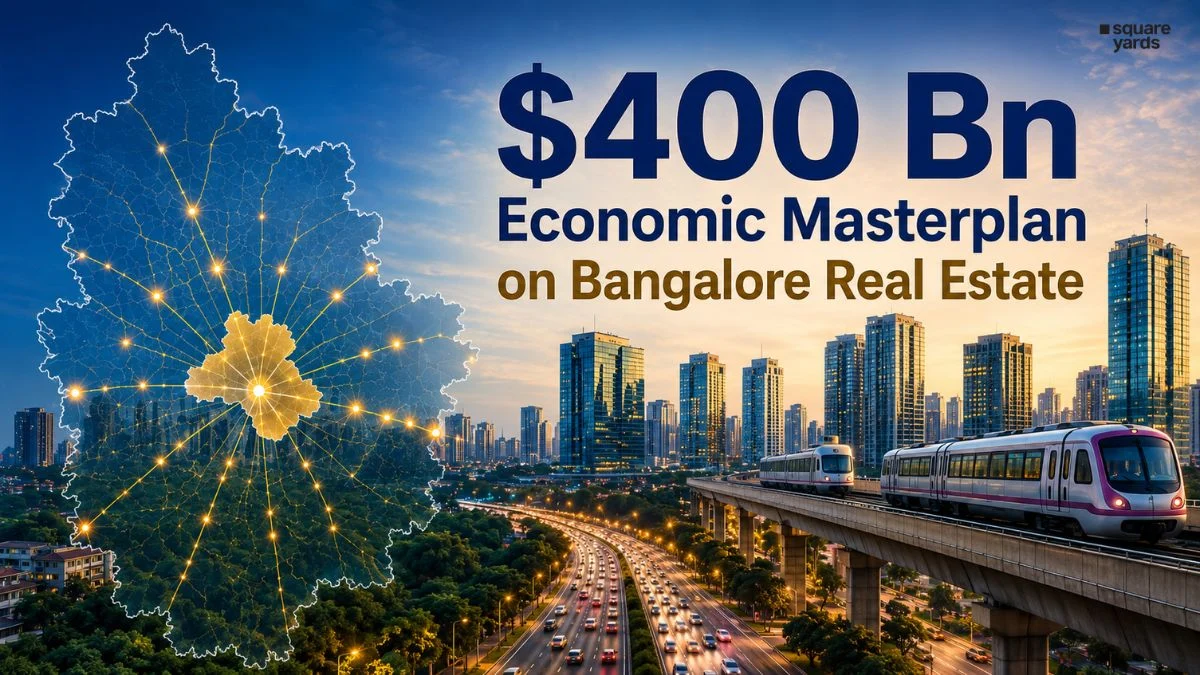
BENGALURU – In a move that signals a paradigm shift for India’s technological capital, the Bengaluru Metropolitan Region (BMR) has unveiled a comprehensive economic masterplan designed to catapult the region’s economy from its current $149 billion to a staggering $400 billion by 2037. This ambitious roadmap, timed to coincide with the 500th anniversary of the city’s founding, represents one of the most significant urban planning exercises in modern Indian history.
The plan is not merely a collection of infrastructure projects but a foundational restructuring of how the region—comprising Bengaluru Urban, Bengaluru Rural, and Ramanagara—will function, move, and grow. With a focus on creating 2.5 million jobs and achieving a 75% public transport modal share, the blueprint aims to solve the systemic bottlenecks that have long threatened the city’s global competitiveness.
Main Facts: A Vision for the 500th Anniversary
The "Bengaluru 2037" vision is anchored by several high-stakes objectives that define the state government’s priorities for the next decade.
1. The Economic Leap
The primary headline is the target of a $400 billion Gross District Domestic Product (GDDP). Currently, the BMR contributes approximately 40% of Karnataka’s total GDP despite occupying a fraction of its landmass. To reach the $400 billion mark, the region must maintain an aggressive growth trajectory, fueled by the expansion of Global Capability Centers (GCCs), high-tech manufacturing, and a burgeoning startup ecosystem.
2. Employment and Demographic Shifts
The masterplan estimates the creation of 2 to 2.5 million new jobs. Given that the region is already home to 16 million people, this influx of employment is expected to drive further migration, necessitating a massive expansion in housing and social infrastructure.
3. The 75% Public Transport Mandate
Perhaps the most audacious goal is the plan to shift 75% of all daily commutes to public transport. In a city currently defined by its traffic congestion and reliance on private vehicles, this target implies a total overhaul of the transit network, integrating the Namma Metro, suburban rail, and bus systems into a seamless "transit-first" environment.
Chronology: From Concept to Blueprint
The development of this masterplan has been a fast-tracked collaboration between the state government and specialized think tanks.
- May 2026: The Government of Karnataka signed a formal Statement of Intent (SoI) with the Institute for Sustainability, Employment and Growth (ISEG Foundation). This agreement tasked the institute with creating a data-driven blueprint for the 2032–2037 period.
- May – August 2026: A four-month intensive study was conducted, analyzing land use, economic output across three districts (Urban, Rural, and Ramanagara), and existing infrastructure gaps.
- September 2026: The completed masterplan was officially presented to Chief Minister Siddaramaiah and Deputy Chief Minister D.K. Shivakumar.
- Late 2026: Following the presentation, the government began aligning the masterplan with immediate infrastructure tenders, including the expansion of the Namma Metro Phase 3 and the proposed double-decker transit corridors.
Supporting Data: The Economic and Real Estate Landscape
To understand the magnitude of the $400 billion target, one must look at the current performance of Bengaluru’s micro-markets and its existing economic engine.
Regional Dominance
The BMR spans over 8,000 square kilometers. While it houses only 25% of Karnataka’s population, its 40% contribution to the state’s GDP highlights an incredible concentration of wealth and productivity. The masterplan seeks to decentralize this slightly by encouraging growth in "Bengaluru Rural" and "Ramanagara" to prevent the core urban center from collapsing under its own weight.
Real Estate Appreciation Trends
The real estate market has already begun pricing in the expectations of this growth. As of late 2026, the city has seen a year-on-year residential price growth of 9-10%. However, specific corridors are outperforming the average:
- Whitefield: 14% appreciation, driven by the saturation of ITPL and new GCC office leases.
- Sarjapur Road: 12% appreciation, benefiting from its proximity to the Outer Ring Road (ORR) and a surge in high-end gated communities.
- North Bengaluru (Airport Corridor): Currently priced between ₹5,500 and ₹11,000 per sq. ft., this area is viewed as the city’s next frontier, with significant land banks available for commercial development.
Transit Expansion Metrics
The 75% public transport target is supported by the planned expansion of the Namma Metro. The network is set to grow from its current 96 km to 137 km in the immediate future. Phase 3, which includes a record-breaking double-decker corridor, is expected to go to tender shortly, providing the physical capacity needed to move millions of additional commuters daily.
Official Responses and Expert Insights
The government’s strategy has met with a mix of optimism and cautious pragmatism from industry leaders.
Navin Dhanuka, Director of ArisUnitern RE Solutions Pvt. Ltd., emphasizes that the plan marks a departure from traditional "reactive" planning. "The proposed economic masterplan marks an important shift towards infrastructure-led and transit-oriented growth for the Bengaluru Metropolitan Region," Dhanuka noted. "Expanding Metro, suburban rail, and RRTS networks can unlock new development corridors by improving access to employment hubs. The success, however, will depend on coordinated execution across transport infrastructure and land-use planning."
State officials have also signaled that the financing of these projects will rely on innovative models like Land Value Capture (LVC). This mechanism allows the government to recover some of the increased value of private land resulting from public infrastructure investments. By formalizing the link between "metro announcements" and "land pricing," the state aims to create a self-funding loop for future phases of the masterplan.
Implications: Reshaping the Real Estate and Social Fabric
The 2037 Masterplan is poised to redefine the "value" of property in Bengaluru, shifting the focus from mere location to "connectivity-adjusted proximity."
1. The End of the "Far" Neighborhood
For decades, areas like North Bengaluru or the far reaches of Sarjapur were considered "investment bets" for the distant future. The masterplan’s 75% public transport target changes this. If a neighborhood is connected to a high-frequency metro line, its physical distance from the city center becomes secondary to its "commute time." This is expected to lead to a "premiumization" of properties located within a 500-meter to 1-kilometer radius of upcoming transit hubs.
2. Rental Yields and the IT Workforce
South Bengaluru and Electronic City currently offer the city’s highest gross rental yields at approximately 5%. With the masterplan leaning heavily on the growth of the IT and GCC sectors, these affordable hubs (priced at ₹6,000–₹10,500 psf) are likely to see a surge in demand from young professionals. The masterplan provides a roadmap for renters to identify which "affordable" areas will soon be linked to major employment hubs.
3. Commercial Real Estate and the GCC Surge
The $400 billion target is largely dependent on Bengaluru remaining the global capital for GCCs. The masterplan’s focus on "social infrastructure"—parks, schools, and civic amenities—is a strategic move to ensure the city remains attractive to global talent. For commercial investors, this suggests that Grade-A office spaces in integrated townships will likely outperform standalone buildings.
4. The Land Value Capture (LVC) Impact
Investors and landowners must now account for the LVC mechanism. As the state takes a direct financial stake in the appreciation of land near transit corridors, the "speculative" nature of land buying may give way to more regulated, transparent pricing. This could lead to faster development cycles, as the government is incentivized to complete infrastructure projects to realize the tax and levy gains from surrounding land.
Conclusion: A Decade of Transformation
The Bengaluru Metropolitan Region’s economic masterplan is a high-stakes bet on the city’s resilience. By setting a hard deadline of 2037—the city’s 500th anniversary—the government has created a sense of historical urgency.
For the homebuyer, the message is clear: the "transit roadmap" is now just as important as the "property title." For the investor, the $400 billion target provides a sector-by-sector guide on where the government will facilitate growth.
However, the ultimate success of the blueprint lies in its execution. Bengaluru has often struggled with the "last-mile" of its infrastructure projects. The next decade will determine whether the city can bridge the gap between its visionary planning and the daily reality of its 16 million residents. If the 75% public transport target and the $400 billion GDP goal are met, Bengaluru will not just be the Silicon Valley of India, but a global benchmark for 21st-century urban evolution.
