

Paris, France – September 14, 2026 – In a moment charged with profound emotion and a palpable sense of collective anticipation, global music icon Celine Dion made her much-anticipated return to the stage on Friday evening, marking her first full concert performance since March 2020. The sold-out 26-night residency at the Pleyel Arena in Nanterre, a prestigious venue nestled on the right bank of the Seine River, commenced with a poignant rendition of "On ne change pas" (We Don’t Change). This performance, however, was far from a simple curtain-raiser; it was a deeply personal and courageous testament to Dion’s unwavering spirit in the face of a formidable health battle.
The overwhelming demand for tickets, with an estimated nine million people vying for less than half a million seats, underscored the profound connection audiences worldwide feel with the Canadian superstar. This fervent desire for her comeback, however, hinted at a broader question: what does an audience truly seek when it calls for an artist’s return, especially one grappling with significant personal challenges? The answer, as witnessed on Friday, was not just about recapturing past glories, but about witnessing raw human resilience and the enduring power of shared experience.
A Symphony of Emotion: The Opening Night Unveiled
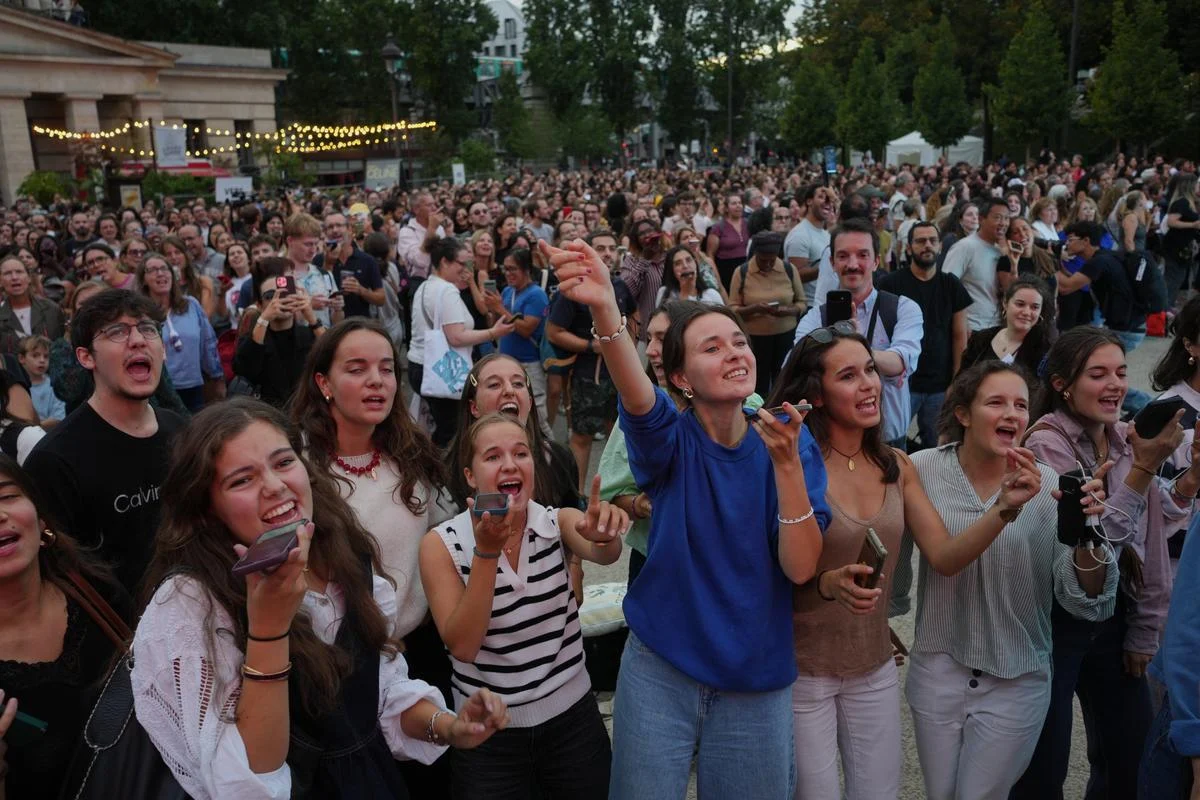
The evening began with a slight delay, 47 minutes past the scheduled start, as if the very fabric of time was holding its breath. When Celine Dion finally appeared, accompanied by a solitary pianist and four violinists, the impact was immediate and profound. The opening lines of "On ne change pas," a song that speaks to the enduring nature of self, resonated with a new layer of meaning. The audience, a sea of expectant faces, rose to their feet before the first verse had concluded, a spontaneous outpouring of support and recognition for the arduous journey she had undertaken.
Yet, the initial moments of the performance were not without their vulnerability. Midway through the first number, Dion’s voice faltered, the familiar lyrics momentarily eluding her. In a gesture that transcended the typical performer-audience dynamic, she extended the microphone to the 30,000-strong crowd. Without hesitation, the audience embraced the moment, their collective voices rising to carry the melody to its conclusion. This was not a moment of faltering, but a powerful demonstration of mutual support, a shared burden and a collective triumph. Later, speaking to the audience with a tremor in her voice, Dion confessed, "I had promised myself not to cry," before adding with a gentle smile that these were "the good kind" of tears.

The Weight of Expectation and the Reality of Stiff-Person Syndrome
The journey to this comeback has been fraught with challenges. In December 2022, Dion publicly revealed her diagnosis of stiff-person syndrome (SPS), a rare neurological disorder characterized by progressive muscle rigidity and painful spasms. This condition presents a significant hurdle for any performer, demanding a level of physical control and stamina that SPS directly undermines. A power ballad, by its very nature, requires a crescendo of vocal and emotional intensity, a sustained effort that can be particularly taxing for someone with Dion’s condition.
Her return, therefore, was not merely a performance; it was a profound act of courage, a deliberate testing of the limits of her own physical capabilities after an extended absence of six years from the stage. The sheer scale of the demand for her residency, as evidenced by the ticket ballot figures, speaks volumes about the enduring affection and unwavering loyalty of her global fanbase. They were not just seeking entertainment; they were seeking inspiration.
A Stripped-Down Spectacle: Simplicity as Strength
In contrast to the elaborate, often theatrical productions associated with major stadium tours, Dion’s Parisian residency embraced a striking simplicity. The stage design, curated by Willo Perron, featured a series of plain, dark slabs that opened and closed, creating a stark yet evocative backdrop. There were no towering video screens or extravagant costume changes. Instead, the focus was squarely on the artist and her voice.
Subtle yet impactful visual elements punctuated the performance. A vibrant pink feathered cape appeared as she delivered a powerful rendition of the Catalani aria, set against a backdrop of falling snow. At another poignant moment, Dion knelt at the edge of the stage, her hand reaching out to those in the front rows, a gesture of intimate connection that transcended the vastness of the arena. This minimalist approach allowed the raw emotion and the sheer power of her vocal performance to take center stage, proving that true artistry often thrives in its unadorned form.

Celine Dion’s Enduring Resonance in India
While the global spotlight has been firmly fixed on her Parisian return, it is important to acknowledge Celine Dion’s significant and often underestimated presence in Indian popular culture. Her timeless ballads have become an integral part of the Indian soundtrack of life, weaving their way into the fabric of everyday moments. From post-dinner family gatherings to late-night taxi rides, and even as cherished pieces in school annual day functions, Dion’s music has been a constant companion. For countless aspiring singers in India, mastering songs like "Because You Loved Me" or "My Heart Will Go On" represented a crucial step in their artistic journey, a benchmark of vocal proficiency and emotional expression. Over the years, her melodies have become deeply intertwined with personal memories, imbuing her music with a nostalgic and deeply cherished significance for a generation of Indian listeners.
A Path of Perseverance, Not Cure
Crucially, Celine Dion has never presented this return as a definitive cure for her condition. The reality of stiff-person syndrome remains, a persistent challenge that has necessitated the rescheduling of ten of the 26 planned performances to May of the following year. Her words to the audience, "The path was rocky and the road longer than expected, but I managed to stay on it," serve as a powerful declaration of her enduring resilience. This was not a statement of being healed, but a profound affirmation of her unwavering commitment to persevere.
In essence, Jim Steinman, the songwriter of "It’s All Coming Back to Me Now," captured the essence of this profound human experience in the late 1980s. While his initial intention was to explore the unsettling nature of "dead things coming to life," the song evolved into a powerful love ballad, much like Dion’s career has been shaped by audience perception. Now, her voice, which has supported countless narratives and emotions for three decades, is itself being supported. The 30,000 people who lifted her voice on Saturday will undoubtedly be there to do so again on Wednesday, Friday, and for every subsequent performance, a testament to the unbreakable bond between an artist and her devoted global family. Celine Dion’s return is not just a concert; it is a profound statement of the human spirit’s capacity to endure, to adapt, and to connect, even in the face of life’s most formidable challenges.
