

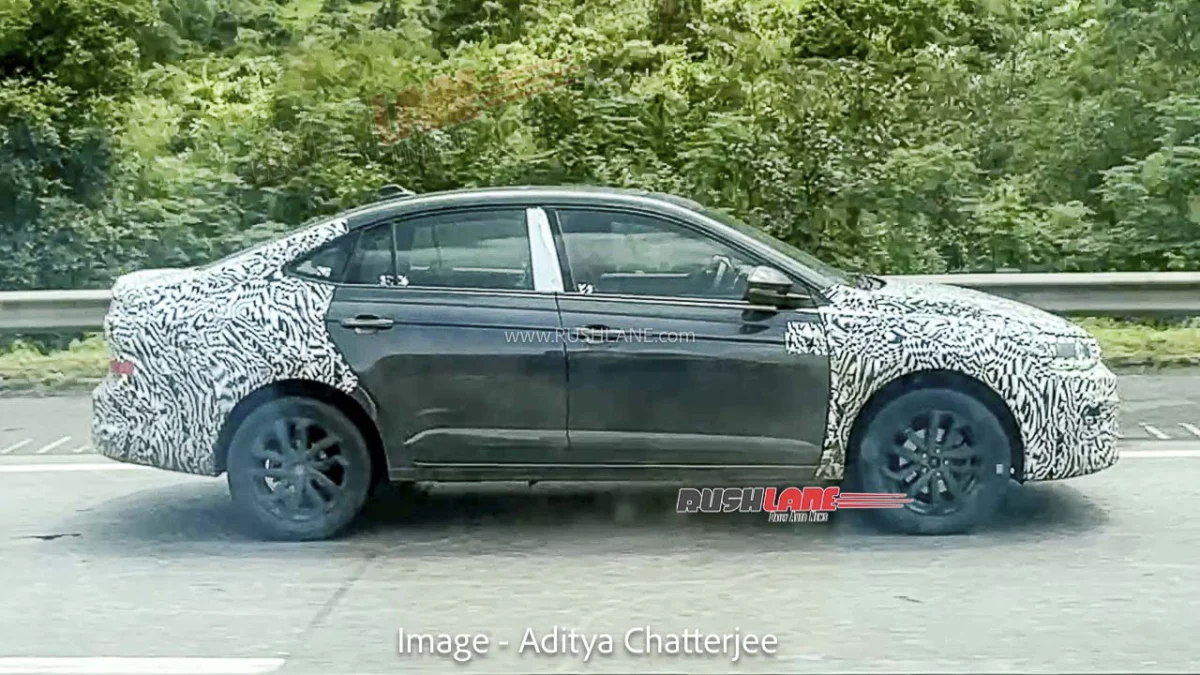
The Indian automotive landscape, currently dominated by the relentless surge of Sub-compact and Mid-size SUVs, still holds a prestigious sanctuary for the classic three-box sedan. At the pinnacle of this segment sits the Volkswagen Virtus. Recently, the excitement surrounding this German-engineered sedan reached a fever pitch as a heavily camouflaged test mule of the 2026 Volkswagen Virtus Facelift was spotted undergoing rigorous high-speed testing on the Mumbai-Pune Expressway.
These latest spy shots, credited to automotive enthusiast Aditya Chatterjee, offer the clearest look yet at the aesthetic and functional revisions Volkswagen is preparing for its flagship sedan in India. As the "India 2.0" project matures, this facelift represents a critical mid-life update intended to sustain the Virtus’s momentum against a backdrop of evolving consumer preferences and tightening competition.

Main Facts: What the 2026 Virtus Facelift Brings to the Table
The Volkswagen Virtus facelift is not merely a cosmetic exercise; it is a strategic alignment with its sister brand, Skoda, which recently updated the Slavia. The core objective of this refresh is to integrate modern technology, refine the driving dynamics, and sharpen the "Germanic" visual appeal that has made the Virtus a favorite among driving enthusiasts.
Exterior Refinements
Based on the sightings, the primary focus of the exterior changes is concentrated on the front and rear fascias. While the elegant, low-slung silhouette remains untouched, the front end is expected to feature:

- Redesigned LED Headlamp Clusters: A sharper lighting signature, potentially incorporating advanced matrix-like LED technology in higher trims.
- Revised Grille: A sleeker, more pronounced grille that may feature additional chrome or piano-black elements depending on the variant (Dynamic vs. Performance Line).
- Aggressive Bumper Styling: Larger air intakes and a redesigned fog lamp housing to give the car a wider, more planted stance.
At the rear, the camouflage suggests a significant overhaul of the lighting department. The spy shots reveal a new internal LED signature for the tail lamps. There is ongoing speculation regarding whether Volkswagen will adopt a "connected" LED light bar across the boot lid, a trend currently sweeping the Indian market, though the test mule’s wrap leaves this detail to the imagination.
The Mechanical Milestone: The 8-Speed Transmission
Perhaps the most significant update lies beneath the hood. The 2026 Virtus is slated to receive the new 8-speed torque converter automatic gearbox for the 1.0-litre TSI engine. This unit will replace the aging but reliable 6-speed automatic. The move to an 8-speed system is designed to provide smoother gear transitions, better fuel efficiency at highway speeds, and a more responsive low-end torque delivery, addressing one of the few minor critiques of the current powertrain.

Chronology: The Road to the 2026 Facelift
To understand the importance of this facelift, one must look at the timeline of the Virtus’s journey in the Indian market:
- March 2022: The Volkswagen Virtus makes its global debut in India, replacing the venerable Vento. It was built on the localized MQB-A0-IN platform, promising a blend of global safety standards and Indian cost-efficiency.
- June 2022: Official market launch. The Virtus immediately set a new benchmark for boot space (521 liters) and ground clearance in the sedan segment.
- 2023-2024: Volkswagen focused on "Variant Management," introducing the GT Edge Limited Collection and various color updates (like the Lava Blue and Matte Editions) to keep the product fresh.
- August 2026: Volkswagen launches the Virtus Anniversary Edition. Historically, in the VW group’s playbook, "Anniversary" or "Final" editions often serve as a bridge to clear existing inventory before a facelifted model arrives.
- September 2026: Multiple sightings of the facelifted test mule on public roads, coinciding with the launch of the updated Skoda Slavia.
- October-November 2026 (Expected): The official debut and price announcement of the Virtus Facelift, timed perfectly for the Indian festive season, where consumer spending is at its peak.
Supporting Data: Market Performance and Competition
Despite the general decline in sedan sales across the industry, the Virtus has remained a resilient performer. However, the data from August 2026 highlights why a facelift is necessary now.

Sales Figures (August 2026)
- Volkswagen Virtus: 1,301 units
- Skoda Slavia: 897 units
- Hyundai Verna: 529 units
- Honda City: 514 units
While the Virtus comfortably leads its segment, a deeper look at the year-on-year (YoY) data reveals a 22.28% decline in sales compared to August 2025. This contraction suggests that the initial novelty of the "India 2.0" sedans is wearing off, and consumers are either moving toward SUVs like the Taigun and Kushaq or waiting for updated versions of the sedans.
Technical Specifications (Projected)
The facelift will maintain the two-engine strategy that has defined its success:

- 1.0L TSI 3-Cylinder: Producing 115 PS and 178 Nm of torque. This engine will now be paired with either a 6-speed manual or the new 8-speed torque converter.
- 1.5L TSI 4-Cylinder: Producing 150 PS and 250 Nm of torque. This remains the "enthusiast’s choice," featuring Active Cylinder Technology (ACT) and the lightning-fast 7-speed DSG (dual-clutch transmission).
Official Context and Strategic Positioning
While Volkswagen India has not released a formal statement regarding the specific launch date of the facelift, the company’s leadership has frequently emphasized a "Product-First" strategy. The introduction of the 8-speed gearbox is a clear indication of the group’s commitment to the MQB-A0-IN platform’s longevity.
The Virtus Facelift is expected to bridge the gap between the current model and the eventual transition to the "India 2.5" or "India 3.0" plans, which may involve heavy electrification. By upgrading the infotainment to a more seamless 10.25-inch interface and adding a 360-degree camera—features already found in several sub-Rs. 15 lakh SUVs—Volkswagen is addressing the "feature-gap" that often sways buyers away from sedans.

Furthermore, the alignment with the Skoda Slavia’s update cycle allows for economies of scale in parts procurement (such as the new transmission and ADAS sensors), ensuring that while prices will likely see a marginal hike (estimated at ₹30,000 to ₹60,000), the value proposition remains competitive.
Implications: What This Means for the Indian Market
The arrival of the 2026 Virtus Facelift carries several implications for the automotive industry and potential buyers:

1. The Survival of the Sedan
Volkswagen’s continued investment in the Virtus signals that the German giant does not believe the sedan is dead. By offering a "premium-plus" experience, VW is targeting the upwardly mobile professional who seeks status and driving pleasure over the rugged, utilitarian appeal of an SUV.
2. Feature Democratization
The expected inclusion of Level 2 ADAS (Advanced Driver Assistance Systems) in the Virtus Facelift will put it on par with the Hyundai Verna and Honda City. This includes features like Autonomous Emergency Braking, Lane Keep Assist, and Adaptive Cruise Control. For a brand that prides itself on safety (5-star Global NCAP rating), adding active safety tech is the logical next step.

3. Resale Value and Brand Loyalty
Existing Virtus owners might see a slight dip in the resale value of the pre-facelift models once the 8-speed automatic becomes the standard. However, for the brand, this refresh strengthens loyalty. VW owners are notoriously brand-conscious, and providing a modern, tech-laden path for an upgrade within the same family is crucial for customer retention.
4. Pressure on Rivals
The Honda City, once the undisputed king of this segment, now finds itself in fourth place. The Virtus facelift, with its superior performance figures and updated tech, will likely widen the gap further, forcing rivals to either innovate or risk becoming niche players in a shrinking segment.

Conclusion
The 2026 Volkswagen Virtus Facelift is more than just a new set of bumpers and lights. It is a calculated move to reinforce Volkswagen’s dominance in the mid-size sedan category. By addressing mechanical refinements with the 8-speed gearbox and meeting modern tech expectations with a 360-degree camera and ADAS, Volkswagen is ensuring that the Virtus remains the "Gold Standard" for those who still believe that the best way to travel is in a sophisticated, powerful sedan.
As the festive season approaches, the Mumbai-Pune Expressway sightings serve as a final teaser for what is arguably the most anticipated sedan launch of the year. For the 1,301 buyers who chose a Virtus last month, and the thousands more waiting on the sidelines, the message from Wolfsburg is clear: the sedan is not just surviving; it is evolving.
