

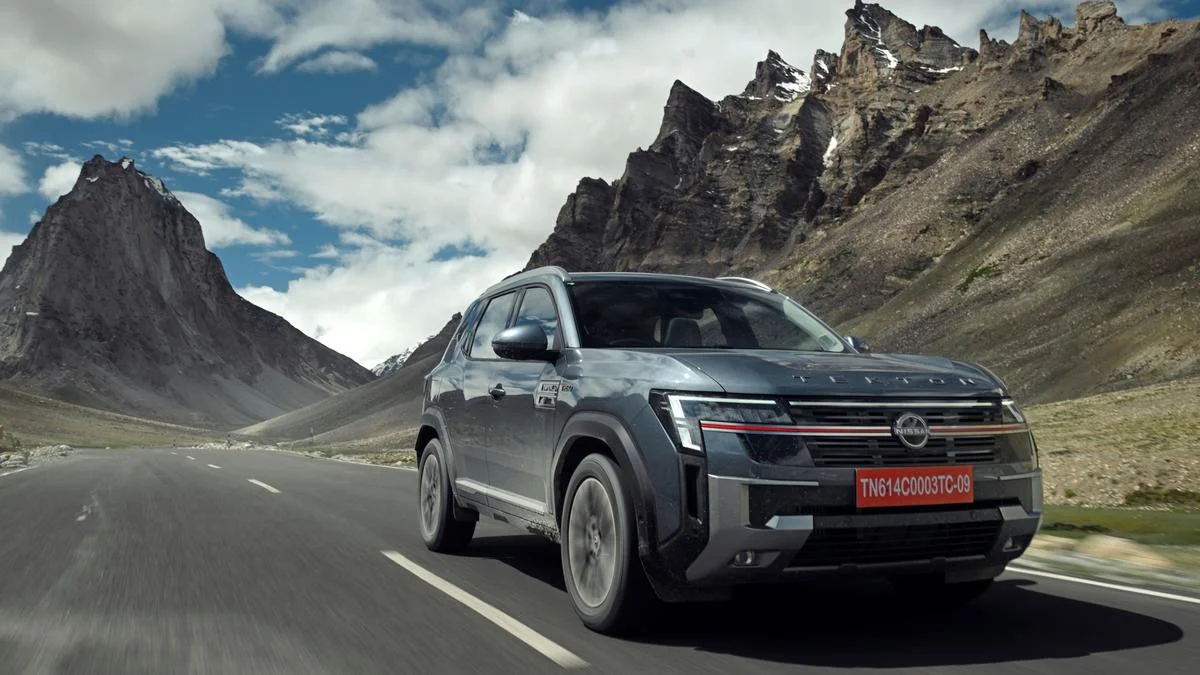
The Indian automotive landscape is currently witnessing a fierce battle in the mid-size SUV segment, a territory dominated by established titans and tech-heavy newcomers. Into this fray steps the Nissan Tekton, a vehicle that immediately sparks a fundamental question among enthusiasts and buyers alike: is this merely a Renault Duster with a different badge? While the mechanical DNA suggests a close kinship, a 700-kilometer expedition from the plains of Chandigarh to the high-altitude reaches of Leh reveals a more nuanced story. The Tekton is Nissan’s attempt to take a proven, rugged architecture and elevate it into a premium, lifestyle-oriented package that challenges the status quo of the ₹10 lakh to ₹19 lakh price bracket.
Main Facts: The Tekton’s Identity and Market Positioning
The Nissan Tekton enters the market with a clear mission: to offer the legendary ruggedness of the CMF-B platform with a layer of sophistication that the previous generation of "budget" SUVs lacked. Launched with an aggressive price range of ₹10.49 lakh to ₹18.59 lakh (ex-showroom), it positions itself directly against the Hyundai Creta, Kia Seltos, Volkswagen Taigun, and its own cousin, the Renault Duster.
At its core, the Tekton is a front-wheel-drive SUV that prioritizes ride quality and structural integrity. It is available with two distinct turbocharged petrol powertrains—the T160 and the T280—aimed at different types of consumers. The vehicle’s standout specifications include a class-leading 212mm ground clearance and a massive 518-liter boot capacity, making it one of the most practical long-distance tourers in its class. Furthermore, Nissan has secured a five-star Bharat NCAP safety rating, a critical credential in a market increasingly sensitive to occupant protection.
Chronology: From Chandigarh to the Roof of the World
To truly understand if the Tekton is more than the sum of its shared parts, it was subjected to one of the most grueling test routes in the world: the journey from Chandigarh to Leh. This 700km+ route serves as a chronological proving ground for any vehicle’s claims of "ruggedness."

Phase 1: The Highway Cruise
Starting from Chandigarh, the initial leg of the journey consisted of smooth multi-lane highways. This phase highlighted the Tekton’s refinement. At cruising speeds, the T280 engine (the 1.3-litre variant) showed its prowess. Despite the inherent three-cylinder-like characteristics often found in small turbos, the four-cylinder T280 remained composed. The cabin insulation was tested against wind and tire noise, revealing a significant upgrade over previous Nissan offerings in this segment.
Phase 2: The Foothills and Broken Tarmac
As the route wound through the foothills toward Manali, the road conditions began to deteriorate. This is where the Tekton’s chassis—the "star of the show"—began to shine. Unlike many of its rivals that feel stiff or "fidgety" over minor road imperfections, the Tekton’s suspension absorbed potholes with a level of compliance that felt sophisticated rather than soft. The 212mm ground clearance became an immediate asset, allowing the driver to maintain momentum where others were forced to crawl.
Phase 3: The High Mountain Passes
The final ascent toward Leh, involving steep gradients and thin air, put the turbochargers to the ultimate test. It was here that the distinction between the T160 and T280 became most apparent. While the smaller 1.0-litre engine might suffice for city commutes, the 1.3-litre T280’s 280Nm of torque was essential for overtaking slow-moving trucks on narrow mountain ledges. Despite some initial turbo lag at low revs, the mid-range punch allowed the Tekton to conquer the passes without feeling breathless.
Supporting Data: Engineering and Performance Breakdown
The "premium" claim of the Tekton is supported by specific engineering choices and performance data. Nissan has not just changed the plastic bumpers; they have recalibrated the interface between the car and the driver.

Powertrain Specifications
| Feature | T160 Variant | T280 Variant |
|---|---|---|
| Engine | 1.0L 3-cyl Turbo Petrol | 1.3L 4-cyl Turbo Petrol |
| Power | 100 PS | 163 PS |
| Torque | 166 Nm | 280 Nm |
| Transmission | 6-speed Manual | 6-speed Manual / 6-speed DCT |
| 0-100 kph | N/A | 9.51s (MT) / 9.89s (DCT) |
| Claimed Efficiency | N/A | 17.8 kpl (MT) / 18.5 kpl (DCT) |
Design and Dimensions
The Tekton’s exterior design is a deliberate nod to the Nissan Patrol, the brand’s flagship global off-roader. It features a broad, upright stance and C-shaped daytime running lights (DRLs) that give it a "big car" feel. The use of 18-inch alloy wheels on higher trims fills out the chunky wheel arches, providing a balanced aesthetic.
Inside, the cabin breaks away from the industry-standard "black and beige" palette. Nissan has introduced a controversial but distinctive purple detailing. This interior theme is complemented by high-end tech, including:
- Infotainment: 10.1-inch touchscreen with wireless smartphone integration.
- Instrumentation: 10.25-inch digital cluster.
- Comfort: Ventilated front seats, dual-zone climate control, and a panoramic sunroof.
- Safety: Six airbags as standard, ADAS (Advanced Driver Assistance Systems), and a 3D Around View Monitor.
Official Strategy: Nissan’s "Differentiation" Doctrine
While Nissan has been transparent about the shared platform with Renault, their official positioning emphasizes "distinct interpretation." According to the brand’s strategy, the Tekton is designed for the "adventurous professional"—someone who needs a vehicle capable of handling the daily urban grind but demands the mechanical integrity to head into the wilderness on weekends.
Nissan’s engineers focused heavily on the "Human-Machine Interface" (HMI). By offering adjustable steering weights (Light and Heavy modes) and a more ergonomic seating position than the traditional Duster, Nissan aims to attract buyers who found the previous platform-sharers too utilitarian. The inclusion of "Google built-in" connectivity in higher variants is a clear signal that Nissan is targeting a tech-savvy demographic that would otherwise look toward Korean or European competitors.

However, the official strategy also reveals a calculated risk: the absence of a hybrid or diesel powertrain. In a market where fuel economy is often the primary driver of sales, Nissan is betting entirely on the efficiency and performance of its turbo-petrol lineup. They argue that the T280’s efficiency (up to 18.5 kpl) is competitive enough to offset the lack of a hybrid, though this remains a point of contention among industry analysts.
Implications: What the Tekton Means for the Indian Market
The arrival of the Nissan Tekton has several long-term implications for the Indian SUV sector and for Nissan’s future in the subcontinent.
1. The Death of the "Cheap" Rebadging
The Tekton proves that the era of simple "badge engineering" (where only the logo is changed) is over. To succeed, manufacturers must now invest in unique sheet metal, distinct interior themes, and differentiated feature lists. The Tekton’s Patrol-inspired looks and purple interior are vital because they give the car a soul that is separate from its Renault sibling.
2. A Shift Toward Ride Quality over Gadgetry
For the past five years, the mid-size SUV segment has been a "feature war," with brands competing on screen size and ambient lighting. The Tekton shifts the focus back to the chassis. If consumers respond well to its superior ride quality and "go-anywhere" confidence, it may force other manufacturers to prioritize suspension tuning and structural rigidity over superficial electronics.

3. The Viability of the "Petrol-Only" Strategy
Nissan’s success with the Tekton will be a litmus test for the viability of high-performance turbo-petrols as a replacement for diesel. With 280Nm of torque, the T280 offers diesel-like pull, but its real-world fuel economy under heavy loads (like the climb to Leh) will determine if traditional diesel buyers are willing to make the switch.
4. Nissan’s Brand Resurgence
After years of relying heavily on the Magnite, the Tekton represents a critical "second pillar" for Nissan India. It elevates the brand’s perception from a budget-friendly manufacturer to a provider of premium, capable SUVs. If the Tekton succeeds, it paves the way for Nissan to bring more of its global portfolio, such as the X-Trail or the actual Patrol, to Indian shores.
Conclusion: The Verdict of the Leh Road
As the Tekton rolled into Leh, dusty but undeterred, the conclusion was clear. It is not just a Duster in a fancy suit. It is a vehicle that takes the best part of its heritage—the indestructible suspension and the high clearance—and wraps it in a package that is finally pleasant to live with on a daily basis.
While it faces stiff competition and the lack of a hybrid option may deter some, the Tekton stands out as the "driver’s choice" for those who actually plan to use their SUV as an SUV. For the buyer who values the confidence to tackle a broken mountain road as much as the convenience of a 360-degree camera, the Nissan Tekton is a compelling, rugged, and surprisingly premium evolution of a legendary formula.
