

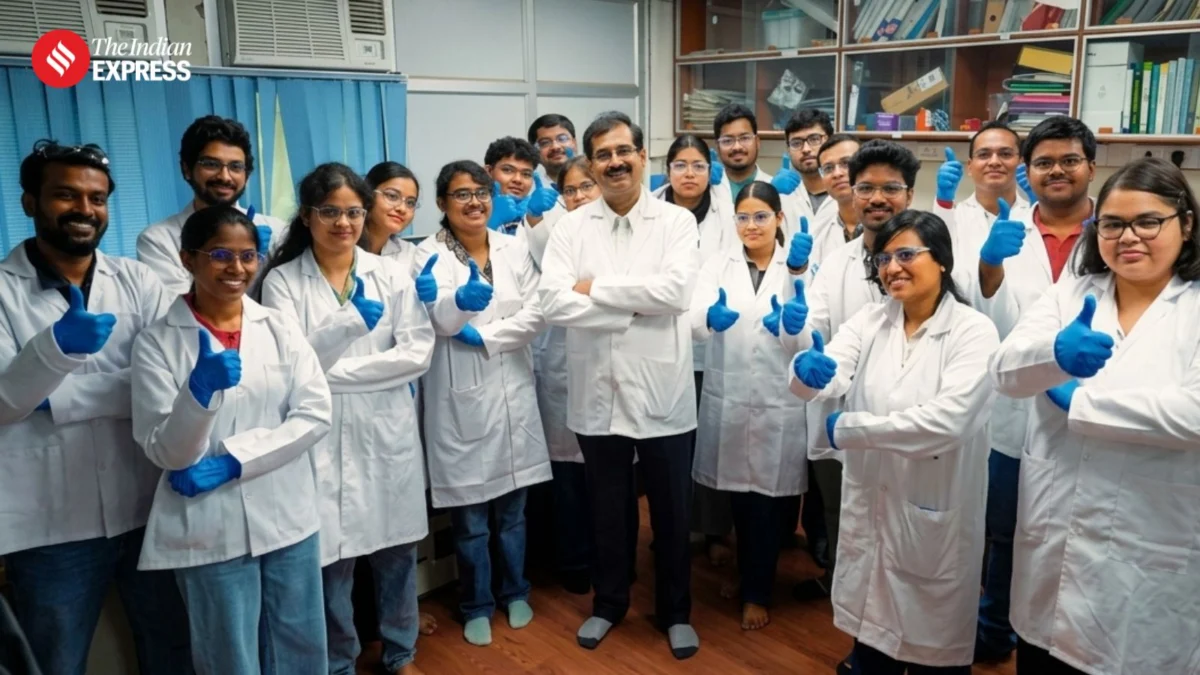
New Delhi | September 18, 2026, 6:30 PM IST
In the hallowed halls of the Indian Institute of Technology (IIT) Kanpur, a crucible of engineering prowess and innovation, a different kind of academic pursuit is unfolding. While many students arrive with aspirations of high-flying careers and groundbreaking technological advancements, Professor Sankar Prasad Rath, a distinguished figure in the Department of Chemistry, is diligently cultivating a deeper appreciation for the fundamental sciences. His unwavering dedication to igniting curiosity and fostering critical thinking, particularly among students who may not have initially chosen chemistry as their primary focus, has earned him the prestigious National Teacher Award 2026.
Professor Rath’s journey to this esteemed recognition is a testament to perseverance, a profound understanding of the student psyche, and an unyielding belief in the power of foundational knowledge. For two decades, he has navigated the unique academic landscape of IIT Kanpur, a place where the allure of engineering often overshadows the intricate beauty of subjects like chemistry. His award underscores the vital role of educators who go beyond the curriculum to inspire a genuine love for learning, especially in disciplines that are often perceived as mere stepping stones to a desired career.
The Genesis of a Vision: From a Flooded Village to an IIT Classroom
Professor Rath’s narrative is not one that began amidst the polished labs and lecture halls of a premier institution. Instead, it originates in Mirzapur, a modest village in East Midnapore, West Bengal. This region, frequently grappling with the challenges of seasonal floods, primarily relied on agriculture for its sustenance. "Agriculture was the only source of income in my family," Professor Rath recalls, painting a vivid picture of his humble beginnings. This rural upbringing, marked by its inherent resilience and resourcefulness, would later shape his pedagogical approach and his empathy for students from diverse backgrounds.
The path from Mirzapur to IIT Kanpur was a meticulously constructed ascent, marked by incremental yet significant milestones. His early education took place at a local school, followed by a transformative period at Ramakrishna Mission Vidyamandira in Belur Math. This was succeeded by a Master’s degree from the University of Calcutta, a prestigious institution steeped in academic tradition. His doctoral research was conducted at the Indian Association for the Cultivation of Science (IACS) in Kolkata, under the tutelage of the esteemed Professor Animesh Chakravorty. A postdoctoral fellowship at the University of California, Davis, further broadened his scientific horizons. In December 2004, Professor Rath found his academic home at IIT Kanpur, where he has remained a fixture ever since.
Reflecting on his own educational trajectory, Professor Rath doesn’t necessarily romanticize the climb. "The transition from a rural upbringing to demanding centres of higher education was itself formative," he states. "It made me value discipline, self-learning, and perseverance." However, this formative experience also endowed him with a unique perspective, an innate ability to discern potential in students who might not possess the same inherent advantages or prior exposure as their more privileged peers. "A teacher must recognise potential even when it is not yet polished by privilege or opportunity," he emphasizes, a principle that guides his interactions with every student.
The Art of Teaching the Unchosen: Making Chemistry Resonate
A prevailing perception within the IIT ecosystem is that students primarily enroll to secure lucrative engineering jobs, viewing subjects like chemistry as a hurdle to be cleared rather than a field of intrinsic interest. For many, chemistry is simply a prerequisite for their engineering degree, a subject to be mastered for examination purposes. Professor Rath has dedicated two decades to challenging this perspective, striving to transform chemistry from a mere academic obligation into a captivating lens through which to understand the world.
His pedagogical strategy is rooted in engagement and critical inquiry. "I try to use questions, real chemical problems, experimental observations, and connections with everyday life, so that students see chemistry as a way of understanding the world rather than as a collection of reactions to memorise," he explains. This approach moves beyond rote learning, encouraging students to grapple with concepts, explore their practical applications, and appreciate the elegance of chemical principles.
Professor Rath also champions a learning environment that values intellectual struggle. He is not inclined to provide immediate answers, believing that the process of discovery is as crucial as the outcome. "If we give them every answer too quickly, we may improve short-term performance but weaken independent thinking," he observes. For him, the most rewarding moment in a classroom is not the delivery of a correct answer, but rather an unexpected and insightful question posed by a student – a sign that genuine intellectual curiosity has been sparked. This emphasis on fostering deep understanding over superficial achievement is a hallmark of his teaching philosophy.
Navigating the Exodus to Industry: Retaining Talent in Academia
The allure of industry, with its promise of rapid career progression, financial security, and tangible project impact, often draws bright young minds away from the pursuit of academic research. Professor Rath acknowledges this trend, stating, "Talented students often see a clearer career path, faster financial security, larger teams, and more immediate applications there." The academic route, conversely, demands years of rigorous training with no guaranteed outcome, a prospect that can be daunting for ambitious students.
Rather than attempting to dissupple students through moral suasion, Professor Rath advocates for making academia a more compelling and rewarding choice. His proposed solutions include "better mentoring, greater stability, adequate resources, intellectual freedom, and a culture in which good science, not merely the number of publications, is genuinely valued." By fostering an environment that nurtures intellectual growth, provides robust support systems, and truly celebrates scientific discovery, he believes academia can better compete for and retain top talent. This involves a systemic shift towards valuing the quality and impact of research, rather than solely focusing on quantitative metrics.
AI in the Classroom: A Tool, Not a Crutch
The rapid integration of Artificial Intelligence (AI) into educational settings presents both opportunities and challenges. Professor Rath approaches AI with a degree of caution, recognizing its potential to both enhance and hinder genuine learning. "Easy access to an answer can create the illusion of understanding," he warns. Students might become adept at quickly retrieving information but risk losing the ability to engage in deep, critical thinking.
His strategy for integrating AI into the classroom is not to ban these powerful tools but to redefine the expectations placed upon students. Instead of simply seeking answers, students are encouraged to demonstrate their reasoning, meticulously check evidence, and rigorously defend their conclusions. This shift in focus transforms AI from a shortcut to knowledge into a tool for deeper exploration and critical evaluation. By demanding a more profound engagement with the subject matter, Professor Rath ensures that AI serves as an enhancer of learning, not a substitute for it.
The Enduring Legacy: Two Decades of Impact
When asked about the cumulative impact of his two decades at IIT Kanpur, Professor Rath’s response is both humble and profound. "What gives me the greatest sense of fulfilment is the combination of students I have taught and mentored," he states. His pride lies not in personal accolades, academic titles, or published papers, but in the growth and development of the individuals he has guided.
His own research interests delve into the intricate mechanisms by which nature utilizes iron, a fundamental element present in our own biology, to facilitate highly efficient chemical reactions within living cells. He believes that a deeper understanding of these biological processes could pave the way for developing more sustainable and innovative chemical solutions for the real world. "Curiosity," Professor Rath concludes with conviction, "is not a luxury. It is the only thing that makes the work last." This sentiment encapsulates his enduring philosophy: that a deep-seated, intrinsic drive to understand is the most powerful engine for both personal fulfillment and scientific progress. His National Teacher Award is a fitting recognition of a career dedicated to nurturing that very spark in the minds of future innovators.
