

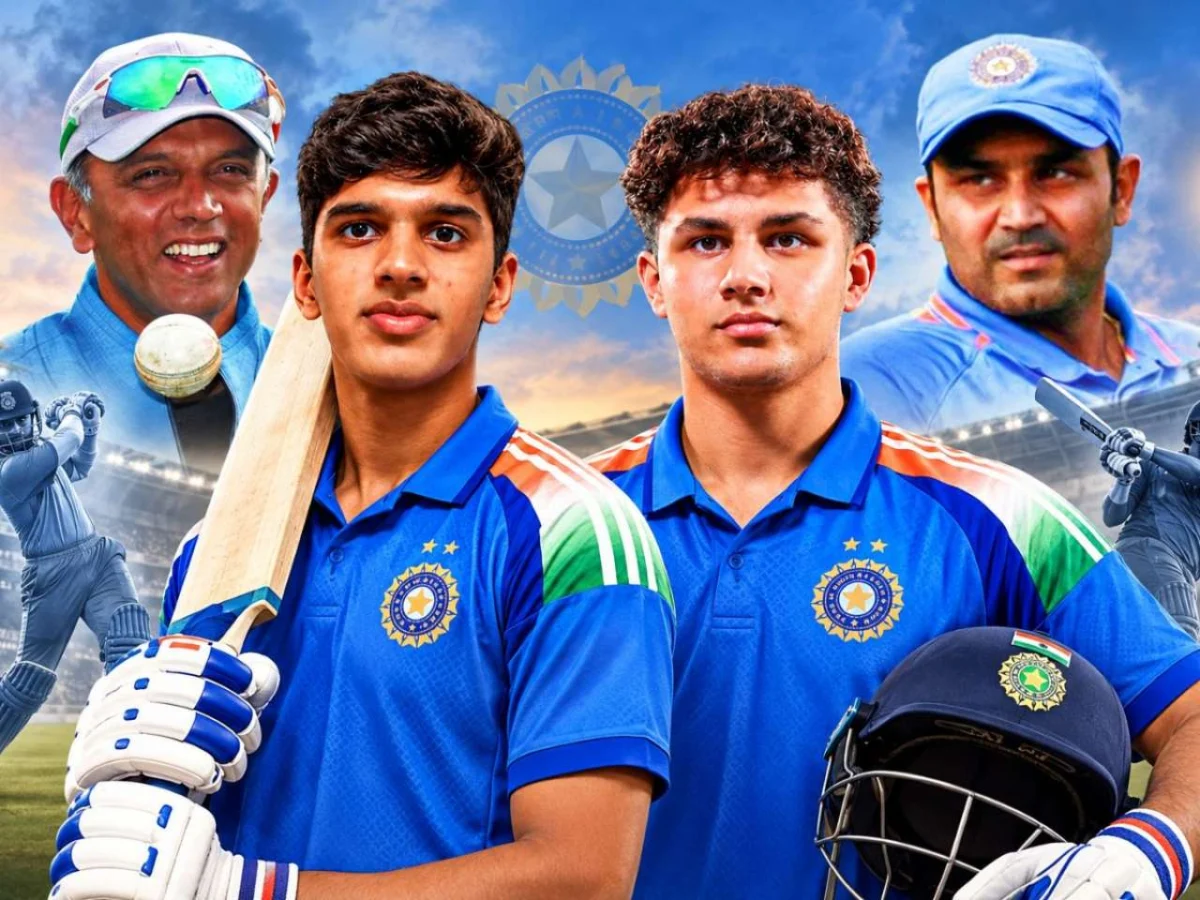
Rajkot, India – September 18, 2026 – In a moment that resonated with the echoes of Indian cricket’s glorious past, two surnames synonymous with batting excellence reappeared on the national scoresheet, heralding a potentially thrilling new era. Anvay Dravid and Aryavir Sehwag, sons of legendary cricketers Rahul Dravid and Virender Sehwag respectively, prominently featured in India U19’s recent victory over Australia U19 in the first unofficial One-Day International held at the Nianjan Shah Stadium in Rajkot. This encounter not only marked a significant milestone for the young talents but also captivated observers with the intriguing contrast and continuity they presented, carving individual niches while carrying the weight of formidable legacies.
The match, curtailed to 20 overs due to inclement weather, saw India U19 post a competitive total of 182 for 6. While Aryavir Sehwag anchored the top order with a brisk 28 runs, Anvay Dravid provided a late-innings fireworks display, blazing an impactful 38 runs off just 18 deliveries. Their performances, distinct yet impactful, have sparked considerable discussion about the evolving dynamics within India’s burgeoning youth cricket scene and the fascinating journeys of these emerging stars.
Main Facts: A New Chapter for Cricket Dynasties
The convergence of the Dravid and Sehwag names on an India U19 team sheet is more than just a passing curiosity; it represents a compelling narrative in the ongoing saga of Indian cricket. For two decades, Rahul Dravid, the epitome of resilience and classical technique, and Virender Sehwag, the architect of fearless, boundary-laden assaults, stood as pillars of the senior national team, shaping an era defined by their contrasting yet complementary brilliance. Now, their sons are beginning to author their own stories, albeit with a fresh script.
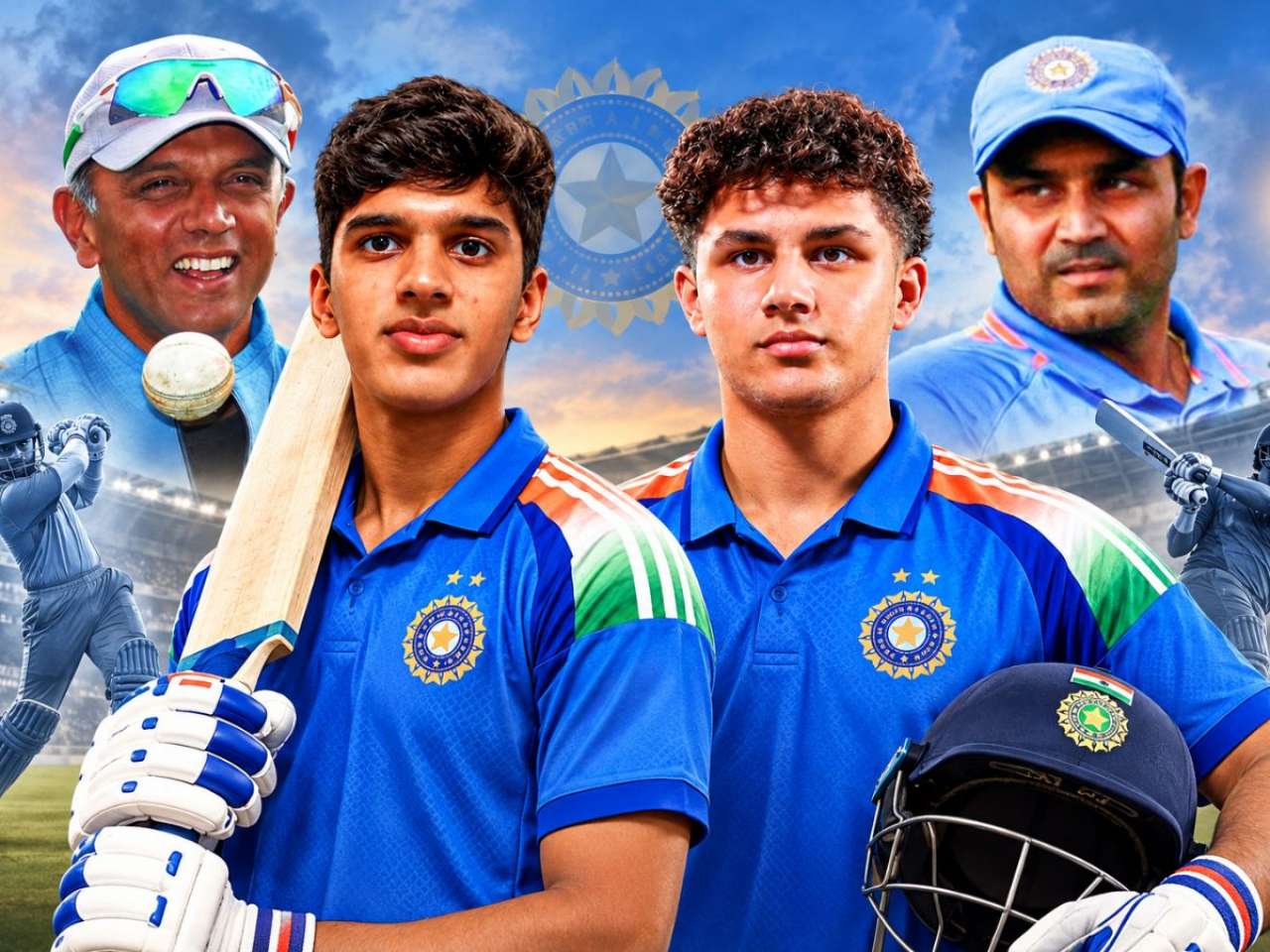
Rajkot Witnesses Emerging Talent
The Nianjan Shah Stadium in Rajkot bore witness to this unfolding narrative on a rain-affected Friday. In the inaugural unofficial ODI against Australia U19, the spotlight inevitably fell upon Anvay Dravid and Aryavir Sehwag. Aryavir, making his debut for the India U19 side, stepped onto the field as an opening batsman, a role his father redefined with audacious power. He delivered a promising start, scoring 28 runs from 26 balls, featuring five well-timed boundaries.
Later in the innings, Anvay Dravid, batting lower down the order at No. 6, unleashed a rapid-fire cameo that propelled India U19 to a strong finish. His innings of 38 from just 18 balls, punctuated by two fours and three towering sixes, came at an astounding strike rate of 211.11. This explosive display stood in stark contrast to the patient, meticulous image often associated with his father, Rahul ‘The Wall’ Dravid, yet it underscored a potent adaptability and a clear intent to forge his own identity. The match concluded with India U19 setting a target of 183, with the performances of these two young men drawing immediate attention and igniting conversations across cricketing circles.
Chronology: Tracing the Journey of Young Prodigies
The path to representing India at any level is arduous, paved with years of dedication, rigorous training, and consistent performances in domestic age-group cricket. For Anvay Dravid and Aryavir Sehwag, this journey is further complicated – or perhaps amplified – by the immense shadows cast by their fathers’ legendary careers.
)
The Legacy of Legends: Rahul Dravid and Virender Sehwag
To truly appreciate the significance of Anvay and Aryavir’s recent exploits, one must first revisit the indelible marks left by their fathers. Rahul Dravid, affectionately known as ‘The Wall,’ was the embodiment of classical Test cricket, a batsman whose unwavering concentration, impeccable technique, and relentless patience allowed him to grind down opposition attacks. He was the crisis man, the accumulator, the one who would wear bowlers down through sheer willpower and surgical precision. While he adapted his game for limited-overs formats, even captaining India and proving adept in T20s towards the end of his career, his primary identity remained rooted in endurance and steadfastness.
Virender Sehwag, on the other hand, was the revolutionary. He redefined opening batting in Test cricket, approaching the longest format with the mindset of a limited-overs slogger. His philosophy was simple: see ball, hit ball. Sehwag dismantled bowling attacks with audacious cuts, pulls, and drives, often reaching milestones like 50s, 100s, and even triple centuries faster than most batsmen would score singles. He was pure aggression, a swashbuckling entertainer who instilled fear in the hearts of bowlers worldwide. The contrast between Dravid’s stoicism and Sehwag’s flamboyance created a fascinating dynamic within the Indian team, contributing significantly to what many refer to as the ‘golden age’ of Indian batting in the late 1990s and 2000s.
From Domestic Arenas to International Youth Stage
The sons have been diligently working their way through the ranks, proving their mettle beyond their famous surnames.

Anvay Dravid’s Ascent: Anvay Dravid’s emergence has been steadily building. While the Rajkot innings captured significant attention, it wasn’t his first foray into the international youth circuit. He had previously toured Sri Lanka with the India U19 squad, where he showcased glimpses of his burgeoning talent. During that tour, one notable performance saw him score a fluent 87 off just 67 deliveries, an innings embellished with nine fours and a six. This particular knock hinted at an attacking instinct that was perhaps less pronounced in his father’s game, suggesting a player eager to dictate terms rather than merely absorb pressure. Anvay’s development has been carefully observed, with coaches focusing on honing his natural stroke-making abilities while refining his temperament for various match situations. His journey reflects a player who, despite having access to arguably the best cricketing mind in the country, is committed to crafting his own style and earning his place through performance.
Aryavir Sehwag’s Debut and Formative Years: Aryavir Sehwag’s path has also been marked by impressive domestic performances. Earlier this year, he made headlines with a monumental innings in the prestigious Cooch Behar Trophy, representing Delhi against Meghalaya. In that fixture, Aryavir smashed an incredible 297 runs, narrowly missing a triple century. What made this innings particularly noteworthy was not just the sheer volume of runs, but the manner in which they were scored. He faced 309 balls, exhibiting a blend of aggression and sustained concentration, hitting 51 fours and three sixes. This performance showcased his ability to bat for long periods, build an innings, and still maintain a high scoring rate – a testament to his multifaceted batting prowess.
The Rajkot match, however, marked a significant milestone for Aryavir: his very first game for India U19. Stepping out to open the innings, he carried the weight of a position his father had dominated for years. His composed yet aggressive 28 runs on debut suggested a player capable of absorbing the pressure of a big stage while staying true to his attacking instincts.
)
The Rajkot Encounter: The first unofficial ODI against Australia U19 was a crucial fixture for both teams, serving as a platform for young talents to gain international exposure. The rain-shortened format added an element of urgency, demanding quick scoring and tactical flexibility. For India U19, the early loss of wickets put pressure on the middle order, making Anvay Dravid’s late assault even more critical. His partnership with Yashbardhan Chauhan, which yielded 69 runs in a mere 34 balls, transformed the innings from a modest total to a challenging one. Aryavir’s early contribution, though not a match-winning score, provided a solid platform and demonstrated his ability to handle the new ball and the intensity of international youth cricket. Together, their contributions highlighted a dynamic and adaptable India U19 squad, capable of both steady accumulation and explosive hitting.
Supporting Data: Performances and Statistical Insights
The numbers from the Rajkot encounter, coupled with their prior domestic records, paint a vivid picture of Anvay and Aryavir’s burgeoning talents and their evolving cricketing personas.
Anvay Dravid’s Explosive Impact
Anvay Dravid’s knock of 38 off 18 balls was the innings of the match in terms of sheer acceleration. Coming in at No. 6, a position often demanding quick runs and a rapid assessment of the situation, Anvay delivered precisely that. His strike rate of 211.11 is exceptional in any format, particularly in a match where wickets were falling. He dispatched two fours and three sixes, showcasing a clean hitting ability and a penchant for clearing the ropes.
)
This aggressive approach starkly contrasts with the popular image of his father, Rahul Dravid, who was renowned for his impregnable defense and methodical accumulation. While Rahul Dravid did adapt his game to score quickly in ODIs and T20s, his fundamental game was built on wearing down bowlers. Anvay, however, appears to possess an inherent desire to dominate, to put bowlers on the back foot from the outset. The 69-run partnership he forged with Yashbardhan Chauhan in just 34 balls was pivotal. This blistering stand dramatically shifted the momentum in India’s favour, allowing them to reach a formidable total that seemed unlikely at one stage. It demonstrated Anvay’s ability not just to hit big, but to forge match-defining alliances under pressure.
His earlier performance in Sri Lanka – 87 off 67 balls, including nine fours and a six – further reinforces this attacking temperament. That innings, scored in a longer format, showed that his aggression isn’t limited to T20-style cameos but can be sustained over a longer period, indicating a versatile batsman who likes to control the pace of the game. The "reversed role" is indeed fascinating: the son of ‘The Wall’ is emerging as ‘The Blaster,’ redefining expectations and charting his own course with the bat.
Aryavir Sehwag’s Top-Order Aggression
Aryavir Sehwag’s debut innings of 28 off 26 balls, while not as explosive as Anvay’s, was crucial in setting the tone for India U19. Opening the batting, a role synonymous with his father Virender Sehwag’s legendary career, Aryavir showcased controlled aggression. He struck five boundaries, indicating a clear intent to score and put pressure on the Australian bowlers. His strike rate of approximately 107.69 is a healthy one for an opener, especially in a debut innings, demonstrating his ability to rotate the strike and find the ropes.
)
The 45-run opening partnership with captain Lakshya Rajesh Raichandandi provided a stable foundation, allowing the later batsmen to play with more freedom. While he didn’t unleash the kind of uninhibited blitzkrieg his father was famous for, the underlying aggression and positive intent were unmistakable. This performance was a clear nod to the Sehwag legacy of fearlessness at the top of the order.
However, it is Aryavir’s monumental 297 for Delhi against Meghalaya in the Cooch Behar Trophy that truly showcases his immense potential and temperament. Facing 309 balls and hitting 51 fours and three sixes, this innings was a masterclass in long-form batting combined with consistent scoring. It proved that he is not merely a T20 slogger but possesses the technique, concentration, and stamina to bat for extended periods and compile massive scores. This innings reveals a more rounded batsman than just a carbon copy of his father’s all-out attack. It suggests he has the ability to blend aggression with patience, a trait that could make him a formidable force across all formats. He continues the tradition of opening, but with a nuanced approach that is distinctly his own.
The Broader Context of India U19 Cricket
The India U19 system is a vital pipeline for future international cricketers. It provides a crucial bridge between domestic age-group cricket and the rigours of first-class and eventually, international senior cricket. Playing against strong teams like Australia U19 offers invaluable experience in high-pressure situations, exposing young players to different conditions and competitive environments. The development of players like Anvay Dravid and Aryavir Sehwag, alongside other promising talents in the squad, is indicative of the robust infrastructure and talent identification programs within Indian cricket. Their performances are not just individual achievements but also reflections of a system designed to nurture and prepare the next generation. The competition for spots in the U19 team is fierce, and earning a place, let alone performing with distinction, speaks volumes about their current abilities and future potential.
)
Expert Commentary and Official Responses
While direct official statements or expert quotes regarding Anvay and Aryavir’s specific performances are not yet widely available, it is possible to infer the general sentiment and likely perspectives from within the cricketing establishment.
Coaches’ Perspectives on Emerging Talent
Coaches within the India U19 setup and selectors for various age-group teams consistently emphasize the importance of looking beyond surnames when assessing talent. A hypothetical statement from a national selector or a member of the India U19 coaching staff might articulate this:
"At this level, our focus is entirely on a player’s skill, temperament, and ability to perform under pressure, irrespective of their background. Anvay and Aryavir have earned their spots through consistent performances in domestic age-group cricket. What we’ve seen from them is highly encouraging. Anvay’s fearless hitting and ability to accelerate the innings is a valuable asset, while Aryavir has shown that he can both provide brisk starts and build substantial innings, as evidenced by his triple-century effort. We are nurturing their individual styles, ensuring they develop into well-rounded cricketers who can adapt to different situations. The goal is to provide them with the right environment to grow, learn from their experiences, and forge their own identities on the field."
)
This perspective underscores the professional approach taken by the BCCI and its coaching academies, aiming to foster talent based on merit rather than legacy.
The Family View: Balancing Legacy and Individuality
For Rahul Dravid and Virender Sehwag, who have both experienced the intense scrutiny of international cricket, their sons’ journeys would undoubtedly be a source of immense pride, coupled with a deep understanding of the pressures involved. While they rarely speak publicly about their children’s cricketing careers to avoid adding undue pressure, their stance is likely one of unwavering support and encouragement to be themselves.
A hypothetical sentiment from Rahul Dravid might be: "My primary advice to Anvay has always been to enjoy the game, work hard, and be true to his own style. Every player is unique, and he should not feel the need to emulate anyone, not even me. It’s fantastic to see him expressing himself so freely on the field and finding his own way to contribute to the team’s success. The journey is long, and the focus should be on continuous improvement."
)
Similarly, Virender Sehwag might express: "Aryavir loves the game, and that’s the most important thing. I tell him to play his natural game, back his instincts, and learn from every match. He has shown he can score quickly and also bat for a very long time, which is a great sign. It’s his journey, and he’s making his own mark. We are just there to support him in whatever way he needs."
These hypothetical statements highlight a parental desire for their children to embrace their individuality and navigate the challenging cricketing landscape on their own terms, free from the direct comparison to their illustrious fathers. The unique challenge of being a "star kid" in cricket means constant comparisons and heightened expectations, and the families are likely keen to shield them from excessive external pressure.
Fan and Media Reception
The immediate reaction from fans and media alike has been a mix of excitement, nostalgia, and intense curiosity. Social media platforms buzzed with discussions about the "next generation" of Indian cricket, with many drawing parallels and contrasts between the fathers and sons. The headlines globally highlighted the famous surnames, inevitably linking the past to the present. This initial surge of attention, while flattering, also sets an immediate benchmark, and every subsequent performance by Anvay and Aryavir will be viewed through the prism of their lineage. The media’s role in this narrative is crucial – to celebrate their individual achievements while responsibly managing the expectations that come with such celebrated names.
)
Implications: Charting Future Trajectories
The performances of Anvay Dravid and Aryavir Sehwag for India U19 carry significant implications, not just for their personal careers but also for the broader landscape of Indian cricket.
The Weight of Expectation
Undoubtedly, the most significant challenge for both Anvay and Aryavir will be managing the immense weight of expectation. Carrying the surnames Dravid and Sehwag is a double-edged sword. On one hand, it guarantees instant recognition, media attention, and potentially opens doors to opportunities. On the other, it sets an impossibly high benchmark. Every shot, every innings, every decision will be scrutinized and compared to the unparalleled careers of their fathers. This constant comparison can be stifling, potentially hindering a young player’s natural development and confidence.
For Anvay, the expectation might be to be ‘The Wall’ – patient, technically perfect, and resilient. Yet, he is showing a more aggressive, free-flowing style. For Aryavir, the expectation might be the unadulterated aggression of Virender Sehwag. However, his Cooch Behar innings demonstrated a capacity for long, disciplined batting. The key for them will be to internalize this pressure, channel it into motivation, and remain steadfast in their individual cricketing philosophies. They must understand that their path is unique, and success will be defined by their own achievements, not by how closely they mimic their fathers.
)
Forging Individual Identities
The most compelling aspect of their recent performances is how clearly they are forging individual identities. Anvay Dravid’s explosive hitting from the middle order, contrasting with his father’s methodical approach, is a powerful statement. He is not trying to be the next Rahul Dravid; he is the first Anvay Dravid. Similarly, while Aryavir Sehwag embraces the opening role, his ability to craft a 297-run innings suggests a temperament that can blend his father’s aggression with a more measured approach, if the situation demands.
This distinction is vital for their long-term careers. By showcasing unique skill sets and temperaments, they are beginning to step out of their fathers’ monumental shadows. Their performances help shift the narrative from "sons of legends" to "talented cricketers in their own right." Continued consistency and development of their distinct styles will be crucial in solidifying these individual identities. The cricketing world is eager to see how these young men continue to evolve, learning from their famous lineage while carving out their own unique legacies.
The Future of Indian Cricket
The emergence of talents like Anvay Dravid and Aryavir Sehwag underscores the strength and depth of the Indian cricket system. India has consistently produced a conveyor belt of world-class cricketers, and the U19 level is a critical proving ground. These players, alongside others in the current U19 squad, represent the next generation of Indian cricket. Their performances offer a tantalizing glimpse into what the future might hold.
)
Should they continue their impressive trajectories, it is conceivable that in a few years, we might see them competing for spots in the senior Indian team or making significant impacts in the Indian Premier League (IPL) and first-class cricket. The narrative appeal of a new "Dravid-Sehwag" era, even if in different roles and with different stylistic approaches, would be immense for fans and the sport as a whole. It signifies continuity, the enduring appeal of cricketing dynasties, and the exciting prospect of fresh talent enriching the sport. Their journey will be closely watched, not just for their individual brilliance, but for what it signifies for the sustained excellence of Indian cricket on the global stage. The initial steps have been taken, and the future promises to be as fascinating as their lineage.
