


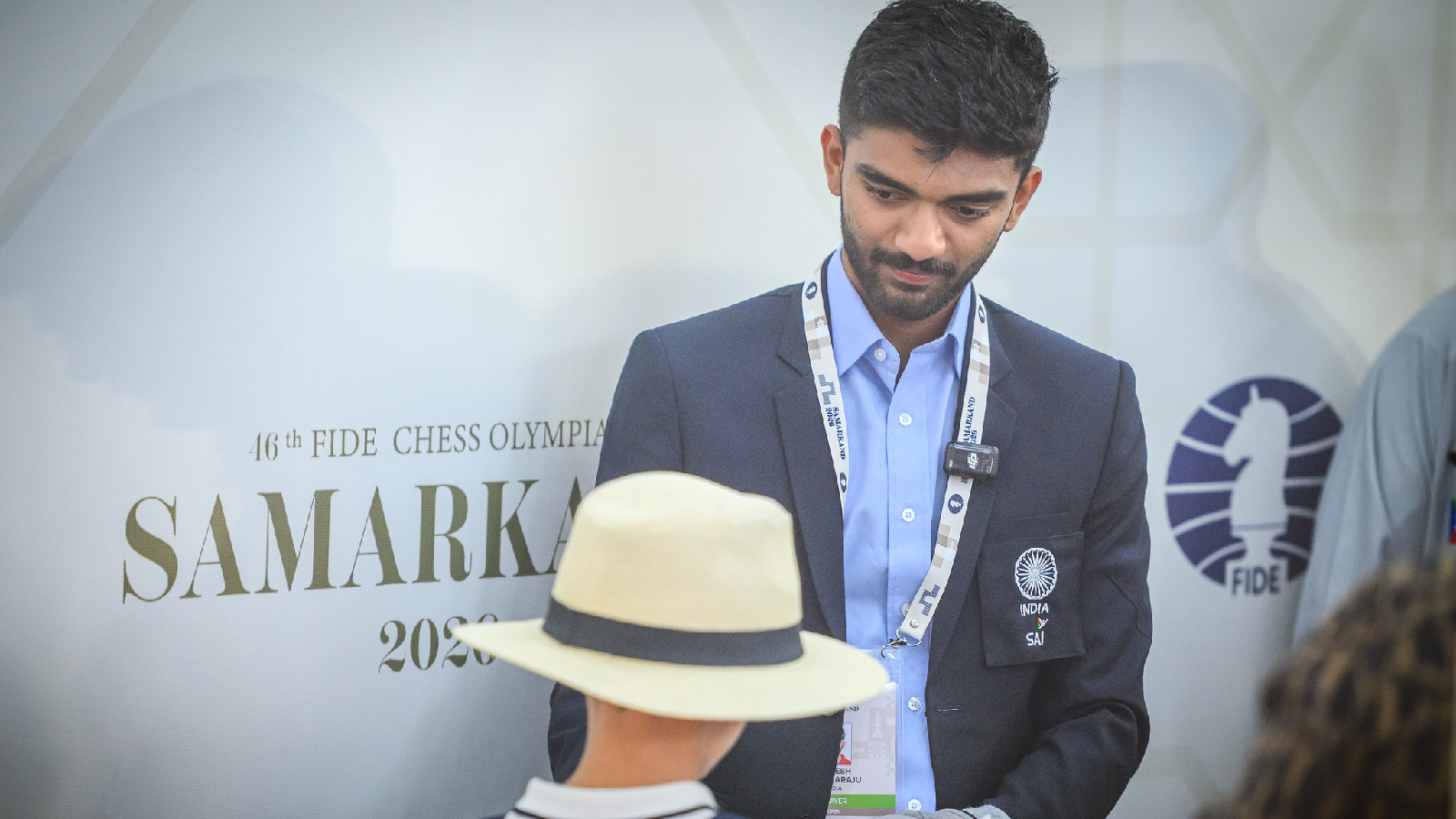
Samarkand, Uzbekistan – September 18, 2026 – The world of chess witnessed an extraordinary display of humility and strategic brilliance as India’s reigning World Champion, Gukesh Dommaraju, stepped onto board four for his nation at the prestigious Chess Olympiad in Samarkand. This surprising decision, initially met with raised eyebrows across the global chess community, has been revealed by Gukesh himself as a calculated, collective strategy designed to maximize India’s chances for gold. His powerful third-round victory over Italian Grandmaster Sabino Brunello with the black pieces underscored not only his enduring class but also the profound team spirit pulsating within the Indian contingent.
The announcement of the Indian team’s board order – with Rameshbabu Praggnanandhaa, Arjun Erigaisi, and Nihal Sarin positioned ahead of the youngest ever World Champion – had ignited widespread speculation. Observers questioned whether Gukesh’s recent "barren, trophy-less stretch" of 19 months, since claiming the world title at just 18, had led to a perceived dip in form or a lack of faith from the team management. However, Gukesh’s candid explanation following his impressive win has rewritten the narrative, painting a picture of selfless dedication to the national cause.
"It was my idea. The whole team… we all thought the same thing: that this is the board order that gives us the best chance of winning the tournament," Gukesh stated simply in an interview with FIDE. His words resonated with a profound sense of purpose. "It’s pretty clear that Pragg and Arjun have been in really good shape. And about the world champion playing on board four, if the team needs it I would even rest all the games. We are here playing for India and there’s no player that’s bigger than the country. I’m just happy to do whatever it takes for the team to do well."
This declaration, coming from a player who sits atop the chess world, instantly transformed initial skepticism into admiration. It highlighted a maturity beyond his years and a deep understanding of team dynamics, prioritizing collective glory over individual prestige. As India decisively defeated Italy 3-1 in the third round, powered by Gukesh’s crucial point and a win from Nihal Sarin, the wisdom of this unconventional strategy began to unfold.
A Chronology of Strategic Shifts and Stellar Performances
The journey to this pivotal moment at the Samarkand Chess Olympiad is a tapestry woven with personal triumphs, recent challenges, and a bold strategic gambit.
Pre-Olympiad Buzz: India’s Young Vanguard and Gukesh’s Reign
India arrived in Samarkand as one of the top contenders, boasting an enviable pool of young Grandmasters who have rapidly ascended the global ranks. The names Gukesh, Praggnanandhaa, Erigaisi, and Sarin represent a golden generation, often dubbed the "Indian Chess Renaissance." Two years prior, in Budapest, the Indian team had clinched a historic gold medal, losing only once in 44 contests across four boards, a testament to their collective strength and depth. That victory had set a high bar and fueled expectations for Samarkand.
Gukesh D, specifically, had captivated the world by becoming the youngest-ever World Champion at 18. His meteoric rise was marked by fearless play, tactical brilliance, and an unwavering drive. However, the 19 months following his championship win had seen him grapple with the immense pressure and heightened scrutiny that comes with the title. While still performing at an elite level, a "barren, trophy-less stretch" had led to discussions about his form, creating a backdrop of anticipation for his performance at the Olympiad.
The announcement of the board order for the Indian team, with Gukesh on board four, was a strategic curveball that caught many by surprise. Traditionally, the highest-rated or most in-form player occupies board one, facing the toughest opposition. Placing the World Champion on board four, beneath three other prodigies, was an audacious move that immediately sparked debate among pundits and fans alike. Was it a demotion, a tactical maneuver, or a sign of Gukesh’s own acknowledgment of his recent struggles? The answers would soon emerge from the champion himself.
Overcoming Early Hurdles: Travel Woes and Round Two’s Setback
The Indian contingent’s arrival in Samarkand was not without its tribulations. Gukesh explained that "a very hectic travel" schedule was compounded by "organizational issues" on the first day of the tournament. These logistical challenges led to a significant six-hour delay in securing rooms for the players, impacting their rest and preparation. "The first day was a bit tricky for all of us," Gukesh recounted. "Arjun got a room late. We all waited for six hours to get a room. So obviously in the first round, Arjun was just tired and he blundered in the end." This unfortunate incident, where Arjun Erigaisi suffered a loss, meant India had already matched their solitary defeat from their gold-winning campaign in Budapest, highlighting the immediate impact of the travel fatigue.
Round two brought its own set of challenges for Gukesh. Playing with the black pieces, he was held to a draw, a result that, while not catastrophic, carried a significant statistical implication. For the first time in many years, Gukesh slipped below the coveted 2700-rating threshold in the live ratings. The 2700 mark is widely regarded as the unofficial benchmark for elite Grandmasters, distinguishing the very top tier of players. While live ratings fluctuate rapidly, dropping below this psychological barrier could have been disheartening for a lesser player. However, Gukesh remained stoic. "I wouldn’t really consider yesterday’s result a disappointment. It was just a very good game by both sides. And my opponent defended well, sometimes you can’t do anything." This philosophical approach underscored his resilience.
Round Three’s Resurgence: A Statement Victory
The third round proved to be a turning point, not just for Gukesh, but for the team’s narrative. Facing Italian Grandmaster Sabino Brunello, Gukesh delivered an "imperious display of chess with the black pieces." Brunello, an experienced and formidable opponent, found himself outmaneuvered by Gukesh’s precise and confident play. "Today, I did nothing special. I had black pieces again, so I just wanted to play a good game. Luckily my opponent was a bit too creative and I took over," Gukesh humbly remarked, downplaying his masterful performance. His victory was a crucial point in India’s 3-1 win over Italy. Praggnanandhaa and Arjun Erigaisi both played out draws, while Nihal Sarin secured another win, demonstrating the depth and balanced strength of the Indian lineup.
Meanwhile, the Indian women’s team continued their own dominant run. Vantika Agrawal (board 3) and Savitha Shri (board 4) both claimed their third consecutive wins, showcasing impeccable form. Koneru Humpy, the seasoned veteran on the top board, secured a win, while Divya Deshmukh was held to a draw on board 2. The women’s team’s consistent performance further solidified India’s overall strong position in the tournament.
Supporting Data: The Nuances of Ratings, Form, and Board Order
The Significance of the 2700 Elo Rating
The Elo rating system is the bedrock of competitive chess, providing a numerical measure of a player’s skill relative to others. Crossing the 2700 Elo barrier is a monumental achievement, signifying entry into an exclusive club of super-Grandmasters. Falling below it, even temporarily in live ratings, can be a psychological blow for players accustomed to being at the pinnacle. For Gukesh, whose rating had soared past 2750 at his peak, this dip was a rare occurrence, drawing attention to his recent results. However, elite players understand the volatile nature of ratings and often prioritize performance and victory over short-term numerical fluctuations, especially in team events. Gukesh’s ability to brush off the rating dip and focus on his game in Round 3 demonstrated his mental fortitude.
India’s Deep Talent Pool: A Strategic Advantage
The decision to place Gukesh on board four is unthinkable for most national teams, where a World Champion would invariably occupy the top board. However, India’s current chess landscape is unique. The nation boasts an unprecedented number of young, world-class Grandmasters. Praggnanandhaa, Erigaisi, and Sarin are all top-tier talents, capable of challenging any player in the world. Praggnanandhaa, in particular, has been in exceptional form, making deep runs in major tournaments and consistently holding his own against the elite. Arjun Erigaisi, known for his aggressive and dynamic style, also possesses the firepower to contend on the top boards. Nihal Sarin, another prodigy, has proven his mettle with consistent performances.
This depth allows India the luxury of unconventional strategic choices. By placing Gukesh on board four, the team aims to:
- Maximize Board Strength: Ensure that every board has a strong, in-form player who can deliver points. If Pragg and Arjun are indeed in "really good shape," as Gukesh stated, deploying them on higher boards against potentially stronger opponents makes tactical sense.
- Psychological Edge: A World Champion on board four can be a devastating weapon against opponents who might underestimate the "lower" boards. It creates a formidable lineup from top to bottom, putting immense pressure on opposing teams.
- Pressure Management: It potentially alleviates some of the immense pressure on Gukesh, allowing him to play with slightly less scrutiny on a "lower" board while still contributing crucial points. This could be particularly beneficial during a period where he acknowledges a "barren spell."
The Chess Olympiad: A Team Battle
The Chess Olympiad is a biennial team event where national teams compete across four boards. Unlike individual tournaments, the focus is entirely on the collective score. A team’s overall performance, not individual board performance, dictates success. This format inherently encourages strategic board ordering, where captains consider individual player form, opponent matchups, and psychological factors to construct the most effective lineup. Gukesh’s decision underscores this team-first philosophy, a hallmark of successful Olympiad campaigns. India’s 2024 gold medal was a result of such collective strength and strategic cohesion.

Official Responses and Expert Commentary
Gukesh’s Unambiguous Stance
Gukesh’s quotes provided the definitive "official response" to the board order controversy. His words, "It was my idea. The whole team… we all thought the same thing: that this is the board order that gives us the best chance of winning the tournament," directly addressed the speculation. He unequivocally stated his willingness to sacrifice personal glory for team success: "There’s no player that’s bigger than the country. I’m just happy to do whatever it takes for the team to do well." This statement was not just a diplomatic answer; it conveyed genuine conviction and a deep sense of national pride.
Captain Srinath Narayanan’s Endorsement (Implied)
While Captain Srinath Narayanan was not quoted directly in the original report regarding the specific board order, Gukesh’s assertion that "The whole team… we all thought the same thing" clearly indicates that the captain and the team management were fully on board with this strategy. A decision of this magnitude, involving the reigning World Champion, would undoubtedly require the full consensus and backing of the team leadership. The fact that Gukesh articulated it as a collective decision, rather than an order from above, speaks volumes about the collaborative spirit within the Indian camp.
Initial Punditry and Shifting Narratives
Prior to Gukesh’s clarification, chess pundits and commentators were largely divided. Some expressed surprise and concern, interpreting the move as a sign of Gukesh’s struggling form or a perceived lack of confidence from the team. Others, however, speculated on the tactical brilliance behind such a move, recognizing India’s exceptional depth. Once Gukesh’s explanation emerged, the narrative shifted dramatically. Experts lauded his selflessness and maturity, seeing it as a powerful statement of leadership and team commitment. Grandmasters and coaches worldwide recognized the strategic genius of having a player of Gukesh’s caliber on a "lower" board, effectively creating a "super team" where every board is a potential winning one.
Implications: A Blueprint for Team Success and a Legacy of Selflessness
Gukesh D’s decision to play on board four carries profound implications, both for the immediate success of the Indian team at the Samarkand Olympiad and for his long-term legacy within the world of chess.
Reinforcing Team Dynamics and Morale
This bold move sends an unequivocal message to the entire Indian contingent: individual accolades are secondary to collective glory. For the younger players like Praggnanandhaa, Erigaisi, and Sarin, it’s an immense vote of confidence, elevating them to higher board positions against formidable opponents. For Gukesh himself, it could be a psychologically liberating experience, allowing him to contribute without the singular burden of carrying the team on the top board. The collective ownership of the strategy, as articulated by Gukesh, is a powerful unifying force, fostering an environment of mutual respect and shared purpose. This robust team spirit, vital in long, arduous tournaments like the Olympiad, could be India’s secret weapon.
A Strategic Masterstroke for Medal Hopes
From a purely strategic standpoint, deploying the World Champion on board four could prove to be a masterstroke. It creates an intimidating lineup where opponents cannot afford to relax on any board. Teams often focus their strongest players on the top boards, but facing a Gukesh on board four means every game is a potential minefield. This balanced strength across all boards could lead to a higher overall match score for India, significantly boosting their chances of clinching another gold medal. The flexibility and adaptability demonstrated by the Indian team, willingness to deviate from traditional norms, showcases their innovative approach to competition.
Gukesh’s Evolving Legacy: Champion and Team Player
Beyond the immediate tournament, Gukesh’s gesture is set to define a significant aspect of his legacy. Already celebrated as the youngest World Champion, he is now adding another dimension to his persona: that of a selfless leader and ultimate team player. In an individual-centric sport like chess, such an act of humility and dedication to the national flag is rare and deeply resonant. It solidifies his status not just as a prodigious talent but as a role model, inspiring future generations of chess players to prioritize sportsmanship and national pride. This decision could be a turning point, not in his form, but in how he approaches his career, integrating individual brilliance with a profound sense of collective responsibility.
A Stronger Indian Chess Future
This incident further underscores India’s unparalleled rise as a global chess superpower. The ability to field such a strong, deep, and flexible team, capable of making such unconventional yet effective strategic decisions, speaks volumes about the talent pipeline and the supportive ecosystem within Indian chess. The message is clear: India is not just producing individual champions; it is building a formidable national team that is poised to dominate the international stage for years to come. The "bad form" Gukesh mentioned could simply be a temporary lull, and this team-first approach might be exactly what he needs to rediscover his sharpest edge, unburdened by singular pressure, and contribute to a glorious Indian triumph. The initial travel hiccups and the early loss for Arjun have been overcome, and the team spirit, as Gukesh confirmed, remains "high." The stage is set for India to make a powerful statement at the Samarkand Chess Olympiad.
