

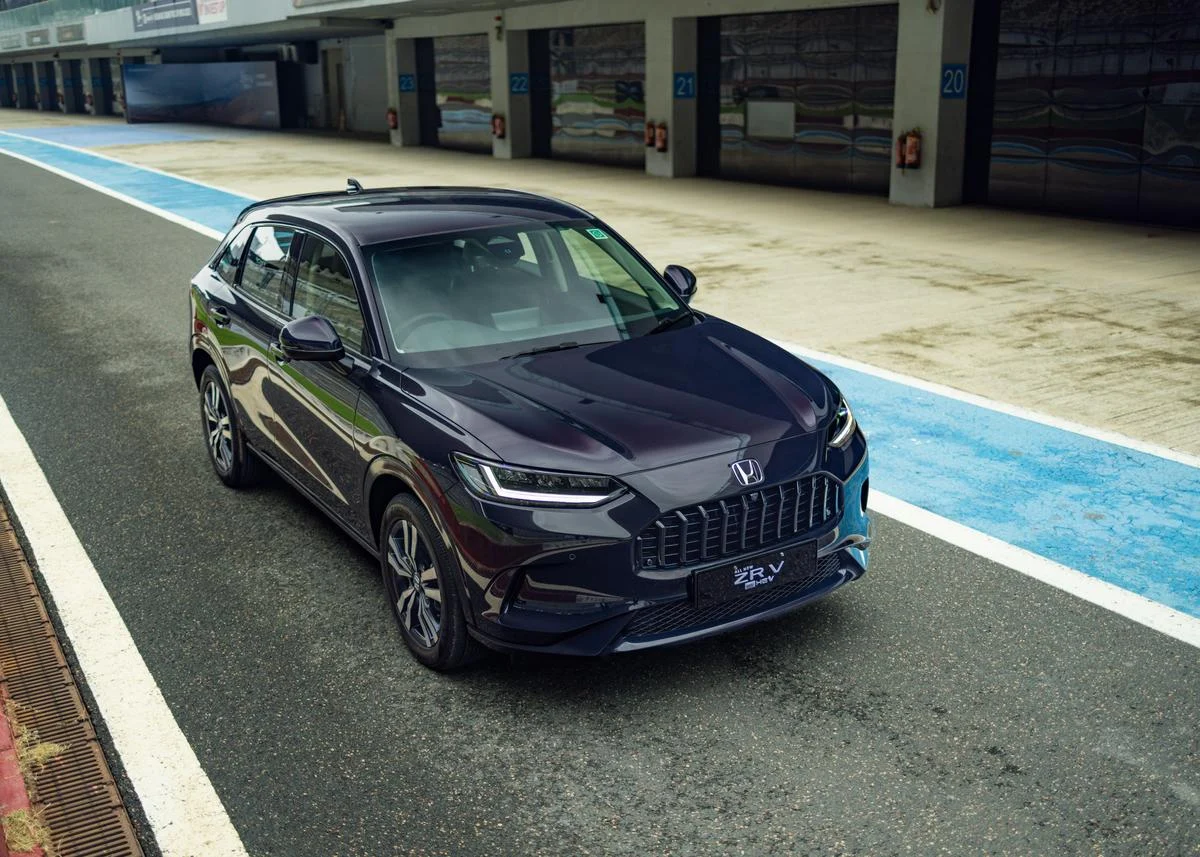
The Indian automotive landscape is currently embroiled in what industry analysts call a "battle of excess." In the premium SUV segment, the prevailing strategy among manufacturers has been one of maximalism: larger-than-life grilles, sprawling panoramic displays that span the dashboard, and an almost frantic race to include every possible electronic gimmick. However, Honda, a brand synonymous with engineering-led philosophy, has chosen a radically different trajectory with the introduction of the ZR-V.
The Honda ZR-V does not shout; it speaks with the quiet confidence of mechanical integrity. While competitors vie for attention with aggressive styling and marketing-led feature lists, the ZR-V focuses on the "fundamentals"—the tactile quality of a switch, the precision of a steering rack, and the seamless transition of a sophisticated hybrid powertrain. As it enters the Indian market as a Completely Built Unit (CBU), it challenges the notion that value in a luxury vehicle is measured solely by the length of its spec sheet.
Main Facts: The ZR-V Proposition
The Honda ZR-V arrives in India with a price tag of ₹47.99 lakh (ex-showroom). At this price point, it occupies a unique and somewhat precarious niche. It is a five-seater SUV imported directly from global production hubs, which subjects it to the country’s significant import duties. Consequently, on a pure "feature-per-rupee" basis, it faces stiff competition from both locally assembled European rivals and feature-rich domestic flagships.
Key Specifications at a Glance:
- Powertrain: 2.0-litre Atkinson-cycle petrol engine paired with Honda’s i-MMD (intelligent Multi-Mode Drive) strong hybrid system.
- Performance: A combined output of 181 bhp and 315 Nm of peak torque.
- Transmission: e-CVT (Electric Continuous Variable Transmission).
- Efficiency: A claimed ARAI-equivalent of 22 kmpl, with real-world estimates hovering around 17-18 kmpl.
- Safety: 8 airbags as standard, Euro NCAP 4-star rating, and a comprehensive suite of Advanced Driver Assistance Systems (ADAS).
- Price: ₹47.99 Lakh (Ex-showroom).
The ZR-V’s primary challenge lies in its configuration. In a market where buyers at the ₹50-lakh mark often expect seven seats or All-Wheel Drive (AWD), the ZR-V offers neither. Instead, Honda is betting on a demographic of "rational enthusiasts"—buyers who value the longevity of a well-engineered machine over the fleeting novelty of digital interfaces.

Chronology: From Global Success to the Buddh International Circuit
The ZR-V (known as the HR-V in North American markets) was designed to bridge the gap between the compact HR-V/Elevate and the larger CR-V. Its development focused on a "Civic-like" driving experience in an SUV body style.
The Indian introduction of the ZR-V was marked by an unconventional choice of venue for a family hybrid: the Buddh International Circuit (BIC). Typically, media drives for hybrids are confined to city traffic to showcase fuel economy. By placing the ZR-V on India’s only Formula 1 track, Honda sent a clear message regarding the vehicle’s structural rigidity and chassis tuning.
During high-speed testing on the back straight of the BIC, the ZR-V demonstrated a level of composure rarely seen in the segment. It reached an indicated 150 km/h with a "planted" feel, devoid of the vertical oscillations or steering vagueness that often plague high-riding SUVs. The chronology of the drive moved from high-speed stability tests to a technical slalom course, where the vehicle’s ability to manage weight transfer at 80 km/h highlighted its sophisticated suspension geometry.
Supporting Data: Engineering Excellence and the Hybrid Heart
The centerpiece of the ZR-V is undoubtedly the latest generation of Honda’s e:HEV strong hybrid system. To understand why this vehicle commands a premium, one must look at the data behind its operation.

The e:HEV Architecture
Unlike "mild hybrids" that use a small motor to assist the engine, or "parallel hybrids" where the engine and motor work together most of the time, Honda’s system operates primarily as an electric vehicle in urban settings.
- EV Drive Mode: At low speeds, the lithium-ion battery powers the propulsion motor, which drives the wheels directly.
- Hybrid Drive Mode: When more power is required, the 2.0-litre engine acts as a generator, supplying electricity to the motor rather than driving the wheels.
- Engine Drive Mode: At sustained highway speeds (the most efficient zone for a petrol engine), a lock-up clutch connects the engine directly to the front wheels.
This "Series-Parallel" approach results in a 0-100 km/h sprint of just 7.9 seconds. More impressively, the torque delivery of 315 Nm is available almost instantly, mimicking the "shove" associated with pure electric vehicles.
Thoughtful Design Metrics
The ZR-V’s engineering is further evidenced by "micro-innovations" that improve daily usability:
- Wiper Integration: The windscreen washer jets are integrated into the wiper arms. Data shows this reduces fluid waste by 25% and ensures zero "blind spots" during the cleaning cycle, a critical safety factor during monsoon driving.
- Tailgate Logic: The powered tailgate features a "Walk Away Close" delay. Rather than closing immediately and forcing the user to scramble, the system uses proximity sensors to wait until the key-holder has stepped a safe distance away.
- Visibility Indices: By thinning the A-pillars and mounting the side mirrors on the door skins rather than the window corners, Honda has achieved a class-leading field of vision, reducing blind spots in tight Indian traffic.
Official Responses and Manufacturer Philosophy
While Honda India has remained cautious about volume projections for the ZR-V, their official stance emphasizes "Brand Elevation." In discussions surrounding the vehicle’s positioning, the focus has consistently been on the "Total Cost of Ownership" (TCO) and "Ownership Experience."

A spokesperson for the brand noted that the ZR-V is intended for the "discerning customer who has likely owned luxury sedans in the past and is now looking for the reliability of a Japanese brand without sacrificing the driving dynamics they are accustomed to."
Honda’s philosophy with the ZR-V also addresses the "longevity gap." While many modern SUVs are designed with a five-year lifecycle in mind (after which the electronics often become obsolete or glitchy), the ZR-V is built on a platform designed for a decade of heavy use. The use of high-tensile steel in the chassis and the refinement of the interior materials suggest a cabin that will remain rattle-free long after its competitors have begun to show their age.
Implications: A Niche Future in a Mass-Market World
The arrival of the ZR-V has significant implications for the Indian premium SUV segment.
1. The "Quality over Quantity" Litmus Test
The ZR-V serves as a test case for whether Indian buyers are ready to pay a premium for "invisible" quality. It lacks the ventilated seats, panoramic sunroof, and massive 12-inch screens that are standard on vehicles half its price. If the ZR-V finds success, it could encourage other manufacturers to invest more in mechanical engineering and safety rather than just digital features.

2. The Hybrid vs. EV Debate
At nearly ₹48 lakh, the ZR-V competes directly with several entry-level Luxury EVs. However, the ZR-V offers a "no-compromise" solution for those who want the environmental benefits and torque of an electric motor without the range anxiety associated with India’s nascent charging infrastructure. Its 22 kmpl efficiency makes it one of the most eco-friendly ways to cover long distances across the subcontinent.
3. Honda’s Brand Perception
For years, Honda in India was perceived as a brand that had lost its "premium" edge, focusing instead on budget-conscious models like the Amaze. The ZR-V, alongside the City Hybrid, re-establishes Honda as a leader in sophisticated powertrain technology. It acts as a "halo" product that brings prestige back to the "H" badge.
Conclusion: The Rational Choice
The Honda ZR-V is a reminder that a car is, first and foremost, a piece of machinery. In its pursuit of excellence, Honda has neglected some of the "theatre" that modern buyers have come to expect. The 9-inch infotainment system feels modest, and the lack of seat ventilation is a genuine oversight in the Indian climate.
However, these omissions fade into the background once the vehicle is in motion. The ZR-V offers a level of refinement, a sense of solidity, and a brilliance of powertrain integration that is rare at any price point. It is not a vehicle for the buyer who wants to impress their neighbors with a light show or a giant screen. It is a vehicle for the driver who wants to feel a sense of satisfaction every time they take a corner or merge onto a highway.

Viewed through the lens of a three-year lease, the ZR-V might seem expensive. But viewed through the lens of a ten-year partnership, it emerges as one of the most sensible, well-rounded, and genuinely enjoyable premium SUVs on the market today. For those who value substance over spectacle, the Honda ZR-V is not just a car; it is a statement of intent.
Data and insights provided in association with Motorscribes and The Hindu. For further automotive updates, follow @motorscribes.
