

In the high-stakes arena of the Indian automotive market, the sub-four-meter compact sedan segment remains one of the most contested battlegrounds. While SUVs have dominated the headlines, the demand for practical, fuel-efficient, and feature-rich sedans continues to hold a significant share of the market. Tata Motors, a pioneer in this segment since the days of the Indigo eCS, is now reportedly preparing for a seismic shift in its strategy.
According to recent trademark filings and leaked design patents, Tata Motors is set to retire the "Tigor" nameplate in favor of a fresh identity: the Tata Aeris. This move, scheduled for an official unveiling on September 25th, represents more than just a cosmetic facelift; it is a comprehensive repositioning of Tata’s sedan portfolio designed to challenge the long-standing dominance of the Maruti Suzuki Dzire.
Main Facts: A Strategic Rebranding and Design Overhaul
The core of this development lies in a recent trademark application for the name "TATA AERIS" under the classification for land vehicles and parts. While manufacturers often trademark names for future use, the timing coincides perfectly with the advanced testing phase of the Tigor’s successor.
A New Aesthetic Identity
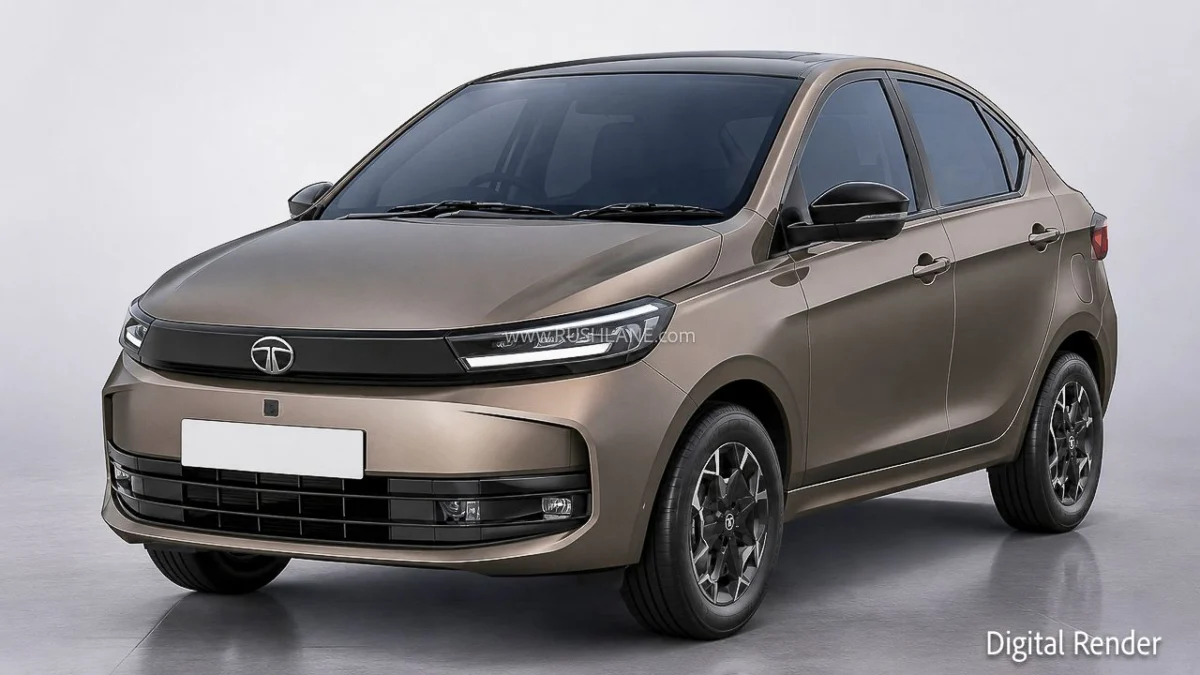
Design patent images that surfaced earlier this year suggest a radical departure from the current Tigor’s "Impact 2.0" design language. The upcoming Aeris is expected to feature:

- A Sharper Front Fascia: Slimmer, more aggressive LED headlamp units integrated into a glossy black connecting element.
- Enhanced Aerodynamics: A more upright front end with a revised bumper that incorporates vertical and horizontal detailing, aimed at giving the car a wider, more planted stance.
- Modernized Rear Styling: Revised LED tail lamps and a reworked rear bumper to complete the "AERIS" persona.
- Premium Detailing: New alloy wheel designs that move away from the current 14- and 15-inch options toward more intricate, premium patterns.
Technological Integration
Inside the cabin, the Aeris is expected to bridge the gap between the budget segment and the premium hatchback category. Taking cues from the recently updated Tiago, the Aeris will likely boast a 10.25-inch high-definition touchscreen infotainment system, a fully digital instrument cluster, and a revised steering wheel. Features such as wireless Android Auto, Apple CarPlay, and a 360-degree camera system are anticipated to be the highlights of the top-tier trims.
Chronology: From Indigo to Aeris
To understand the significance of the Aeris, one must look at the lineage of Tata’s compact sedans.
- The Pioneer Era (2008–2014): Tata Motors essentially invented the sub-four-meter sedan segment with the Indigo eCS. By shortening the trunk to fit within 4,000mm, Tata took advantage of lower excise duties, offering a "big car" feel at a "small car" price.
- The Zest Transition (2014–2017): As competition from the Maruti Dzire and Honda Amaze intensified, Tata launched the Zest. While it was a significant leap forward in quality and design, it struggled to shed the "taxi" image associated with the Indigo.
- The Birth of Tigor (2017–2024): Tata introduced the Tigor with its unique "Styleback" silhouette. It was lauded for its safety (4-star GNCAP rating) and design but consistently lagged behind in sales volume.
- The Aeris Pivot (2025–Present): With the Tigor’s sales stagnating at approximately 1,000 units per month, Tata leadership recognized the need for a "clean slate" approach. The Aeris is the culmination of this strategy—a vehicle that retains the safety and platform strengths of the Tigor but introduces a premium, tech-heavy identity to attract private buyers.
Supporting Data: The Sales Gap and Competitive Landscape
The decision to rebrand the Tigor as the Aeris is driven by cold, hard data. Despite Tata Motors’ overall success in the SUV segment (with the Nexon and Punch frequently topping charts), their sedan sales have remained a weak point.
Comparative Sales Figures (Average Monthly Volume)
- Maruti Suzuki Dzire: 18,000 – 20,000 units
- Hyundai Aura: 6,000 – 7,000 units
- Honda Amaze: 3,500 – 4,500 units
- Tata Tigor: 1,000 – 1,200 units
The data reveals a stark reality: the Tigor currently captures less than 5% of the segment’s volume. By introducing the Aeris, Tata aims to disrupt the status quo. The goal is to move the needle from 1,000 units toward the 4,000–5,000 range, effectively rivaling the Hyundai Aura and the Honda Amaze.

Powertrain Specifications
The Aeris will likely retain the proven 1.2-litre Revotron three-cylinder engine, but with refinements for better NVH (Noise, Vibration, and Harshness) levels.
- Petrol Mode: 86 PS power and 113 Nm torque.
- CNG Mode: 75.5 PS and 96.5 Nm torque.
- Transmission: 5-speed manual and a 5-speed AMT (Automated Manual Transmission).
Crucially, the Aeris will continue Tata’s "twin-cylinder" CNG technology, which preserves usable boot space—a major pain point for sedan buyers opting for alternative fuels.
Official Context and Industry Response
While Tata Motors has not officially commented on the "Aeris" name change, the company’s recent history of rebranding provides a template. The "Gravitas" was renamed the "Safari" shortly before launch to leverage brand heritage, and the "HBX" concept became the "Punch."
Industry analysts suggest that Tata is moving toward a more evocative naming convention. Names like "Nexon," "Harrier," and "Safari" evoke a sense of adventure and modernity. "Tigor," while distinct, perhaps lacked the premium resonance required to compete with the sophisticated branding of the Hyundai Aura or the upcoming next-generation Maruti Dzire.

A spokesperson for the brand previously emphasized that Tata’s "New Forever" philosophy involves constant iteration. "We are committed to listening to our customers. If a segment requires a fresh perspective, we are not afraid to evolve our products and their identities to meet those aspirations," the company noted during a general product briefing earlier this year.
Implications: A New Era for Tata Sedans?
The launch of the Tata Aeris on September 25th carries several significant implications for the manufacturer and the market at large.
1. The Premiumization of the Entry-Level Sedan
By incorporating features like a 360-degree camera, six airbags as standard, and a 10.25-inch screen, Tata is signaling that the Aeris is not a "budget" car. This reflects a broader trend in the Indian market where buyers are willing to pay a premium for safety and technology, even in smaller vehicle segments.
2. The EV Factor (Aeris.ev)
Tata Motors currently dominates the electric vehicle market in India. The Tigor EV has been a steady performer, particularly in the fleet and entry-level private EV space. The transition to "Aeris.ev" will allow Tata to align its sedan EV with the more modern design language of the Punch.ev and Nexon.ev, potentially featuring an improved range and faster charging capabilities.

3. Challenging the Dzire’s Hegemony
The Maruti Suzuki Dzire is also due for a generation change. By launching the Aeris now, Tata is attempting to steal the spotlight and offer a more "SUV-like" tech suite in a sedan body style before Maruti releases its updated bestseller. If the Aeris can successfully market its 4- or 5-star safety potential alongside these features, it could finally bridge the trust gap with family buyers who have traditionally defaulted to Maruti or Hyundai.
4. Fleet vs. Private Distinction
One of the Tigor’s biggest hurdles was its popularity in the commercial fleet segment (as the XPRES-T). By rebranding the private version as the Aeris, Tata can effectively decouple the two identities. The Tigor name could potentially continue for fleet sales, while the Aeris becomes the exclusive badge for private, aspirational ownership.
Conclusion
The transition from Tigor to Aeris is a calculated gamble by Tata Motors. It acknowledges that in the modern automotive landscape, a product’s name and "vibe" are just as important as its engine specifications. With a launch date set for late September, the automotive industry is watching closely. If the Aeris can deliver on the promise of its leaked patents—combining striking aesthetics with class-leading technology and Tata’s signature safety—it may well be the vehicle that finally restores Tata Motors to a position of strength in the sedan segment.
The Aeris isn’t just a new name; it’s Tata’s declaration that the compact sedan is far from dead—it just needed a reason to be exciting again.
