

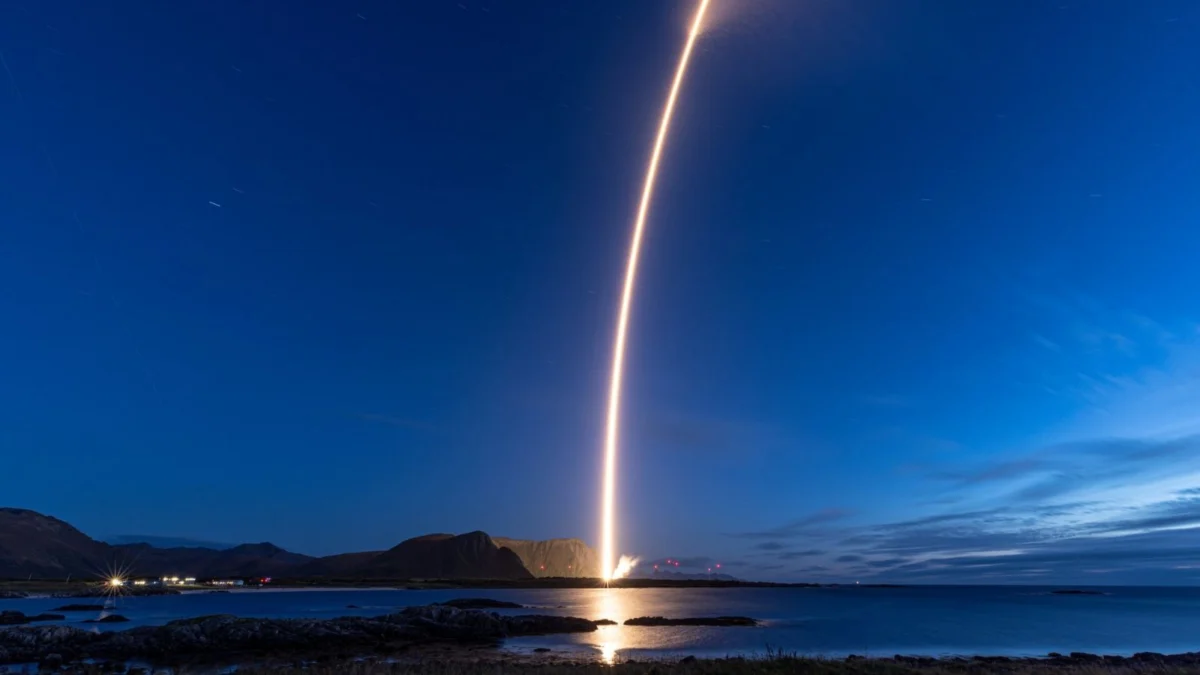
ANDØYA, NORWAY – In the late hours of September 5, 2026, the silence of the Arctic Circle was shattered by the roar of the Spectrum rocket, a sound that signaled more than just a successful engine ignition. As the two-stage vehicle ascended from the Andøya Space Centre, it carried with it the aspirations of a continent. When Isar Aerospace’s Spectrum rocket successfully reached its target orbit minutes later, it officially became the first private rocket to achieve orbit from Western European soil, marking a transformative milestone for the global space economy and a pivotal moment for European strategic autonomy.
The mission, aptly titled "Onward and Upward," represents the culmination of years of rigorous engineering, several high-profile setbacks, and a significant shift in how Europe approaches the cosmos. By successfully deploying five CubeSats and a scientific experiment into an elliptical orbit, Isar Aerospace has not only validated its technology but has also positioned Germany and Norway as central players in the "New Space" race.
The Main Facts: A Midnight Triumph in the Arctic
The launch took place at 10:12 PM local time under the shimmering skies of northern Norway. The Spectrum rocket, a 28-meter-tall marvel of German engineering, performed a flawless ascent. Approximately seven minutes after liftoff, the rocket’s upper stage reached its initial elliptical orbit.
Following the initial ascent, the mission entered a critical phase: the circularization burn. This maneuver, conducted by the upper stage, was necessary to transition the payloads from an elliptical path (with a perigee of 180 kilometers and an apogee of 500 kilometers) into a stable, circular orbit suitable for satellite operations. Two hours after the initial launch, Isar Aerospace confirmed that the maneuver was successful and all five CubeSats had been deployed as planned.
The success of the Spectrum rocket is particularly notable for its geographical significance. While Russia has long utilized the Plesetsk Cosmodrome—which sits on the European continent—that facility remains under Russian sovereign control. Previous attempts to launch into orbit from the United Kingdom and other Western European sites had met with failure or technical stagnation. Thus, Isar Aerospace has effectively opened a new gateway to space, providing Europe with a domestic launch capability that does not rely on French Guiana or foreign providers.
Chronology: The Arduous Path to Orbit
The road to the September 5 success was paved with technical challenges and the "trial-by-fire" reality of aerospace development. To understand the magnitude of this achievement, one must look back at the timeline of the Spectrum program.
The Failure of "Going Full Spectrum" (March 2025)
In March 2025, Isar Aerospace attempted its maiden flight from the same Andøya facility. The mission, titled "Going Full Spectrum," ended in disaster just 30 seconds after liftoff. The rocket suffered a catastrophic anomaly and crashed into the Norwegian Sea.
A subsequent months-long investigation revealed a complex chain of events: an unintended opening of a vent valve led to a loss of pressure, which in turn caused a loss of attitude control during a critical roll maneuver. The failure was a sobering reminder of the "Space is Hard" mantra that governs the industry.
The Year of Delays (January – August 2026)
Determined to learn from the failure, Isar spent the remainder of 2025 and early 2026 redesigning critical fluid systems and flight software. However, the second attempt, "Onward and Upward," faced a gauntlet of delays:
- January 2026: A faulty pressurization valve forced a scrub during the final countdown.
- March 2026: Heavy Arctic storms and the intrusion of a private vessel into the offshore "keep-out zone" halted two separate launch windows.
- April 9, 2026: A leak was detected in a composite overwrapped pressure vessel (COPV), necessitating a return to the hangar for repairs.
- June 15, 2026: "Off-nominal behavior" in the vehicle’s fluid systems during a wet dress rehearsal led to another stand-down.
These setbacks led many industry skeptics to wonder if a private European firm could truly compete with the likes of SpaceX or Rocket Lab. However, the Isar team utilized each delay to further refine the vehicle’s reliability.
Supporting Data: Engineering the Spectrum Rocket
The Spectrum rocket is designed specifically to address the burgeoning small-to-medium satellite market. As the world moves away from massive, multi-ton geostationary satellites toward constellations of smaller, agile spacecraft, the demand for "taxi" services to space has skyrocketed.
Technical Specifications
- Height: 28 meters (92 feet).
- Stages: Two-stage liquid-fueled rocket.
- Payload Capacity: 1,000 kilograms (1 metric ton) to Low Earth Orbit (LEO).
- Propulsion: The rocket utilizes Isar’s proprietary engine technology, optimized for cost-efficiency and high-cadence production.
- Manufacturing: Isar has established a state-of-the-art manufacturing hub near Munich, Germany. The facility is designed for mass production, with the capacity to churn out more than 30 Spectrum rockets per year.
The Andøya Advantage
The choice of Andøya, Norway, as a launch site is strategic. Located far north, the site is ideal for launching satellites into polar and Sun-synchronous orbits (SSO). These orbits are essential for Earth observation, climate monitoring, and telecommunications—sectors that currently drive the majority of commercial space demand.
The Payload Profile
Unlike the first flight, which carried dummy weights, Flight 2 carried operational hardware:
- Five CubeSats: These small satellites were provided by various commercial and research institutions, intended for data relay and atmospheric sensing.
- Scientific Experiment: A non-deployable experiment remained attached to the upper stage to study the long-term effects of the vacuum and radiation on specific composite materials.
Official Responses: "Making History for Europe"
The atmosphere at Isar Aerospace’s mission control was one of controlled tension followed by ecstatic relief. As the confirmation of payload deployment came through, the "Spectrum" chief engineer addressed the global audience via the company’s webcast.
"This is right now making history—making history for Spectrum, making history for Isar, and making history for Europe," he stated, visibly moved. "I’m incredibly proud of this massive achievement. We had some delays, obviously. We had some setbacks, but we came back stronger from them. This success validates the tremendous amount of engineering across all our teams. It is what brings us into orbit."
The European Space Agency (ESA), which has been a vocal proponent of fostering a competitive private space sector in Europe, also lauded the achievement. While ESA maintains its own heavy-lift Ariane program, officials have increasingly acknowledged that the "microlauncher" market is where private innovation can most effectively supplement state-led initiatives.
Industry analysts noted that this launch serves as a "proof of concept" for the German government’s aerospace strategy, which has sought to position Munich and the surrounding Bavarian region as the "Silicon Valley of Space."
Implications: A Strategic Shift in the Global Space Race
The success of Isar Aerospace has far-reaching implications that extend beyond a single successful flight. It touches upon geopolitics, economic competition, and the future of European defense.
1. Ending the "Launch Gap"
For the past several years, Europe has faced a "launch gap." With the retirement of the Ariane 5, delays in the Ariane 6, and the suspension of cooperation with Russia’s Soyuz program following the invasion of Ukraine, Europe was left with limited domestic options for reaching space. Isar Aerospace’s success provides a much-needed alternative, ensuring that European companies and governments can launch sensitive payloads without relying on non-European providers.
2. The Commercialization of Low Earth Orbit
The Spectrum rocket is priced competitively to challenge the dominance of North American launch providers. By offering a dedicated service for 1,000 kg payloads, Isar is targeting a "sweet spot" in the market. Many satellite operators prefer a dedicated small launcher over "ridesharing" on a larger SpaceX Falcon 9, as it allows them to choose their exact orbital destination and launch schedule.
3. Economic Revitalization through "New Space"
The ability to manufacture 30 rockets a year signals a shift toward industrial-scale spaceflight. This creates a robust supply chain in Germany and Norway, involving hundreds of sub-contractors and thousands of high-tech jobs. It proves that the "New Space" model—characterized by private investment, rapid prototyping, and cost-reduction—is viable in the European regulatory environment.
4. Setting a Precedent for Western Europe
The success at Andøya sets a high bar for other European sites, such as SaxaVord in the UK or the Esrange Space Center in Sweden. It proves that the logistical and regulatory hurdles of launching from the European mainland can be overcome.
Conclusion: The First Step of a Long Journey
As the Spectrum upper stage continues its silent journey around the Earth, the team at Isar Aerospace is already looking toward the future. The chief engineer’s closing remarks during the broadcast summarized the company’s ethos: "Flight 2 is a big, big milestone, a big success. But this is just the beginning. I’m really looking forward to the next steps."
With a backlog of commercial contracts and a manufacturing facility ready to scale, Isar Aerospace has moved from the category of "promising startup" to "proven orbital provider." For Europe, the successful launch on September 5, 2026, will likely be remembered as the moment the continent finally claimed its own independent seat at the table of the 21st-century space age. The "Onward and Upward" mission has concluded, but for the European commercial space industry, the real ascent has only just begun.
