

Samarkand, Uzbekistan – September 26, 2026, 11:30 PM IST
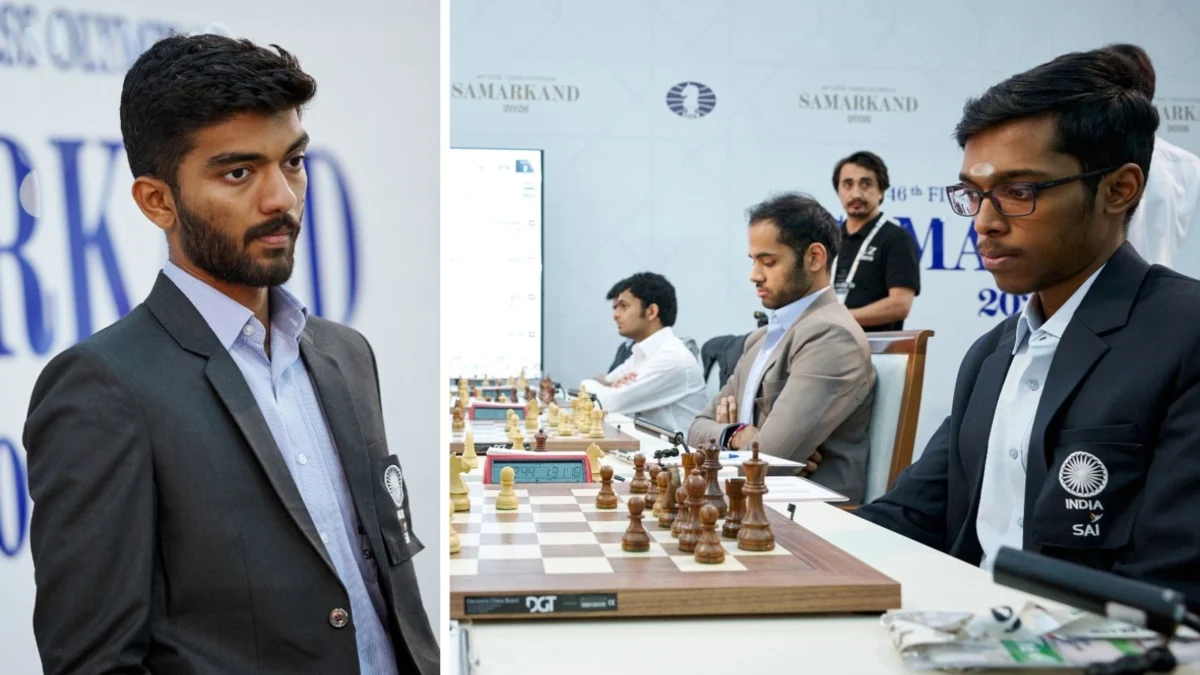
In a display of strategic brilliance and calculated aggression, the Indian chess team delivered a commanding 3.5-0.5 victory over Uzbekistan 2 in Round 10 of the 2026 Chess Olympiad held in the historic city of Samarkand. Clinical performances from Grandmasters R Praggnanandhaa, Nihal Sarin, and the reigning World Champion D Gukesh propelled India to consolidate their hold on sole second place, setting the stage for a nail-biting final round showdown against the host nation’s senior team.
While the win was decisive and crucial for India’s medal aspirations, a palpable undercurrent of concern persists regarding the inconsistent form of the top boards, an "uncomfortable thread" that has plagued both the Open and Women’s Indian teams throughout the tournament. Despite the overwhelming triumph, the gold medal remains tantalizingly out of India’s immediate control, with their fate intertwined with the performance of the leading Uzbek squad.
A Decisive Victory in Samarkand: Round 10 Chronology
The tenth round of the 47th Chess Olympiad witnessed India’s determined push to maintain its medal contention, facing the second-string side of the formidable Uzbek contingent. The atmosphere in the ancient city of Samarkand, a historical crossroad of cultures and intellect, was charged with anticipation as the Indian grandmasters took their places, fully aware of the stakes involved. The previous rounds had sculpted a tense narrative, with India consistently battling for a top-three finish, and this match against Uzbekistan B was seen as a critical stepping stone, a must-win encounter to keep pressure on the leaders. The team’s resolve was evident from the opening moves, reflecting a collective hunger for victory that resonated through the playing hall.
Early Momentum: Nihal Sarin’s Swift Strike
The first point for India came relatively swiftly, courtesy of the agile and precise play of Grandmaster Nihal Sarin. Playing on Board 3, Sarin showcased his tactical acumen and positional understanding, comfortably dispatching his opponent, Mukhammadzokhid Suyarov. From the outset, Sarin seized the initiative, applying steady pressure that gradually eroded Suyarov’s defenses. His opening play was characterized by confident development and a clear strategic plan, which he executed with remarkable efficiency. The game saw Sarin patiently build an advantage, converting a minor edge into a decisive material gain that left Suyarov with no viable path to resistance. This early win not only provided a vital lead for India but also injected a significant boost of confidence into the team, setting a positive tone for the remaining games. Sarin’s ability to secure a comfortable victory underscored his consistent performance throughout the Olympiad, proving to be a reliable scoring machine for the Indian squad.
Gukesh’s Unyielding Dominance
On Board 4, the defending World Champion, D Gukesh, continued his imperious run, further solidifying his reputation as one of the most formidable forces in contemporary chess. Gukesh, with a maturity that belies his young age, outwitted Ortik Nigmatov to notch his seventh individual victory of the tournament. This remarkable win propelled his individual score to a staggering 8.5/10, an outstanding performance that highlights his exceptional form and unwavering focus. Gukesh’s game against Nigmatov was a masterclass in controlled aggression and precise calculation. He navigated complex positions with an almost intuitive understanding, demonstrating a deep tactical insight that repeatedly put his opponent under immense pressure. His ability to convert even the slightest advantage into a decisive win has been a hallmark of his play in Samarkand, making him a cornerstone of India’s success. His consistent scoring has not only bolstered the team’s points tally but has also served as an inspiration to his teammates, exemplifying the dedication and excellence required at the highest levels of competitive chess.
Praggnanandhaa’s Grinding Triumph
The top board witnessed a protracted and grueling battle as Grandmaster R Praggnanandhaa faced Jakhongir Vakhidov. Unlike his teammates’ relatively swift victories, Pragg’s game was a testament to his resilience and ability to grind out a win from seemingly equal positions. The Uzbek Grandmaster, known for his tenacious defense, managed to hold Pragg in a complex positional struggle for an extended period. The game ebbed and flowed, with both players meticulously calculating variations and probing for weaknesses. Pragg, however, demonstrated exceptional patience and strategic depth, gradually outmaneuvering Vakhidov in the endgame. The sheer duration and intensity of the match underscored the competitive nature of the top board encounters, where every move is critical and errors are severely punished. Despite Vakhidov’s determined resistance, he could only delay the inevitable, eventually succumbing to Pragg’s relentless pressure. This hard-fought victory was crucial, not just for the match points but also for the psychological boost it provided, reaffirming India’s ability to win even the toughest contests. Pragg’s win marked his third of the tournament, contributing significantly to the team’s overall score.
The Missed Clean Sweep: Arjun Erigaisi’s Persistent Draws
Despite the dominant team victory, the absence of a clean 4-0 sweep left a lingering sense of missed opportunity. This was primarily due to Grandmaster Arjun Erigaisi’s draw against Abdimalik Abdisalimov on Board 2. While a draw is not a loss, it highlighted an uncomfortable pattern for Arjun, who has now logged an astonishing six consecutive draws in the tournament. With only a solitary win under his belt in Samarkand, his performance on the second board has become a point of concern. In this particular game, despite having opportunities to push for a win, Arjun was unable to convert his advantages, leading to a shared point. This recurring issue prevented India from achieving a perfect score against Uzbekistan 2, a result that could have provided a crucial buffer heading into the final round. The inability to capitalize on winning positions or convert small advantages into full points has been a frustrating aspect of Arjun’s campaign, raising questions about his current form and the pressure associated with playing on a high board in such a prestigious team event.
Supporting Data and Deeper Analysis
The 2026 Chess Olympiad in Samarkand represents more than just a tournament; it is a battleground for national pride and a testament to the global rise of chess. For India, a nation that has witnessed an unprecedented boom in chess talent over the past two decades, the Olympiad holds particular significance. The country’s strong performance in recent years, including a historic gold medal at the 2022 Olympiad (albeit a joint one with Uzbekistan), has raised expectations to an all-time high. This makes the current state of affairs – a strong team performance contrasted with individual struggles on the top boards – a subject of intense scrutiny and discussion within the chess fraternity.
The Ascent of Indian Chess: Context and Expectations
India’s journey to becoming a chess powerhouse has been remarkable. From the singular genius of Viswanathan Anand to the current generation of prodigies like Gukesh, Praggnanandhaa, and Nihal Sarin, the depth of talent is undeniable. The presence of multiple grandmasters under the age of 20, all ranked among the world’s elite, speaks volumes about the efficacy of India’s chess development programs and the burgeoning ecosystem for the sport. Coming into Samarkand, India was widely considered one of the favorites, not just for a medal, but for the coveted gold. The team’s composition, blending experience with youthful exuberance, promised a formidable challenge to any opponent. The expectation was that these young titans would consistently deliver, particularly on the top boards, where their higher ratings and aggressive styles were expected to dominate. This context makes the "top board conundrum" even more perplexing, as it defies the conventional wisdom surrounding the strength of these individual players.
Gukesh’s Phenomenal Form: A World Champion’s Consistency
D Gukesh’s performance in Samarkand has been nothing short of phenomenal. As the defending World Champion, the pressure on his young shoulders is immense, yet he has consistently delivered, often against strong opposition. His individual score of 8.5/10 is not just impressive in isolation; it represents a beacon of stability and excellence within the Indian team. Gukesh’s games have been characterized by an extraordinary blend of strategic depth, tactical sharpness, and nerves of steel. He has shown a remarkable ability to adapt to different styles of play, whether facing aggressive attackers or solid positional players. His consistency is particularly noteworthy given the grueling nature of the Olympiad, with back-to-back high-stakes games demanding peak mental and physical endurance. His presence on Board 4, while perhaps unexpected for a World Champion, has allowed him to rack up critical points against slightly lower-rated opponents, ensuring a steady stream of individual victories for the team. Gukesh’s unwavering performance is a testament to his dedication and intrinsic talent, proving that his World Championship title was no fluke.
The "Top Board Conundrum": An Uncomfortable Thread
The most significant analytical point emerging from India’s Olympiad campaign is the "uncomfortable thread" plaguing the top boards of both the Open and Women’s sections. In the Open section, the combined performance of the top two boards – typically reserved for the highest-rated and most consistent players – has been underwhelming in terms of decisive wins. While Praggnanandhaa secured a crucial win in Round 10, it was only his third of the tournament. More critically, Arjun Erigaisi’s string of six consecutive draws, resulting in only one win in Samarkand, has become a major talking point.
Statistically, out of India’s 16 individual victories in the Open section so far, only four have come from the top two boards. This stark imbalance highlights a scenario where the "engine room" – typically boards 3 and 4 – is firing on all cylinders, while the primary attacking forces at the top are struggling to convert draws into wins. This isn’t necessarily indicative of poor play, but rather a struggle to break through the defenses of equally strong or defensively minded opponents, or perhaps an inability to capitalize on fleeting advantages in high-pressure situations.
This pattern is eerily mirrored in the women’s event. Veteran Grandmaster Humpy Koneru has recorded three wins, a respectable tally, but on Board 2, R Vaishali has managed just a single win alongside two bruising losses. The expectation from players of their caliber is often higher, especially when leading the charge for a national team. The pressure to perform on the top boards is immense, as these players often face the strongest opponents from rival teams. Factors such as fatigue, heightened expectations, and the sheer strength of opposition could be contributing to this trend. In a team event where every half-point matters, the inability to consistently convert draws into wins on the top boards can significantly impact the final standings and medal prospects.
The Uzbek Challenge: A Nation’s Chess Prowess
Facing Uzbekistan 2, even a second-string side, is no trivial matter. Uzbekistan itself is a burgeoning chess nation, having produced a strong contingent of grandmasters and emerging talents. Their senior team currently leads the Olympiad standings, a testament to the country’s deep chess roots and excellent player development. The fact that their ‘B’ team could still present a challenge, particularly in a high-stakes environment like the Olympiad, speaks volumes about the depth of talent within the nation. The historical context of Uzbekistan’s chess tradition, coupled with their recent successes, makes them formidable opponents on home soil. Their strategic approach and tactical sharpness are well-known, and even their reserve players are highly skilled, capable of holding their own against top-tier opponents. This underscores the significance of India’s dominant 3.5-0.5 victory, showcasing the strength of the Indian lineup even against a formidable, albeit secondary, Uzbek squad.
Official Responses and Strategic Outlook
While the immediate reaction to the dominant win was one of relief and satisfaction, discussions among the Indian camp quickly turned to the strategic implications for the final round and the persistent issues on the top boards. Though no official statements were immediately released, the mood within the team management suggested a mixture of pride in the overall team effort and a recognition of areas needing urgent attention.
Coach’s Perspective: Acknowledging Wins, Addressing Concerns
Sources close to the Indian delegation indicated that the team captain and coaches, while commending the clinical performance against Uzbekistan 2, were acutely aware of the "top board conundrum." "This was a crucial win, and the team showed great spirit and determination," an unnamed coach reportedly remarked, acknowledging the contributions of Gukesh, Praggnanandhaa, and Nihal Sarin. "However, we cannot ignore the fact that our top boards need to find a way to convert more of their games into wins. Every half-point counts, especially in an Olympiad where the margins are so fine." The focus for the final round, it was understood, would not only be on individual preparation but also on psychological reinforcement, ensuring that players are in the optimal mindset to deliver decisive results. The coaching staff is likely analyzing game data and player fatigue levels to strategize for the ultimate test on Sunday.
Player Insights: The Pressure Cooker of the Olympiad
The players themselves are undoubtedly feeling the immense pressure of the Olympiad, particularly in the penultimate rounds. For young Grandmasters like Arjun Erigaisi, the string of draws, while frustrating, is a part of the learning curve in such high-stakes environments. "It’s tough when you’re trying your best, but the games just don’t go your way," a player, speaking anonymously, might have confided. "Everyone is giving their all, but the competition is incredibly strong. You’re playing against the best, and sometimes a draw is the maximum you can get." The camaraderie within the team remains strong, with players supporting each other through individual highs and lows, recognizing that team success supersedes individual statistics. The collective goal remains the driving force, even as personal battles on the board wage on.
Implications for the Final Round and Beyond
With just a single match point separating the gold medallists of the last two Olympiads – Uzbekistan and India – the stage is perfectly set for a tantalizing shootout in Sunday’s final round. The hosts cling to the top spot with 17 match points, while India sits breathing down their necks on 16. Just behind them, a ruthless chasing pack featuring Ukraine, Germany, and Hungary are knotted at 15 match points, making the medal race incredibly tight and unpredictable.
The Grand Finale: Permutations for Gold
For India to clinch the coveted gold medal, a complex set of permutations must align in their favor. The most straightforward path involves India securing a decisive victory in their final-round match, while simultaneously hoping that the leading Uzbek senior team either loses or draws their respective encounter. If India wins and Uzbekistan draws, the gold could potentially be decided by tie-breaks, which factor in various criteria such as board points or game points. A direct loss for Uzbekistan, coupled with an Indian victory, would see India leapfrog to the top. The strength of the final round opponents for both India and Uzbekistan will play a critical role in these calculations. Every single game, every half-point, will be scrutinized, turning the final day into a high-stakes drama for chess enthusiasts worldwide.
India’s Path to Silver: A Realistic Assessment
Given the current standings and the nature of the final round matchups, securing a silver medal appears to be the most probable outcome for the Indian team. While gold is still mathematically possible, it is no longer entirely in their own hands, a position that always adds an element of anxiety. To guarantee silver, India would ideally need to win their final match or secure a strong draw, ensuring they stay ahead of the chasing pack. Even if Uzbekistan wins their final match, an Indian victory would solidify their second-place finish, a commendable achievement in such a highly competitive tournament. However, any slip-up could see them overtaken by Ukraine, Germany, or Hungary, who are all capable of delivering strong final-round performances. The focus for India will be on securing a strong result, regardless of what happens on the top board, and hoping for a favorable outcome from the other critical matches.
The Broader Landscape of Indian Chess: Talent vs. Performance Pressure
Beyond the immediate medal implications, the 2026 Chess Olympiad serves as a crucial barometer for the broader landscape of Indian chess. The emergence of so many young talents has created unprecedented depth, but it also brings unique challenges, particularly the pressure to consistently perform at the highest level. The "top board conundrum" highlights that while talent is abundant, the mental fortitude and ability to convert advantages in high-stakes environments are continually tested. The Olympiad experience, whether culminating in gold, silver, or bronze, will be invaluable for these young Grandmasters. It will provide critical lessons in resilience, strategic adaptation, and managing the immense pressure that comes with representing a chess-crazed nation on the global stage. Regardless of the final outcome on Sunday, India’s presence at the forefront of global chess is undeniable, and the lessons learned in Samarkand will undoubtedly shape the future trajectory of these promising young stars for years to come.
