

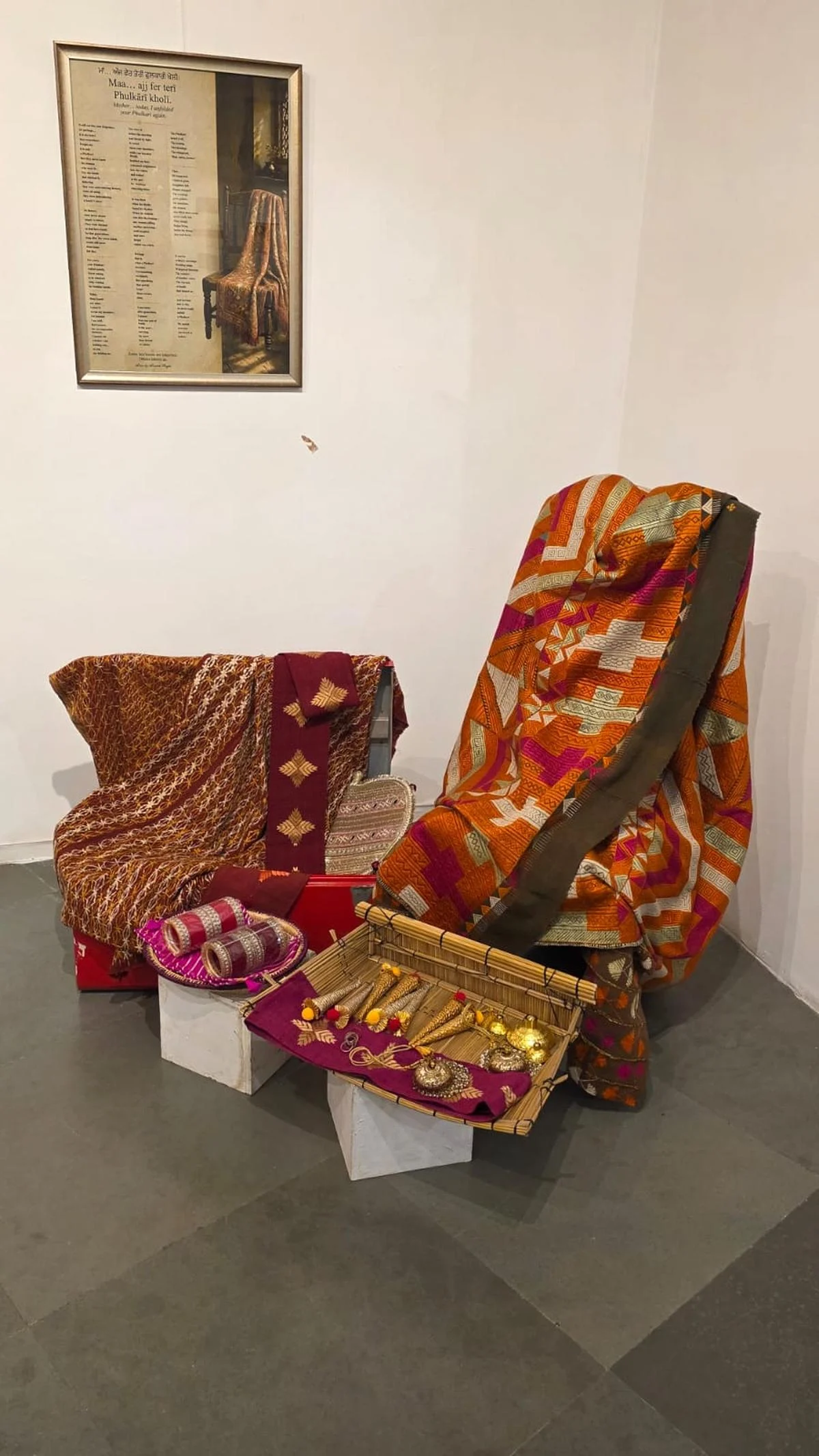
New Delhi, India – At the heart of the India International Centre, textile designer and revivalist Sunaina Suneja’s exhibition, Phulkari: A Lingering Presence, offers a profound exploration into the intricate world of this vibrant Punjabi embroidery. The exhibition, which opened its doors to the public on [Date of Opening, e.g., September 15, 2026] and will continue until October 1, 2026, challenges conventional perspectives by commencing with a piece displayed in reverse. This deliberate choice, showcasing the raw, often hidden side of the embroidery, immediately signals Suneja’s intent: to delve beyond the surface and reveal the deep-seated emotions and meticulous craftsmanship embedded within each stitch.
The exhibition masterfully weaves together vintage textiles from Suneja’s extensive personal collection with her own contemporary creations. This juxtaposition serves as a powerful testament to her decades-long, passionate engagement with the phulkari craft, tracing its evolution, its cultural significance, and its enduring artistic legacy.
The Genesis of a Revival: Suneja’s Journey into Phulkari
Sunaina Suneja’s profound connection with phulkari was not an immediate discovery but rather a gradual immersion that began in 2008. Her initial foray into the craft was sparked by a project aimed at generating income for women in villages surrounding Nabha, Punjab. Suneja entered the endeavor with the assumption that the women possessed a deep-seated knowledge of traditional embroidery techniques. However, she soon encountered a reality that necessitated a significant recalibration of her approach. Much of the work she observed was being executed on pre-traced or printed designs, a departure from the older, more intricate method of thread-counting that formed the bedrock of authentic phulkari.
This realization marked the commencement of a protracted and deeply investigative process. The project, designed to revitalize the craft and empower women, took a formidable two and a half years to gain momentum. The core challenge lay in reintroducing and re-establishing the practice of thread-counting. This was not a mere stylistic preference but a fundamental technique that demanded a keen visual acuity and an intuitive understanding of the fabric’s weave. For the embroiderer, it transcended the simple act of following a pattern; it required the development of an innate sense of where to insert the needle and how many threads to meticulously pick up, a process deeply ingrained in the artisan’s connection with the material.
A pivotal moment in Suneja’s journey came with the serendipitous appearance of an elderly woman at one of the early training sessions. This woman, a repository of traditional knowledge, offered an unexpected but invaluable insight. She demonstrated a few stitches from the reverse side of the fabric, revealing a technique that had been practiced in her youth. This encounter served as a crucial affirmation of Suneja’s pursuit and provided a tangible link to the authentic methods she was striving to revive.

Later, a subsequent project in Tarn Taran, Punjab, presented Suneja with an even more profound challenge: to not only relearn the craft from its foundations but also to effectively impart this knowledge to others. This experience was not just about mastering the stitches; it was a rigorous exercise in pedagogical innovation. Suneja found herself constantly contemplating the most effective language and pedagogical strategies to convey the nuances of thread-counting embroidery. "My mind was also working," she recalls. "What are the words I was going to use? How was I going to deliver that training?" This period of teaching and learning became instrumental in shaping her understanding of the craft and its transmission.
Decoding the Visual Lexicon: The Search for Phulkari’s Identity
Central to Suneja’s research and artistic practice is the quest to understand and define the unique visual identity of phulkari, what she terms the pehchaan. This pursuit involved an intensive study of her collection of vintage textiles. She meticulously examined borders, central panels, and individual motifs, engaging in a comparative analysis across a diverse range of pieces. Her aim was to identify the recurring visual language, the subtle yet distinct elements that differentiate phulkari from generic floral embroidery, thereby establishing its unique artistic signature.
The absence of comprehensive historical documentation presented both a hurdle and an opportunity. Suneja embraced this challenge, transforming it into an exercise of deep observation and scholarly research. She likens this process to having an "open canvas" where new interpretations and understandings can emerge. By comparing borders, central panels, and individual motifs across numerous textiles, she sought to uncover patterns, repetitions, and evolutionary trends that might shed light on the historical development of phulkari’s visual vocabulary.
A significant discovery emerged from her examination of a sainchi piece. Its central panel bore a striking resemblance to a motif featured in a book, complete with corresponding figures, placement, and even the depiction of animals. This observation suggested that the design was not necessarily a singular, unique creation but rather part of a repertoire of forms that could be adapted and repeated, demonstrating a systematic approach to design within the tradition.
Suneja’s research also leads her to resist any notion of a rigidly defined appearance for phulkari. She highlights the diversity within the craft itself, pointing to variations such as chand bagh, pachranga, darshan dwara, and sona chandni. These distinct styles showcase different arrangements of color, geometric patterns, and motifs, underscoring the inherent fluidity and adaptability of phulkari. "Phulkari could have been any flower," she explains. "On this one, you see flowers. On another one, you see geometry." This emphasis on variation challenges the perception of phulkari as a monolithic entity, instead presenting it as a dynamic and multifaceted art form.

Furthermore, Suneja finds profound insights in unfinished pieces. An incomplete embroidery, for instance, offers a rare glimpse into the creative process, revealing where the embroiderer began, the stages of work before the filling commenced, and the point at which the work was abandoned. For Suneja, these unfinished pieces are not merely incomplete works but invaluable evidence of the craft’s making. She also conducted experiments, encouraging women to test how different threads interacted with the fabric, driven by her interest in what she terms the "symbiotic relationship between the thread and the fabric." This meticulous attention to detail and process underscores her holistic approach to understanding phulkari.
Echoes of Life: Textiles as Storytellers
Beyond its technical and aesthetic dimensions, phulkari serves as a profound repository of personal narratives and cultural traditions. The textiles themselves are imbued with stories of women’s lives, marking significant life events such as marriage, departure, and personal aspirations.
A particularly poignant example is a vari da bagh on loan to the exhibition. This piece was reportedly gifted to a friend’s grandmother upon her marriage at the tender age of thirteen. Such garments were not merely decorative items but held deep personal and familial significance, often serving as heirlooms passed down through generations.
The chope, another significant type of phulkari, is traditionally associated with a bride’s wedding rituals. Its creation and gifting marked specific transitional phases in a woman’s life, including the ceremonial bath that signified her final ritualistic engagement in her maternal home before her departure to her new life.
The darshan dwara, a term often associated with offerings made to temples or gurdwaras, further illustrates the spiritual and devotional dimensions of phulkari. However, Suneja maintains a cautious approach to assigning fixed meanings to these pieces, recognizing that their interpretations can be fluid and context-dependent. She believes that the true essence of these textiles lies in the fragments of language they preserve, some documented and some nearly lost to time, which continue to reveal themselves to those who look closely.

This nuanced understanding of the textiles’ ability to carry stories and cultural memory is what underpins the exhibition’s evocative title, Phulkari: A Lingering Presence. It suggests that phulkari is not a static historical artifact but a living tradition, its essence continuing to resonate and reveal itself through the careful study and appreciation of its diverse manifestations.
The Exhibition: A Gateway to Understanding
Phulkari: A Lingering Presence at the India International Centre in Delhi offers a compelling and multi-layered experience. Visitors are invited to engage with phulkari not just as an art form but as a cultural phenomenon deeply intertwined with the lives and stories of the women who created it. Through Sunaina Suneja’s meticulous research, her curated collection of vintage pieces, and her own contemporary interpretations, the exhibition provides a rare opportunity to witness the enduring legacy of this exquisite Punjabi craft. It is a testament to the power of textiles to preserve history, embody tradition, and tell stories that continue to linger, waiting to be rediscovered.
The exhibition is on display until October 1, 2026, at the Art Gallery, Kamaladevi Complex, India International Centre, 40, Max Mueller Marg, New Delhi. It is open to the public daily from 11 am to 7 pm.
