

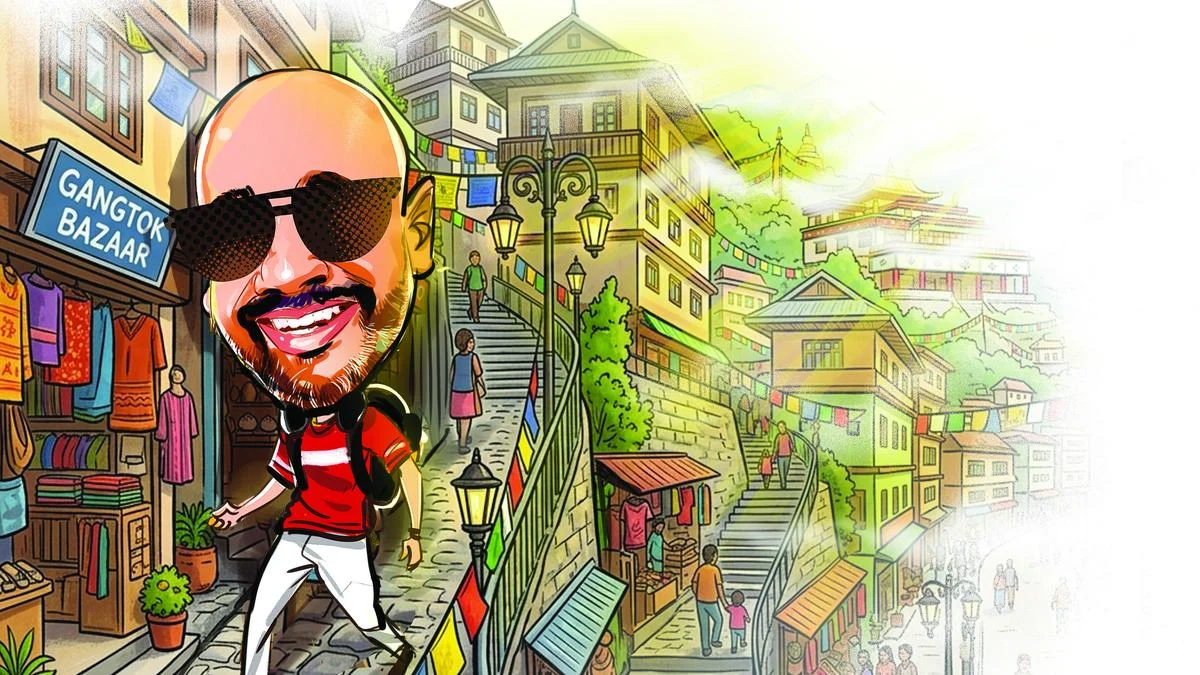
Gangtok, the picturesque capital of Sikkim, nestled in the breathtaking Himalayan foothills, stands as a testament to the enduring charm and practical benefits of a pedestrian-centric urban design. Once a city where walking was not merely a choice but a way of life, Gangtok has, in recent decades, actively reinforced and enhanced its walkability, offering a refreshing contrast to the often car-dominated landscapes of many Indian metropolises. This article delves into the city’s evolution, its unique pedestrian infrastructure, the challenges it faces, and its significance as a model for urban planning in India.
The Genesis of a Walker’s City: Childhood Memories and Early Habits
For many who grew up in Gangtok, the rhythm of daily life was dictated by the cadence of their own footsteps. In an era before widespread vehicle ownership, the city was intrinsically designed for those on foot. Journeys to school involved arduous uphill climbs, while the return trip offered a welcome descent. Even trips to local landmarks like Paljor Stadium necessitated navigating steep inclines, with the town center itself demanding a knee-testing ascent. Early morning physics tuition classes with Mr. CSP Singh were a testament to the ingrained habit of traversing significant distances, often four to five kilometers daily, simply to navigate the town. This was the norm in a small, hilltop settlement where every corner was an invitation to walk. The topography, while challenging, fostered a deep connection with the environment and a sense of self-reliance.
A Transformative Vision: Pedestrianizing MG Marg
The transformation of Gangtok into an even more walker-friendly city was significantly propelled by a landmark decision in 2009: the pedestrianization of its main commercial and social artery, MG Marg. This stretch of road, one of the few relatively straight thoroughfares in the city, was the traditional hub for shopping, dining, and informal social gatherings.
Prashant Pradhan, an architect instrumental in championing the car-free initiative and also responsible for designing several of the city’s footpaths, recalls the initial apprehension that accompanied the proposal. "Shop owners voiced concerns that removing vehicular traffic would cripple their businesses," Pradhan explains. "Residents also worried about the practicalities, such as how they would transport elderly family members to and from medical facilities."
However, these anxieties soon gave way to widespread acclaim. MG Marg, once a thoroughfare for vehicles, blossomed into a vibrant public space teeming with people. "It came alive with people walking, meeting, and engaging with the city rather than simply driving through it," Pradhan observes. The transformation was profound, fostering a sense of community and reclaiming public space for its citizens. Today, the sentiment is overwhelmingly positive, with residents universally thrilled by the change. The pedestrianized zone has become a source of immense civic pride, a bustling promenade that embodies the city’s commitment to a more human-scaled urban experience.
Beyond the Main Square: A Comprehensive Pedestrian Network
While MG Marg stands as a shining example, Gangtok’s commitment to walkability extends far beyond its central square. The city boasts an impressive and often overlooked pedestrian infrastructure that sets it apart from many other Indian urban centers.

Extensive Footpath Networks
A remarkable 12-kilometer footpath runs along the highway, a significant feat in itself. This well-maintained pathway gracefully snakes downhill, extending into the suburbs of Tadong, 5th Mile, and 6th Mile, and continues uninterrupted until it reaches the neighboring town of Ranipool. This continuous network allows residents to traverse considerable distances without ever needing to step onto the main road, ensuring safety and convenience.
Integrated Infrastructure for Seamless Movement
Gangtok’s footpaths are not mere afterthoughts. They are characterized by proper railings on both sides, providing crucial support and safety, particularly on the undulating terrain. This is a stark contrast to many Indian cities where footpaths are often narrow, encroached upon, or entirely absent. The city’s network of stairs, flyovers, and footpaths is thoughtfully integrated, creating a cohesive system that facilitates movement across varying elevations and through different urban zones. This comprehensive approach enables residents to efficiently run errands, visit local businesses, and access essential services entirely on foot.
A Unique Urban Landscape
Unlike metropolises like Bengaluru or Delhi, which may offer ample parks and outdoor spaces but often struggle with pedestrian accessibility on their main thoroughfares, Gangtok offers a different proposition. Chennai, regrettably, also falls short in this regard. Gangtok’s unique topography, combined with its deliberate urban planning, has resulted in a city where walkability is woven into the very fabric of daily life, extending far beyond designated recreational areas.
Challenges and Shifting Perceptions: The Paradox of Progress
Despite its inherent strengths in pedestrian infrastructure, Gangtok is not immune to the challenges that accompany modernization and evolving societal norms. The very success of its pedestrian-friendly design has, paradoxically, revealed a growing reliance on private vehicles and a subtle shift in the perception of walking.
The Allure of the Automobile
While Gangtok has implemented measures to manage vehicle ownership, such as requiring proof of parking space before purchasing a car, the desire for personal mobility remains strong. Government initiatives like the odd-even rule have offered some respite from traffic congestion, but the underlying issue stems from a societal inclination towards vehicular transport.
The "Posh" Factor: A South Asian Insecurity
The author notes a concerning trend: "We people are mostly to blame. We are becoming too posh to walk these days." What were once easily walkable distances twenty years ago are now often deemed inaccessible without a car. This phenomenon, the author suggests, is a "uniquely South Asian insecurity," where wealthy individuals often avoid being seen on foot unless it is for a dedicated morning walk, even if the destination is merely a short distance away. This perception shift undermines the city’s inherent walkability and contributes to traffic congestion.

Rediscovering the Joy of Walking: Personal Experiences and Anecdotes
The author’s personal narrative vividly illustrates the practical advantages and inherent pleasure of walking in Gangtok.
Errands and Exploration on Foot
From hiking to monasteries and hilltop temples to making the short trek to Rachna Books, the author consistently chooses to walk. The journey to the bookstore, involving a series of stairs, footpaths, and a flyover, is often completed in half the time it would take by car. Similarly, visits to the dentist, the tailor, and friends’ houses are all accomplished on foot, highlighting the efficiency and convenience of the city’s layout for pedestrians.
Ambitious Journeys and Provincial Charm
A particularly striking anecdote involves an attempt to walk the 76 kilometers from Gangtok to Kalimpong, another hill station across the border in West Bengal. While the journey had to be aborted at the 60-kilometer mark due to darkness, the experience itself underscored the potential for extended walks along the highway. The author charmingly describes this endeavor as having "something so cute and wonderfully provincial about a 60-km walk along the highway."
Gangtok’s Significance: A Model for Indian Urbanism
Gangtok’s pedestrian-centricity stands as a rare and valuable asset in the Indian urban landscape. The author candidly observes, "I can think of no other Indian city, big or small, with the exception of Chandigarh that is considerate of the walker." While cities like Shimla and Pondicherry make efforts, and Pune and Shillong show some promise, Gangtok’s comprehensive infrastructure and ingrained culture of walking set it apart.
A Stark Contrast to Other Cities
Living part of the year in Chennai, the author experiences firsthand the challenges of finding a pleasant urban walking experience in most major South Asian cities. These often involve navigating a patchwork of dangerous alleyways, scorching beaches, and traffic-choked main roads with non-existent footpaths, a frustrating endeavor that frequently ends in failure.
The Importance of Preserving a Natural Gift
The residents of Gangtok, like many who benefit from abundant resources, often take their city’s walkability for granted. It is only when confronted with the "no-walk zones" prevalent in most South Asian cities that the true value of Gangtok’s pedestrian-friendly environment becomes apparent, fostering a sense of smugness about their good fortune.

Conclusion: A Beacon of Walkable Urbanism
Gangtok’s journey from a childhood city defined by foot traffic to a modern metropolis actively championing pedestrianism offers a compelling narrative. Its well-maintained footpaths, integrated infrastructure, and the visionary pedestrianization of MG Marg have created an urban environment that prioritizes human movement and community interaction. While facing the modern challenges of increasing vehicular reliance and shifting social perceptions, Gangtok’s inherent strengths and the enduring appreciation of its residents position it as a vital model for sustainable and livable urban development in India and beyond. The city serves as a powerful reminder that prioritizing the pedestrian is not just about infrastructure; it’s about fostering a healthier, more connected, and ultimately, a more human city.
Author’s Note: Prajwal Parajuly is a novelist. His new book, Karma and Lola, is forthcoming in mid-2027. He teaches Creative Writing at Krea University and oscillates between New York City and Sri City.
Published: August 14, 2026, 07:34 am IST
