

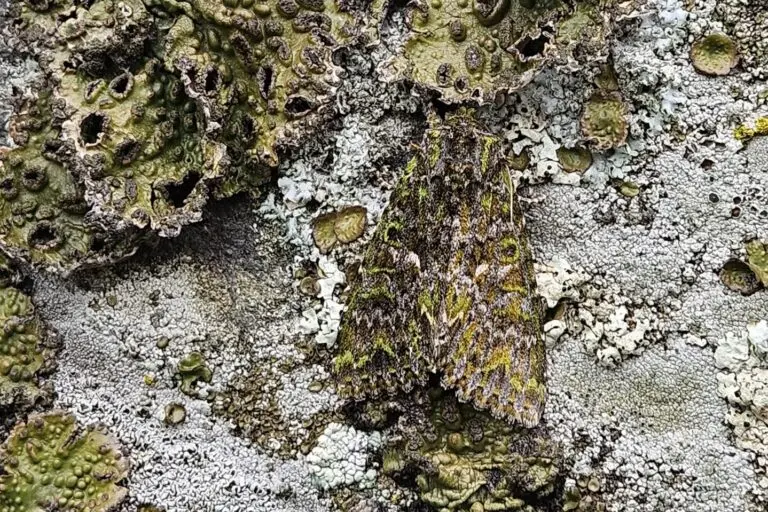
In the rugged, high-altitude terrain of the Himachal Pradesh Himalayas, nature has long been a theater for the extraordinary. However, some of its most profound dramas are played out on a microscopic or nearly invisible scale. A recently published study in the prestigious journal Arthropod-Plant Interactions has unveiled a groundbreaking observation from the Chamba district: the first documented instance of a moth utilizing the umbilicate lichen, Lasallia pertusa, as a camouflage substrate.
This discovery, made at an elevation of approximately 3,200 meters within the Kugti Wildlife Sanctuary, provides a rare glimpse into the complex evolutionary relationships between insects and the flora they inhabit. While lichen-associated camouflage is a known phenomenon in the entomological world, the specific involvement of an umbilicate lichen marks a significant expansion of our understanding of how insects exploit their visual environment to survive.
Main Facts: The Intersection of Crypsis and High-Altitude Botany
The core of the study revolves around a moth belonging to the Noctuidae family—commonly known as owlet moths—and its interaction with Lasallia pertusa. Lichens are composite organisms arising from algae or cyanobacteria living among filaments of multiple fungi species in a mutualistic relationship. They are categorized by their growth forms: crustose (crust-like), foliose (leaf-like), and fruticose (shrub-like).
Lasallia pertusa is a foliose lichen, but more specifically, it is "umbilicate." This means the lichen is attached to its substrate—in this case, exposed rock—at a single central point, much like an umbilical cord. This growth form creates a distinctive, often perforated and highly irregular vegetative body known as a thallus.
The discovery is significant for several reasons:
- Rare Substrate: Most documented moth camouflage involves crustose lichens or tree bark. The use of an umbilicate, leafy lichen is a novel observation.
- Visual Complexity: The irregular, perforated thallus of L. pertusa provides a chaotic and complex visual background, which the moth utilizes to achieve "crypsis."
- High-Altitude Adaptation: The observation at 3,200 meters highlights how species adapt to the harsh, exposed environments of the Himalayas, where cover is sparse and predators are keen-eyed.
The study was authored by a team of researchers, including Sanjay Kumar Uniyal, who documented the interaction during a field expedition in July 2025. Though the moth was identified at the family level (Noctuidae), the specific species remains a mystery as no specimen was collected, a common occurrence in observational field studies where the priority is documenting behavior in situ.
Chronology: From the Slopes of Duggi to Scientific Publication
The journey to this discovery began in the summer of 2025. In the high-altitude region of Duggi, located within the Kugti Wildlife Sanctuary of Himachal Pradesh, researchers were conducting biodiversity surveys. On a clear day in July, at an elevation where the air thins and the vegetation gives way to rocky outcrops, the team noticed a seemingly bare patch of Lasallia pertusa lichen.
Upon closer inspection, what appeared to be a part of the lichen’s irregular thallus was revealed to be a resting moth. The moth’s wings perfectly mirrored the textures, shadows, and perforations of the lichen. Recognizing the rarity of the sighting, the researchers documented the scene with high-resolution photography, ensuring they captured the moth from multiple angles to illustrate the effectiveness of its camouflage.
Following the field observation, the data underwent a rigorous review process. Experts in lepidopterology (the study of moths and butterflies) and lichenology were consulted to identify the participants in this visual dance. While the lichen was definitively identified as L. pertusa, the moth posed a greater challenge. Without a physical specimen for DNA sequencing or genital dissection—the gold standards for insect identification—the researchers had to rely on morphological features visible in the photographs. They concluded it was a member of the Noctuidae family, a group well-known for its cryptic resting postures.
The findings were compiled into a formal paper and submitted to Arthropod-Plant Interactions. After undergoing peer review, the paper was published, officially adding Lasallia pertusa to the list of biological backgrounds used by insects for survival.
Supporting Data: The Science of Hiding in Plain Sight
The mechanism at play here is "crypsis," a form of camouflage where an animal avoids observation or detection by matching its background. Unlike mimicry, where an organism looks like another specific object (like a leaf or a twig), crypsis is about breaking up the animal’s outline and reducing contrast against a heterogeneous environment.
The Complexity of the Thallus
Lasallia pertusa is not a uniform surface. Its thallus is described as "perforated," meaning it is full of small holes and irregular depressions. For a moth, this is an ideal "disruptive" background. The shadows created by the lichen’s perforations allow the moth’s own body shadows to blend in, making it nearly impossible for a predator to distinguish the edges of the insect from the edges of the plant.

The Noctuidae Advantage
Moths of the Noctuidae family are predominantly nocturnal. During the day, they must remain motionless for hours, often in exposed locations. Their survival depends entirely on their ability to remain undetected by "visual hunters"—predators that rely on sight rather than smell or sound. In the high-altitude zones of Chamba, these predators primarily include:
- High-altitude birds: Such as swifts, accentors, and various mountain finches.
- Lizards: Species adapted to rocky terrains that scan surfaces for movement or slight textural anomalies.
Elevation and Environment
At 3,200 meters, the environment is characterized by intense UV radiation and extreme temperature fluctuations. Lichens like L. pertusa are hardy survivors in these conditions, often being the dominant life form on rock faces. For a moth, choosing such a ubiquitous and hardy background is a statistically sound survival strategy.
Official Responses: Insights from the Field
Sanjay Kumar Uniyal, one of the lead researchers and a prominent voice in Indian ecology, emphasized the broader implications of the find. Speaking to Mongabay-India, Uniyal noted that while moth-lichen associations are a staple of evolutionary biology textbooks—most notably the case of the Peppered Moth (Biston betularia) in industrial England—the nuances of these relationships in the wild are still being mapped.
"Though there have been similar observations of moths mimicking lichens in the past, this particular lichen species (Lasallia pertusa) has been documented for the first time," Uniyal shared. He further explained that this is not merely a "cool photo" but a piece of a larger evolutionary puzzle. "This might have an evolutionary consequence which can only be understood through further studies. It suggests a level of specialization that we are only beginning to document in the Himalayan corridor."
The research team also acknowledged the limitations of their study. The paper explicitly states that the findings are based on observation rather than experimental manipulation. In a controlled experiment, researchers might move moths to different backgrounds to measure "detection time" by predators. However, in the sensitive ecosystem of the Kugti Wildlife Sanctuary, such experiments are difficult to conduct. The team maintains that the visual evidence of "background matching" is compelling enough to warrant further investigation into the chemical and visual cues that lead a moth to choose one lichen over another.
Implications: Biodiversity and Conservation in a Changing Climate
The discovery of this moth-lichen association has several far-reaching implications for science and conservation.
1. Expanding the Definition of "Important" Species
Often, conservation efforts focus on "charismatic megafauna" like the snow leopard or the Himalayan brown bear, both of which are found in the Kugti Wildlife Sanctuary. However, this study proves that inconspicuous organisms like the Lasallia lichen play a critical role in the survival of other species. If the lichen populations were to decline due to pollution or climate change, the moths that rely on them for camouflage would become instantly vulnerable to predation, potentially leading to a localized extinction of that insect species.
2. Evolutionary Specialization
The fact that the moth was found on an umbilicate lichen—a growth form that is less "flat" than crustose lichens—suggests that these insects have evolved specific resting postures to match the three-dimensional topography of the lichen. This points to a highly specialized evolutionary path where the moth’s wing patterns and behavior have co-evolved with the lichen’s physical structure.
3. The Need for Taxonomic Surveys
The inability to identify the moth species highlights a "taxonomic gap" in Himalayan biology. Many species in these high-altitude zones remain undescribed or poorly understood. This study serves as a call to action for more comprehensive specimen collection and genetic barcoding in the Chamba district to ensure that the region’s biodiversity is fully cataloged before it is impacted by environmental shifts.
4. Climate Change Vulnerability
High-altitude ecosystems are among the most sensitive to global warming. As temperatures rise, the "treeline" moves upward, and the specific moisture and temperature windows that lichens like L. pertusa require may shift. If the lichen moves or disappears, the entire "visual economy" of the moth’s survival strategy is disrupted.
Conclusion
The sighting at Duggi is a reminder that the natural world still holds many secrets, even in plain sight. A moth resting on a rock might seem like a minor detail in the vastness of the Himalayas, but it represents millions of years of fine-tuned evolution. By documenting the first known use of Lasallia pertusa as a camouflage shield, Uniyal and his team have opened a new chapter in the study of insect-plant interactions, proving once again that in the struggle for survival, the best defense is often the ability to become invisible.
As researchers continue to monitor the Kugti Wildlife Sanctuary, the hope is that further studies will identify the specific Noctuidae species and perhaps even uncover more "invisible" residents of the high mountains, further cementing the Chamba district’s reputation as a vital laboratory for evolutionary biology.
