

THIRUVANANTHAPURAM, KERALA — Standing before a modest, green-painted house, its entrance secured by a weathered, rusty lock, 43-year-old Baby Titus points to what used to be her sanctuary. Today, it is a shell of a home, a casualty of the relentless Arabian Sea. “This was our home,” she says, her voice competing with the rhythmic, violent thud of waves crashing against the structure’s right flank.
Inside, the walls tell a story of a different kind of danger. The seawater, having breached the threshold repeatedly, caused a series of short circuits. “The sea kept entering and receding,” Titus explains. “You would get an electric shock wherever you touched. It wasn’t just the water we feared; it was the very walls turning against us.”
The story of Baby Titus is not an isolated incident. It is the lived reality for thousands of families in the Kulathoor grama panchayat, the southernmost tip of Kerala’s Thiruvananthapuram district. Here, the geography of the coastline is being rewritten by the hour, leaving behind a trail of psychological trauma, economic ruin, and a community struggling to retain its identity.

Main Facts: A Coastline Under Siege
The coastal wards of Kulathoor—including Pozhipallivilakam, Mullassery, Kollamkode, Paruthiyoor, Pozhikara Beach, and Pozhiyoor—have been the frontline of a decades-long battle against coastal erosion. Historically, these vibrant fishing villages were characterized by rows of houses stretching deep into the land. Today, the landscape is unrecognizable. In many of these wards, where once 100 rows of houses stood, only seven or eight remain.
The physical evidence of this retreat is stark. A road passing the Kollamkode Church now leads directly into the surf. Granite boulders, dumped into the water as a makeshift seawall, lie scattered like discarded toys, frequently overwhelmed by the surge. On September 28, the situation reached a breaking point when a massive sea surge caused the collapse of 40 houses in Pozhiyoor in a single day.
For the families who remain, life is a state of perpetual "ready-to-flee." Essential documents, a few changes of clothes, and basic necessities are kept packed in waterproof bags. When the waves breach the dunes, families retreat to nearby government schools, only to be told by authorities to return once the tide recedes—often to homes that are structurally compromised and damp with brine.
Chronology of a Crisis: From Seasonal Surges to Permanent Loss
The crisis in southern Kerala has transitioned from a seasonal hazard to a permanent state of emergency.

- The Decades of Erosion: For over thirty years, the shoreline has been incrementally receding. Initially, this was managed through traditional seawalls and temporary relocations during the monsoon.
- The Acceleration: In the last 15 years, the rate of land loss has spiked. Residents note that the "buffer zone" between the village and the sea has essentially evaporated.
- The 2022 Turning Point: A landmark study highlighted that the Thiruvananthapuram coast was losing land at an alarming rate, far exceeding natural accretion.
- The 2025 Health Crisis: By early 2025, the cumulative stress of displacement led to a recognized mental health crisis in the region, prompting local religious institutions to call for medical intervention.
- September 28 Surge: The recent collapse of 40 homes has underscored the inadequacy of current coastal defenses, pushing the government’s rehabilitation efforts into the spotlight.
Supporting Data: The Science of Disappearing Land
The environmental degradation of Thiruvananthapuram’s coast is backed by sobering scientific data. A 2022 study on coastal changes linked to climate change found that over a 14-year period, approximately 2.62 square kilometers of land along this stretch were lost to erosion. While some land (about 0.7 sq km) was gained through accretion, the net loss remains catastrophic.
The study revealed that while the average rate of erosion along the Thiruvananthapuram coast is approximately five meters per year, Pozhiyoor is an extreme outlier. The area recorded a staggering erosion rate of 10.59 meters per year—more than double the regional average.
Beyond the physical geography, the "human data" is equally concerning. Dr. Shreyas Susan Varghese, a psychiatrist who led a medical camp in Pozhiyoor in 2025, reported that the majority of the population showed symptoms of clinical trauma and depression. "Relocation has disrupted their social and emotional support systems," Dr. Varghese noted. "For these communities, displacement is not just a change of address; it is a psychological trigger that compounds genetic predispositions to distress."
Official Responses: The Punargeham Scheme
In response to the escalating crisis, the Kerala government launched Punargeham, a comprehensive coastal rehabilitation scheme. The program targets fisher families living within 50 meters of the shoreline—the high-risk zone.

Key features of the Punargeham scheme include:
- Financial Assistance: Eligible families receive up to ₹10 lakh to either purchase land and build a house or move into government-constructed flats.
- Niravu Flats: A flagship housing complex in Karode Panchayat, designed to house displaced families from the high-risk Pozhiyoor wards. To date, 128 families from Kulathoor have been moved to this site.
- Criteria for Inclusion: The primary criterion is the willingness to move away from the shoreline. However, this has created a rift within the community. Those who could afford to augment the government grant moved to private land, while the most vulnerable moved into the flats.
While the government views Punargeham as a success in terms of safety, social workers and residents argue that the "human cost" of this transition was underestimated.
Implications: The Loss of the "Beach Common" and Ecological Grief
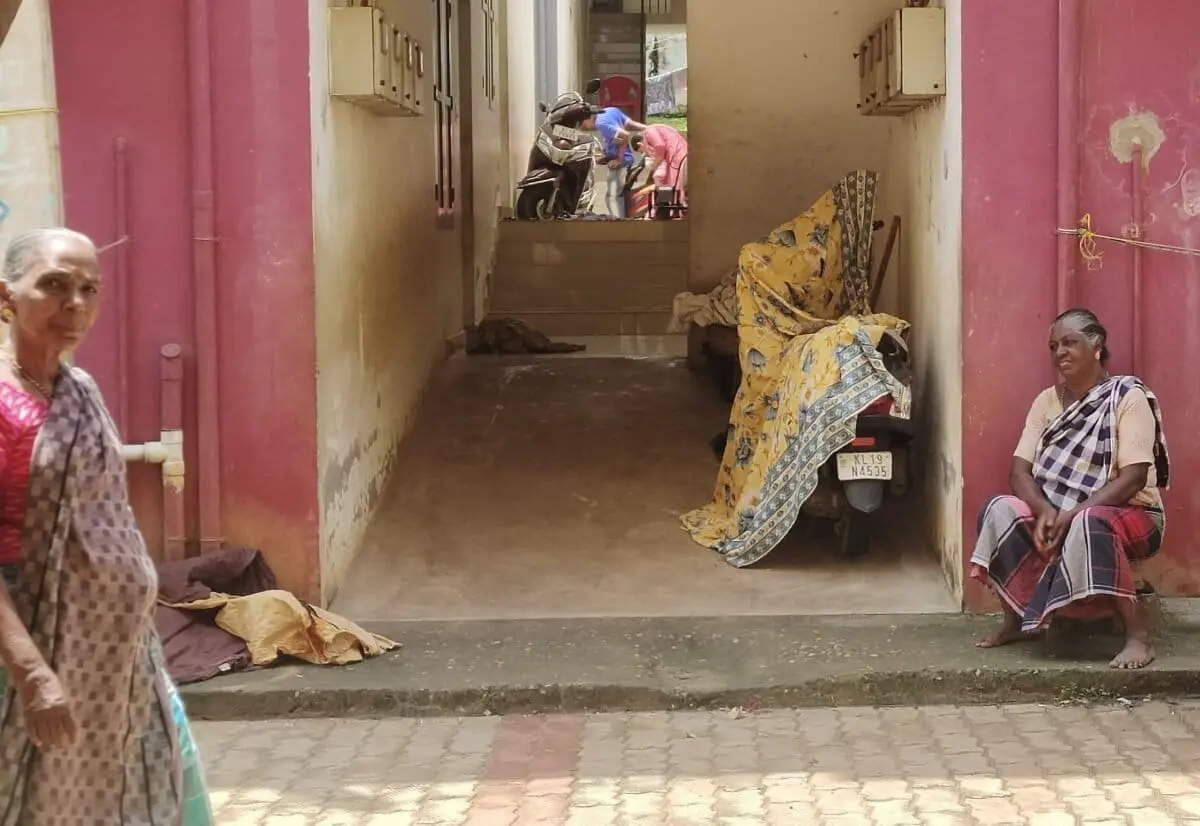
The relocation to Karode, a non-coastal panchayat located seven kilometers inland, has fundamentally altered the socio-economic fabric of the fishing community.
1. Economic Disruption
For artisanal fishermen like Thadhayoos, Baby Titus’s husband, the distance is a barrier. "Even at sea, I am not at peace," he says. The cost of commuting to the shore to launch boats and the inability to monitor the tide has increased the overhead of an already precarious profession. For elderly women, the impact is even more direct. Traditionally, women in these families earned income by collecting and curing fish on the beach. In the confined spaces of the Niravu Flats, there is no room for these activities, leaving many women idle and without financial independence.

2. The Breakdown of Social Cohesion
Jose Thobias, 42, who moved to the flats with his extended family, describes a profound sense of isolation. "Earlier, we would play cricket or football on the beach every evening. Now, this place feels like a medical ward," he says. The "beach common"—the shared space where community ceremonies, sports, and net repairs took place—has no equivalent in the inland housing blocks.
3. The Role of the Church
In these predominantly Catholic villages, the parish church (Kollamkode or Paruthiyoor) served as the center of gravity. It was a place for counseling, community meetings, and emotional solace. For the elderly, like 60-year-old Jenovi Thobias, the distance to the church from the new flats is insurmountable due to age and physical ailments. "I used to find solace there," she says. "Now, I am just waiting."
In response, Father Davidson of Kollamkode Church has launched the "Santhwana Project" in collaboration with Thiruvananthapuram Jubilee Hospital to provide mobile counseling services, recognizing that the community’s spiritual and mental health is tethered to their lost geography.
4. Ecological Grief
Anthropologist Claudia Lang, who studies the Kerala coast, uses the term "ecological grief" to describe the collective mourning of a disappearing environment. "Psychological repair cannot be separated from environmental repair," Lang argues. When a community’s identity, memories, and livelihoods are tied to the sea, moving them to "safer" ground does not necessarily solve the crisis; it merely changes its form.

Conclusion: Looking Beyond Four Walls
The crisis in Thiruvananthapuram is a harbinger of the challenges facing coastal communities globally in an era of rising sea levels. While the Punargeham scheme provides a roof, it does not yet provide a "home" in the holistic sense of the word.
According to parish records, of the 2,400 families who once thrived in the Kollamkode area, approximately 400 are still waiting for secure housing, living in the shadow of houses that could collapse at any moment. For the authorities, the challenge moving forward is to integrate livelihood support, community spaces, and mental health care into the rehabilitation process.
For Baby Titus, watching the waves from her rented room, the future remains as uncertain as the tide. "We are safe from the water here," she says, "but we are far from the life we knew."
The vanishing shoreline of Kerala is a reminder that when the sea takes a house, it takes more than just bricks and mortar; it takes the very ground upon which a community’s soul was built.
