

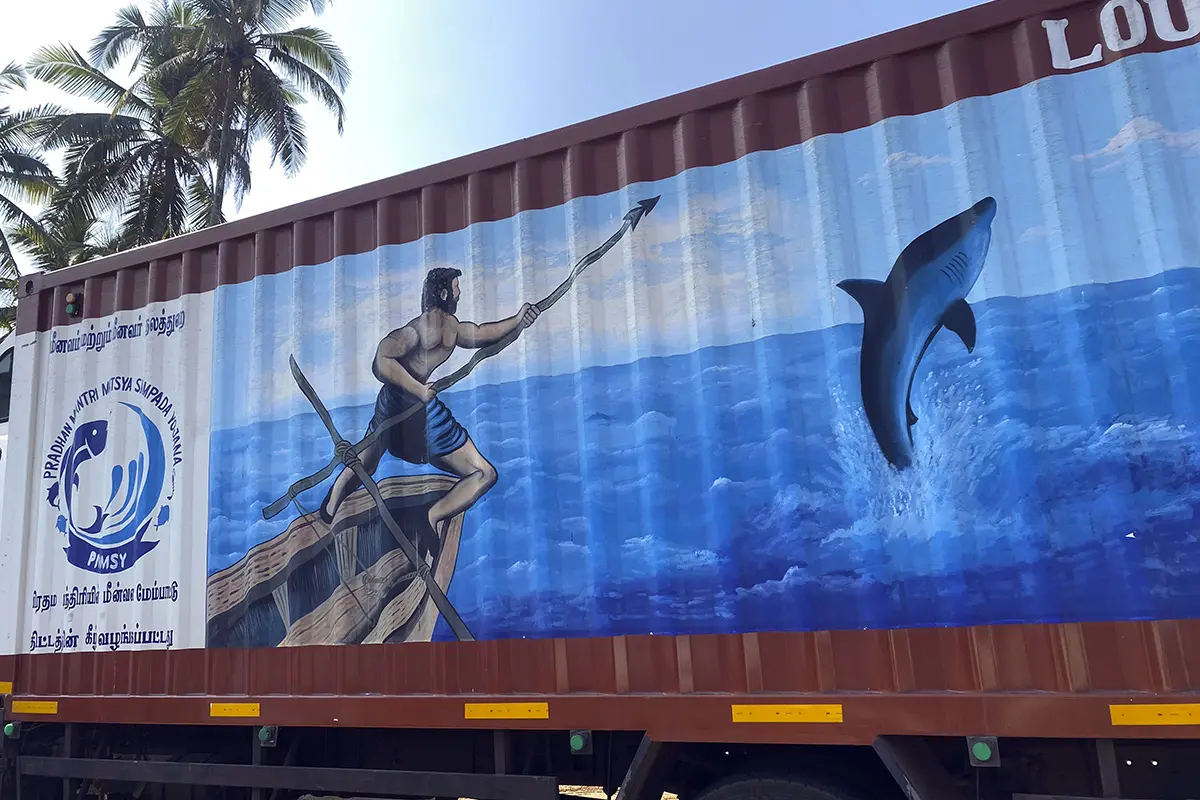
For decades, the rhythmic pulse of India’s coastal economy has been driven by artisanal and small-scale fishers operating within the sight of land. However, as near-shore waters become increasingly depleted due to overfishing and climate change, the Indian government has cast its gaze toward the horizon. The promise is bold: a transition to deep-sea fishing (DSF) that transforms traditional fishers into industrial entrepreneurs, tapping into the vast, unexploited wealth of the Exclusive Economic Zone (EEZ).
Yet, beneath the glossy sheen of policy brochures and multi-crore subsidy schemes lies a turbulent reality. From the shores of Tamil Nadu to the ports of Gujarat, the transition into deeper waters has proved far more complicated than the central government anticipated. While the state envisions a "Blue Revolution," the fishing communities themselves are grappling with a fundamental question: is the economics of the deep sea a lifeline or a debt trap?
Main Facts: The Blueprint for a Blue Revolution
India’s push into deep-sea fishing is primarily encapsulated in the Pradhan Mantri Matsya Sampada Yojana (PMMSY), a flagship scheme launched in 2020 with an investment of ₹20,050 crore (approximately $2.4 billion) for a five-year period. A significant portion of this budget is dedicated to modernizing the fishing fleet and encouraging fishers to move beyond the 12-nautical-mile territorial limit into the 200-nautical-mile EEZ.
The Objectives of the Scheme
The primary objective of the PMMSY is to increase India’s fish production to 22 million metric tonnes by 2024-25 and to double the export earnings to ₹1,00,000 crore. To achieve this, the government has identified deep-sea fishing as a critical lever. The logic is twofold:
- Reducing Pressure on Coastal Waters: By moving larger vessels further out, the government hopes to allow near-shore ecosystems to recover.
- Tapping High-Value Species: The deep sea is home to lucrative species like Yellowfin Tuna, Skipjack Tuna, and Cephalopods, which have high demand in international markets.
The Financial Incentive Structure
To facilitate this, the government offers substantial subsidies. For a deep-sea fishing vessel costing approximately ₹1.2 crore ($145,000), the central and state governments provide a combined subsidy of 40% for the general category and up to 60% for SC/ST and women-led cooperatives. The remaining amount must be covered by the beneficiary, often through high-interest bank loans or private lending.
Chronology: From Palk Bay to the PMMSY
The journey toward deep-sea fishing in India did not begin in a vacuum. It is the result of a decade-long policy evolution marked by both strategic necessity and communal resistance.
- 2014-2015: The Meenakumari Committee Report: This period marked a turning point when a government-appointed committee recommended allowing foreign fishing vessels into India’s EEZ. The move sparked nationwide protests from local fishers who feared being outcompeted by industrial giants, eventually forcing the government to rescind the recommendation and focus on empowering domestic fishers instead.
- 2017: The Palk Bay Scheme: Launched as a precursor to PMMSY, this scheme targeted fishers in Tamil Nadu. The goal was to transition bottom-trawlers—which damage the seabed—into deep-sea long-liners. The primary driver here was geopolitical, aiming to reduce the number of Indian fishers crossing into Sri Lankan waters.
- 2020: Launch of PMMSY: The Ministry of Fisheries, Animal Husbandry, and Dairying launched the PMMSY with a 2020-2025 timeline. This expanded the deep-sea ambitions from a regional conflict-resolution tool to a national economic strategy.
- 2022-2024: The Reality Check: Field reports and Right to Information (RTI) replies began to surface, showing a significant lag between the number of sanctioned vessels and the number of boats actually hitting the water. In states like Andhra Pradesh and Maharashtra, the uptake remained dismal.
Supporting Data: The Economic Friction
The central challenge to India’s deep-sea dreams is the sheer cost of operation. While the government focuses on the capital cost of the boat, the recurring operational costs are staggering for a community used to day-trips.
The Cost of the Deep
According to data gathered through field reporting and Lok Sabha reports, a single deep-sea voyage lasting 15 to 20 days can cost between ₹5 lakh and ₹8 lakh.
- Fuel: Diesel accounts for nearly 70-75% of operational expenses. With fluctuating global oil prices and the removal of certain local subsidies, the break-even point for a voyage is becoming increasingly difficult to reach.
- Labor: Deep-sea vessels require specialized crews of 10 to 15 people. Finding skilled labor willing to stay at sea for weeks is a growing challenge, leading to higher wage demands.
- Ice and Storage: Unlike coastal fishing, deep-sea fishing requires massive quantities of ice and advanced refrigeration to keep high-value tuna export-ready.
The Subsidy Gap
Data from RTI replies indicates that in several coastal states, less than 20% of the allocated funds for deep-sea vessels have been utilized. In Andhra Pradesh, for instance, of the hundreds of vessels planned, only a fraction are operational. The primary reason is "bankability." Despite the 40-60% subsidy, banks are often reluctant to provide the remaining 40-60% as loans because they view deep-sea fishing as a high-risk venture with no guaranteed return on investment.
Target vs. Achievement
As of the 2023-2024 fiscal year, parliamentary reports suggest that the "Blue Revolution" is lagging behind its production targets in the deep-sea sector. While inland aquaculture is booming, marine capture—specifically from the deep sea—has remained relatively stagnant, contributing to only a small fraction of the overall growth in the fisheries sector.
Official Responses: The Government’s Defense
Government officials maintain that the transition is a "long-game" strategy. In various statements to the Lok Sabha and in policy dialogues, the Department of Fisheries has emphasized that the initial friction is expected when shifting a centuries-old traditional industry into a modern industrial one.
Redesigning the Fleet
Officials have acknowledged that the early boat designs were not suited for all coastal conditions. In response to feedback from fishers in Kerala and Tamil Nadu, the government has worked with the Cochin Shipyard and other maritime institutes to refine vessel specifications, ensuring they are more stable in the rougher waters of the Arabian Sea and the Bay of Bengal.
Infrastructure Development
The government’s official stance is that the boats are only one part of the puzzle. They point to the ongoing development of "Integrated Modern Fishing Harbours" and "Fish Landing Centres." The Ministry argues that once the cold-chain infrastructure is robust enough to ensure that a tuna caught in the deep sea reaches a Japanese or European market in "Grade-A" condition, the profits will naturally follow, solving the current economic impasse.
Implications: A High-Stakes Gamble
The push for deep-sea fishing carries profound implications for India’s 4 million-strong fishing community and the marine environment.
1. The Risk of a Debt Trap
For a traditional fisher, investing in a deep-sea vessel is a life-altering financial move. If a voyage returns without a "bumper catch," or if the international price of tuna drops, the fisher is left with a massive daily interest burden. There is a growing concern among sociologists that the PMMSY could inadvertently create a new class of indebted fishers, similar to the agrarian crisis seen in India’s farming heartlands.
2. Ecological Sustainability
While the government promotes DSF as a way to "save" coastal waters, the ecological impact on the deep sea remains under-studied. High-value species like Yellowfin Tuna are already under pressure globally. Critics argue that without stringent monitoring and "vessel monitoring systems" (VMS), the move into the deep sea might simply export the problem of overfishing from the coast to the open ocean.
3. The Corporate Shift
There is a simmering fear among artisanal fishers that the high entry barrier of deep-sea fishing will eventually pave the way for large corporate entities to take over the sector. If individual fishers cannot afford the vessels or the operational costs, the government may eventually open the EEZ to industrial fleets, effectively marginalizing the very communities the scheme was meant to help.
4. Infrastructure and Market Access
Currently, India lacks a "mother ship" concept—large vessels that stay at sea to collect catch, refuel, and provide supplies to smaller deep-sea boats. Without this, Indian fishers must waste fuel and time returning to port. Furthermore, without direct links to international buyers, fishers remain at the mercy of middlemen who take a significant cut of the "high-value" profits.
Conclusion: Keeping the Dream Afloat
India’s deep-sea fishing ambitions represent a pivotal moment in the country’s maritime history. The transition from the shore to the deep is not merely a technical upgrade; it is a socio-economic upheaval.
The findings from Mongabay-India’s extensive reporting suggest that while the government’s "Blue Dream" is grounded in the necessity of resource diversification, the execution is currently disconnected from the lived realities of the fishers. For the scheme to succeed, the focus must shift from merely subsidizing boats to creating a holistic ecosystem that includes fuel subsidies, fair credit access, climate-resilient technology, and direct market linkages.
Until then, the vast expanse of the Indian Ocean remains a frontier of both immense promise and perilous uncertainty for the thousands of fishers being asked to sail into the unknown. The success of the 2020-2025 phase of the PMMSY will ultimately be measured not by the number of boats sanctioned, but by whether those boats can return to shore with their holds full and their owners out of debt.
