

In the silent, freezing reaches of the cosmos, remnants of dead suns perform a violent, high-speed dance that defies the very laws of terrestrial physics. Neutron stars, the ultra-dense cores of collapsed stellar giants, represent the universe’s most extreme laboratory, offering insights into gravity, matter, and the origin of the elements themselves.
For decades, the study of neutron stars was relegated to the fringes of theoretical physics. Today, thanks to advancements in multi-messenger astronomy and gravitational wave detection, these "cosmic lighthouses" are at the forefront of our understanding of the universe. From their violent births in supernova explosions to their role as the primary producers of gold and platinum in the galaxy, neutron stars are far more than mere stellar remnants—they are the keys to unlocking the fundamental secrets of nature.
I. Main Facts: The Physics of the Impossible
To understand a neutron star, one must first abandon traditional notions of scale and density. These objects are the dense remains of massive stars that have exhausted their nuclear fuel and undergone a catastrophic collapse.
1. Birth from Cataclysm
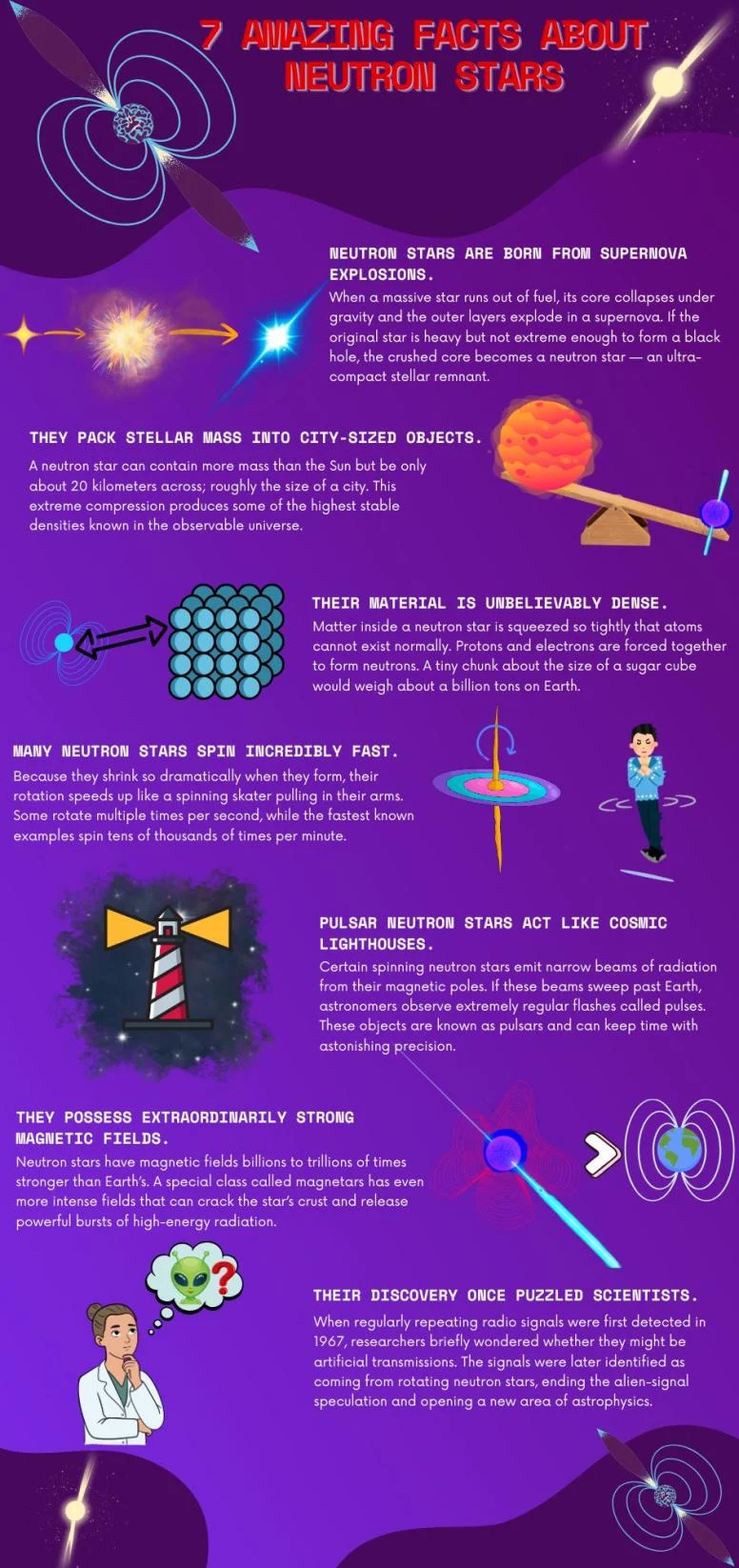
A neutron star is born when a star between eight and twenty-five times the mass of our Sun reaches the end of its life. Once the star’s core begins producing iron, nuclear fusion ceases, and the outward pressure that once balanced gravity vanishes. In a fraction of a second, the core collapses, and the outer layers are blasted away in a supernova. What remains is a core so compressed that its protons and electrons are crushed together into neutrons.
2. City-Sized Behemoths
The most striking characteristic of a neutron star is its compact nature. While it may contain 1.4 to 2.1 times the mass of the Sun, all that matter is packed into a sphere roughly 20 kilometers (12 miles) in diameter. To put this in perspective, a sphere the size of Manhattan contains a mass greater than our entire solar system’s central star.

3. Infinite Density: The "Sugar Cube" Metric
The density of a neutron star is nearly unimaginable. Matter is squeezed so tightly that a single teaspoon (or a sugar-cube-sized portion) of neutron star material would weigh approximately one billion tons. This is equivalent to the weight of the entire human population, or roughly 900 Great Pyramids of Giza, compressed into the tip of a finger.
4. Extreme Rotational Velocities
Conservation of angular momentum dictates that as an object shrinks, its rotation speeds up. Just as a figure skater spins faster when they pull their arms in, a collapsing star’s rotation accelerates exponentially. Some neutron stars, known as millisecond pulsars, rotate hundreds of times per second. The fastest known pulsar, PSR J1748−2446ad, spins at a staggering 716 times per second, or about 24% of the speed of light at its equator.
5. Pulsars: The Universe’s Lighthouses
When a neutron star possesses a strong magnetic field and emits beams of electromagnetic radiation from its poles, it is classified as a pulsar. As the star rotates, these beams sweep across space. If Earth lies in the path of these beams, we detect a rhythmic "pulse" of light or radio waves. These pulses are so regular that they rival atomic clocks in their precision.
6. Magnetars: The Most Powerful Magnets
A subset of neutron stars, called magnetars, possesses magnetic fields a quadrillion times stronger than Earth’s. These fields are so intense that they can distort the shapes of atoms into long cylinders and can literally "crack" the star’s crust, resulting in "starquakes" that release more energy in a fraction of a second than the Sun emits in 100,000 years.
II. Chronology: From Prediction to Detection
The history of neutron star research is a testament to the power of theoretical mathematics and the serendipity of observation.

- 1932: James Chadwick discovers the neutron. Shortly after, Soviet physicist Lev Landau speculates on the existence of dense "neutron cores" within stars.
- 1934: Astronomers Walter Baade and Fritz Zwicky officially propose the existence of the "neutron star." They correctly hypothesize that these objects are formed in supernovae and are incredibly dense.
- 1967: Jocelyn Bell Burnell, a postgraduate student at Cambridge, detects a "bit of scruff" on her radio telescope charts. The signal was a series of pulses repeating every 1.33 seconds. Initially nicknamed "LGM-1" (Little Green Men), the discovery was soon identified as the first observed pulsar (PSR B1919+21).
- 1974: Russell Hulse and Joseph Taylor discover the first binary pulsar, proving that neutron stars can orbit one another. This discovery provided the first indirect evidence for gravitational waves, earning them the Nobel Prize.
- 2017: A new era begins. The LIGO and Virgo observatories detect gravitational waves from the collision of two neutron stars (GW170817). This event was also seen by traditional telescopes, marking the birth of "multi-messenger" astronomy.
III. Supporting Data: The Internal Anatomy of a Neutron Star
To understand why neutron stars behave the way they do, scientists look at their internal structure, which is divided into distinct layers, each weirder than the last.
The Atmosphere and Crust
The atmosphere of a neutron star is only a few centimeters thick, composed of plasma under extreme gravitational pull. Below this lies the outer crust, a solid lattice of iron nuclei. As you go deeper, the pressure becomes so high that "neutron drip" occurs—neutrons begin to leak out of the nuclei.
"Nuclear Pasta"
In the inner crust, the competition between nuclear attraction and electrical repulsion creates bizarre shapes that physicists call "nuclear pasta." These structures resemble gnocchi (spheres), spaghetti (rods), and lasagna (sheets). This material is thought to be the strongest substance in the universe, billions of times harder to break than steel.
The Core: A Quantum Mystery
The composition of the inner core remains the greatest mystery in astrophysics. At these densities, matter may exist as a "superfluid" of neutrons that flows without friction, or it may break down further into a "quark-gluon plasma"—a primordial soup of particles that hasn’t existed since the first microseconds of the Big Bang.
IV. Official Responses and Expert Perspectives
The scientific community views neutron stars as the ultimate proving ground for the laws of physics.

Dr. Elizabeth Howe, a lead researcher at the High-Energy Astrophysics Division, notes: "Neutron stars represent the limit of what nature allows. They sit right on the edge of becoming black holes. If you added just a bit more mass to a typical neutron star, gravity would win its final battle against the pressure of the neutrons, and the entire object would vanish into a singularity."
In a recent report from the National Science Foundation (NSF) regarding the NICER (Neutron star Interior Composition Explorer) mission aboard the International Space Station, officials emphasized the importance of these objects for future technology. "The stability of pulsar signals is so high that we are currently developing ‘X-ray Navigation’ (XNAV). This would allow spacecraft to navigate the solar system using pulsars as a cosmic GPS, independent of Earth-based tracking," the report stated.
Furthermore, NASA’s Goddard Space Flight Center has highlighted the role of neutron stars in "Galactic Alchemy." Data from the 2017 kilonova (neutron star merger) confirmed that these events are the primary source of heavy elements. "We used to think supernovae created most of the heavy elements. Now we know that the gold in your wedding ring and the iodine in your body were likely forged in the fire of two neutron stars colliding billions of years ago," explained NASA astrophysicists.
V. Implications: Why Neutron Stars Matter
The study of neutron stars is not merely an academic exercise; it has profound implications for our understanding of the universe and our place within it.
Testing General Relativity
Neutron stars provide a "clean" environment to test Einstein’s Theory of General Relativity. Because they are so massive and compact, they warp spacetime significantly. By observing pulsars in binary systems, scientists can measure how spacetime curvature affects their orbits, confirming Einstein’s predictions with unprecedented precision.

The Origin of Matter
As mentioned, the "kilonova" events caused by merging neutron stars are the universe’s jewelry stores. The intense heat and neutron-rich environment of a merger allow for the "r-process" (rapid neutron capture), which creates elements like gold, platinum, uranium, and silver. Understanding neutron stars is, therefore, essential to understanding the chemical evolution of our galaxy.
Fundamental Physics
Neutron stars allow us to study matter under conditions that can never be replicated on Earth. We cannot build a laboratory that produces the pressure of a billion atmospheres or the magnetic field of a magnetar. By observing these stars, we are essentially looking at a "high-energy physics lab" provided by the universe for free.
A Gateway to Black Holes
Neutron stars occupy the narrow window between "normal" matter and the total gravitational collapse of a black hole. By determining the maximum possible mass of a neutron star (the Tolman-Oppenheimer-Volkoff limit), scientists can better understand the transition point where matter ceases to exist and a singularity is formed.
Conclusion: The Sentinels of the Deep
Neutron stars are the ultimate paradox: they are small yet massive, dead yet incredibly active, and silent yet screaming with radiation. They challenge our understanding of what matter can endure and serve as the cosmic forges for the very materials we value most on Earth.
As our telescopes grow more sensitive and our gravitational wave detectors more precise, we will continue to peel back the layers of these city-sized enigmas. Whether they are helping us navigate the stars or revealing the secrets of the subatomic world, neutron stars remain one of the most fascinating and terrifying wonders of the modern astronomical era. In the words of the late Carl Sagan, "Somewhere, something incredible is waiting to be known"—and for many astronomers, that "something" is hidden within the dense, spinning heart of a neutron star.
