

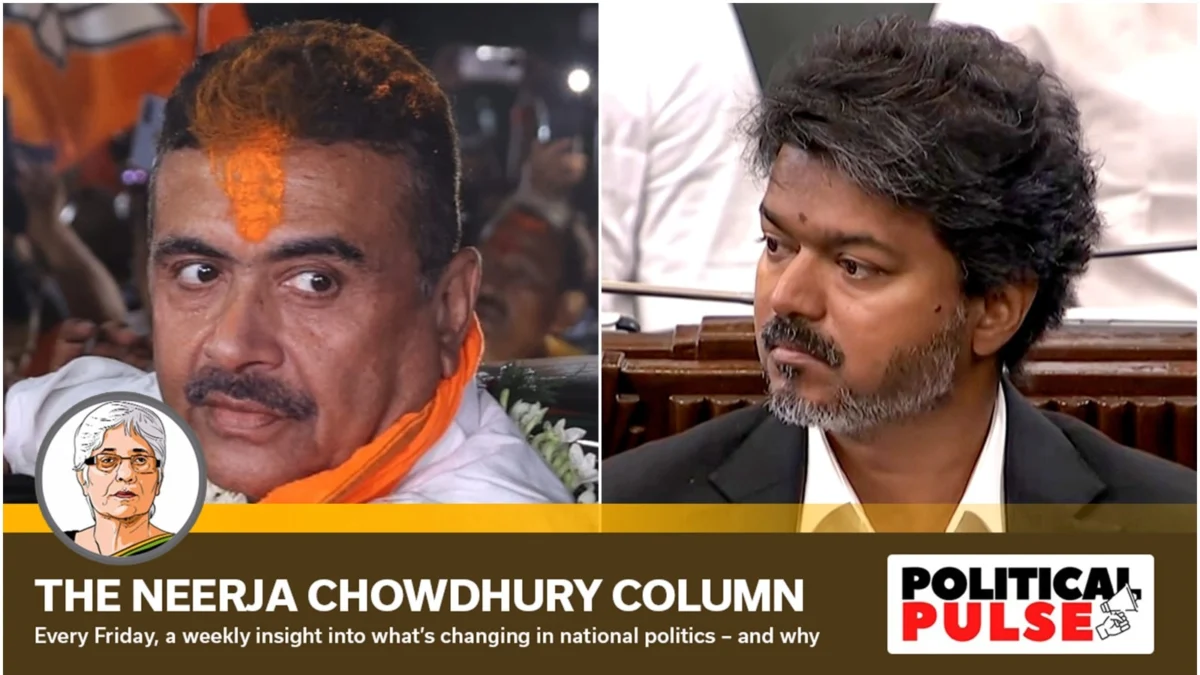
Democracy, at its heart, is a contract of trust – a trust between the governed and the government, and crucially, between political rivals. Its resilience is not merely etched in constitutional texts but in the unwritten norms of conduct, particularly how victors embrace their triumph and the vanquished accept their defeat. Recent political transitions in West Bengal and Tamil Nadu, following keenly contested Assembly polls, have cast a stark spotlight on these foundational tenets, offering a mixed tableau of democratic health and emerging challenges.
A curious, and indeed, concerning, trend emerged from the latest electoral cycles: neither of the outgoing chief ministers, Mamata Banerjee in West Bengal nor M.K. Stalin in Tamil Nadu, attended the oath-taking ceremonies of their respective successors, Suvendu Adhikari and C. Joseph Vijay. While democratic norms are increasingly under strain globally, this dual absence at such symbolically potent events was notably conspicuous, inviting a deeper examination of its implications for India’s democratic fabric.
The Litmus Test of Democracy: Winners, Losers, and Transitions
The peaceful transfer of power is the bedrock of any functioning democracy. It signifies the people’s sovereign will and the cyclical nature of political authority. The manner in which this transition unfolds speaks volumes about the maturity of a nation’s political culture.
The Significance of Swearing-in Ceremonies
A swearing-in ceremony is more than a mere formality; it is a profound ritual of democratic continuity. It is a moment where the baton of governance is visibly passed, reinforcing the principle that power resides with the people, not perpetually with any individual or party. Traditionally, the presence of the predecessor at such an event serves multiple crucial purposes. It softens the often-hard lines of a fiercely contested election, offering a gesture of unity and respect across the political divide. It sends a prudent message to the incoming leader – that their tenure, while significant, is not eternal, underscoring the imperative of performance and accountability. For the outgoing leader, it is a dignified acknowledgement of the democratic process, and subtly, a reassurance that their time might come again. This tradition fosters a culture of mutual respect, acknowledging that while ideologies may differ, the commitment to the democratic process remains shared.
A Glaring Absence: West Bengal and Tamil Nadu
The decision by Mamata Banerjee and M.K. Stalin to forgo attending their successors’ inaugurations therefore represents a departure from these established courtesies. While not constitutionally mandated, such gestures are deeply ingrained in India’s political tradition, meant to underscore the sanctity of the democratic transition. Their absence, particularly in the context of increasingly bitter and hostile electoral battles, raises questions about the willingness of political adversaries to acknowledge legitimate mandates and engage in the fundamental civility required for democratic discourse.
Mamata Banerjee’s Defiance: A Challenge to Democratic Norms
The case of West Bengal’s outgoing Chief Minister, Mamata Banerjee, proved particularly tumultuous. Known for her fiery rhetoric and a political journey marked by relentless struggle, Banerjee’s response to her party’s defeat was one of outright rejection. She refused to accept the outcome, alleging that the election was "stolen" and that approximately 100 seats were "looted" due to a "complicit role" played by the Election Commission (EC). This stance led to her unprecedented refusal to step down immediately after the results were declared.
Allegations of "Vote Chori" and Constitutional Implications
Banerjee’s claims of "vote chori" (vote theft) and the Election Commission’s alleged complicity, while vehemently asserted, directly challenged the legitimacy of the electoral process itself. Such accusations, if unsubstantiated through proper legal channels, can severely erode public faith in democratic institutions. Despite her strong convictions, Mamata Banerjee was aware that the West Bengal Assembly’s tenure was constitutionally set to lapse on May 7, rendering her continued presence as CM untenable. Her decision to enter a "fighting mode" from the outset, rather than immediately conceding, was perhaps a strategic move to energize her vulnerable cadre and maintain party morale in the face of defeat.
However, the implications of such an unprecedented refusal to accept poll results extend far beyond a single state election. It sets a perilous precedent where future chief ministers, or even prime ministers, might choose to reject electoral setbacks on similar grounds. In a country as vast and diverse as India, where allegations of electoral irregularities, whether real or perceived, can always be made, such a trend could destabilize the entire democratic framework. While acknowledging her stated disquiet regarding the deletion of lakhs of names from electoral rolls during the EC’s Special Intensive Revision (SIR) exercise – and without justifying any potential "vote chori" – it is crucial to emphasize that established democratic remedies exist. Election petitions and judicial challenges are the legitimate avenues for addressing such grievances, which her party has indicated it will pursue. The health of democracy hinges on the belief that these remedies are sufficient and fair, even if the perceived impartiality of institutions has waned over time.
The Precedent Set and its Perilous Path
The historical context further illuminates the gravity of Banerjee’s actions. In 1975, then-Prime Minister Indira Gandhi was disqualified from Parliament due to electoral malpractices in her 1971 Rae Bareli election. Her response, the declaration of an Emergency, remains a controversial chapter in Indian democracy. While the context and scale are vastly different, the underlying principle of challenging electoral outcomes and potentially undermining institutional authority carries a significant risk. Today, the perception that action against high office holders for malfeasance is less likely only adds to the challenge of upholding democratic integrity. The refusal to accept a mandate, even with legitimate grievances, risks creating a culture where political defeat is seen not as a consequence of public choice, but as an illegitimate act of subversion, thereby justifying a rejection of the democratic process itself.
M.K. Stalin’s Strategic Grace: Embracing Defeat and Opposition
In stark contrast to the West Bengal narrative, the response of M.K. Stalin, the outgoing Chief Minister of Tamil Nadu, offered a masterclass in strategic grace and democratic maturity. Despite his party, the DMK, facing a significant debacle in the Assembly polls, Stalin’s actions demonstrated a pragmatic understanding of the democratic cycle and the importance of respecting the public mandate.
Navigating a Shifting Political Landscape
Stalin resigned immediately after the results were clear, embodying the principle of accountability. That same evening, he was seen at his party office, actively reassuring his workers and outlining a vision for the DMK as a strong and vigilant opposition. The following day, he embarked on a roadshow in his constituency, Kolathur, to thank the people, a poignant gesture of gratitude even in defeat. This visible engagement, coupled with an emotional connection with his supporters, helped reinforce the idea that losing an election is not the end, but a new beginning for a political party.
The political landscape in Tamil Nadu was particularly charged. The newcomer, actor-turned-politician C. Joseph Vijay, leading his fledgling TVK, had fallen just 10 seats short of a majority. This created a period of intense speculation and maneuvering. Vijay met Governor Rajendra Arlekar repeatedly to stake his claim, actively working to cobble together a majority with smaller parties. In response, his adversaries, including the DMK, initially contemplated a pushback.
The Power of Political Prudence and Public Mandate
For a brief period, there was considerable buzz about a potential, almost unthinkable, alliance between the two arch Dravidian rivals, the DMK and AIADMK. The idea was to sink their decades-old differences to checkmate Vijay, whom they perceived as a "Gen Z-fuelled political disruptor" representing an unwelcome change. Reports even suggested that the DMK considered offering outside support to AIADMK leader Edappadi K. Palaniswami (EPS) to form a government, solely to keep the 51-year-old Vijay at bay.
However, "wiser counsel" ultimately prevailed within the DMK. Sensing an overwhelmingly pro-Vijay public mood, the party pulled back from such a confrontational stance. Nudged by his Left allies, Stalin then encouraged other partners, like the VCK, to back Vijay. This crucial gesture was not lost on the electorate, particularly segments like Dalits and minorities, who had historically gravitated towards the DMK but had shown a marked shift towards the TVK. Stalin’s decision reflected a profound understanding that it was strategically more beneficial, and democratically more responsible, to respect the public mandate and wait for his party’s moment to come again. It was a recognition that attempting to thwart the clear will of the people, even through legitimate political maneuvering, could have long-term repercussions for the party’s image and future prospects.
C. Joseph Vijay’s Breakthrough: A New Era of Civility in Tamil Nadu?
C. Joseph Vijay’s entry into the political arena and his subsequent victory have heralded a potential realignment of political forces in Tamil Nadu. But it was his gesture of goodwill towards his predecessor that truly stood out, marking a welcome departure from the state’s often acrimonious political history.
Breaking Decades of Rivalry
In a move that had not been witnessed in over five decades of bitter rivalry between the DMK and the AIADMK, Vijay called on M.K. Stalin at his residence. This was more than a mere courtesy; it was a powerful symbol of political civility. For decades, the political landscape of Tamil Nadu has been dominated by a zero-sum game between the two Dravidian giants, characterized by intense personal animosity and a lack of overt mutual respect. Vijay’s action, therefore, represented a conscious effort to break this cycle, signaling a potential shift towards a more constructive, if still competitive, political discourse.
Realignment and the Future of State Politics
Vijay’s rise, coupled with his diplomatic gesture, suggests a new dynamic for Tamil Nadu politics. His ability to connect with a younger generation, coupled with his willingness to engage across the political aisle, could foster an environment where political adversaries, while fiercely competing, can still maintain a basic level of respect for each other and for the institutions they represent. This could lead to a more nuanced form of opposition, where critique is aimed at policy rather than personality, and where collaboration on issues of state interest might become more feasible. Such a realignment, if sustained, would not only benefit the state but also strengthen the overall democratic practice, demonstrating that new leadership can indeed bring new, positive norms to the political table.
Historical Echoes: Lessons from India’s Democratic Journey
The contrasting responses in West Bengal and Tamil Nadu resonate with historical precedents in India, offering valuable lessons on the enduring strength and occasional fragility of its democracy.
Indira Gandhi: From Disqualification to Defeat and Comeback
The experience of Indira Gandhi remains a powerful case study. In 1977, after her resounding defeat in the post-Emergency elections, she accepted the people’s verdict with a public address on All India Radio and promptly submitted her resignation to then-acting President B.D. Jatti. This act, while perhaps politically strategic for her eventual comeback, was fundamentally an adherence to democratic process. Personally, however, the transition was profound. She struggled with the sudden loss of power, the cessation of daily routines, the lack of official support, and the stark reality that the drums beaten outside her 1, Safdarjung Road residence were to celebrate her exit, not her leadership. This personal experience underscores the immense difficulty for powerful, popular leaders to accept rejection. Yet, her eventual comeback demonstrated that accepting defeat with grace, and living to fight another day, can indeed be a more potent political option in the long run.
The Resilience of Transitions: The 1996 Paradigm
Former Prime Minister I.K. Gujral once observed that the manner in which power transitions occurred in India after elections was a key factor in the resilience of its democracy. He was particularly referring to the tumultuous period of 1996. Following the defeat of the P.V. Narasimha Rao-led Congress government, Atal Bihari Vajpayee was sworn in as Prime Minister at the head of a BJP-led government. However, he had to resign after just 13 days, unable to prove his majority. Subsequently, a United Front government, led by regional leader H.D. Deve Gowda, was formed.
This period was characterized by immense political uncertainty and simmering tension within Parliament, witnessing the rapid making and unmaking of governments. Yet, crucially, there was no widespread violence, and the change of guard – from Rao to Vajpayee to Deve Gowda – went off smoothly, constitutionally, and without major societal upheaval. This chaotic yet peaceful transition highlighted the robustness of India’s democratic institutions and the underlying political maturity to accept verdicts and changes, even when they are complex and fast-paced. It demonstrated that even in times of deep political instability, the commitment to democratic processes can hold the nation together.
The Erosion of Civility: A Broader Democratic Concern
Beyond the specific instances of individual leaders, the article points to a broader, worrying trend within Indian politics: the erosion of civility and the growing tendency to delegitimize political adversaries.
Delegitimizing the Opposition and its Dangers
There has been a growing and alarming trend of dubbing political adversaries as "anti-national" and viewing the opposition as inherently illegitimate. This betrays a mindset that anyone opposed to the dominant viewpoint is undesirable, a dangerous path that can justify one-party rule and stifle dissent. Such rhetoric not only poisons the political discourse but also disheartens opposition leaders and, crucially, younger politicians. If the message conveyed is that their turn to govern might come only "20-30 years down the line," it fundamentally undermines their stake in the democratic system, making political participation seem futile and discouraging new talent. A vibrant democracy requires a strong, legitimate opposition, one that feels its voice is heard and its turn to govern is possible. When this belief is shattered, the foundations of multi-party democracy begin to crack.
Rebuilding Trust in Institutions
The health of many of India’s institutions, including the Election Commission and the judiciary, has been a subject of public debate and concern. When confidence in these institutions to ensure fair play and justice wavers, the entire democratic edifice is threatened. The perception that action against powerful individuals is less likely today than in the past, for instance, can foster a sense of impunity and further erode public trust. Rebuilding this trust is paramount. It requires transparency, accountability, and a consistent adherence to constitutional principles and ethical conduct by all stakeholders – political parties, leaders, and the institutions themselves.
Conclusion: Beyond Constitutions, Towards a Culture of Democracy
Ultimately, India’s democracy is not solely sustained by its robust constitutional provisions or intricate legal frameworks. It is equally, if not more, reliant on the intangible elements: the niceties, the courtesies, and a fundamental spirit of give-and-take among political actors. These unwritten rules facilitate smooth transitions, soften the blows of defeat, and ensure that fierce political competition does not devolve into existential conflict.
The contrasting narratives from West Bengal and Tamil Nadu serve as a timely reminder. While Mamata Banerjee’s defiance underscores the perils of rejecting electoral outcomes without recourse to established legal remedies, M.K. Stalin’s strategic concession and C. Joseph Vijay’s goodwill gesture highlight the enduring power of democratic civility and the wisdom of respecting the public mandate. For India’s democracy to not just survive but thrive, it must cultivate a political culture where both winners and losers act as responsible custodians of its foundational values, recognizing that their conduct profoundly shapes the nation’s future. The health of democracy, indeed, lies in the graciousness of victory and the dignity of defeat.
(Neerja Chowdhury, Contributing Editor, The Indian Express, has covered the last 11 Lok Sabha elections. She is the author of ‘How Prime Ministers Decide’.)
