

KOLKATA — In the world of materials science, the quest for "living" inorganic matter has long been considered the Holy Grail. For decades, researchers have sought materials that possess the structural integrity of a diamond but the regenerative capabilities of human skin. That boundary has now been significantly blurred.
A multi-institutional team of Indian researchers has announced the discovery of a unique mechanism in molecular crystals that allows them to autonomously repair macroscopic cracks in mere milliseconds. This breakthrough, led by scientists from the Indian Institute of Science Education and Research (IISER) Kolkata, in collaboration with the Indian Institute of Science (IISc) Bangalore, the Indian Institute of Technology (IIT) Indore, and the CSIR-National Chemical Laboratory (NCL) Pune, represents a paradigm shift in how we perceive the durability of solid-state matter.
The discovery, centered on an organic crystal known as 2-methyl-4-nitroimidazole (MNI), offers a blueprint for a future where electronics do not simply break and become waste, but rather "heal" themselves from the daily wear and tear of mechanical stress.
The Breakthrough: Defying the Fragility of the Rigid
Historically, self-healing materials have been synonymous with "soft" matter. Polymers, hydrogels, and various elastomers have demonstrated the ability to mend themselves because their molecular chains are flexible and mobile; when a polymer is cut, its long-chain molecules can wiggle back across the gap to re-establish bonds.
However, rigid crystals—the building blocks of semiconductors and precision optics—are a different story. Crystals are defined by their highly ordered, brittle structures. When a crystal cracks, it usually shatters permanently. While some "hard" self-healing crystals have been developed in the past, they almost universally required an external "trigger." To bridge a fracture, these materials needed to be blasted with high-intensity UV light, submerged in chemical solvents, or heated to extreme temperatures to induce molecular mobility.

The Indian research team has upended this limitation. Their study reveals that MNI crystals require no such intervention. They heal autonomously, driven by internal forces generated by the very act of cracking. This is the first time such a rapid, autonomous repair mechanism has been observed in a rigid, centrosymmetric molecular crystal.
Chronology of Discovery: From Lab Growth to Millisecond Observation
The journey toward this discovery began in the specialized laboratories of IISER Kolkata, where researchers were investigating the mechanical properties of organic solids. The team focused on 2-methyl-4-nitroimidazole (MNI), a laboratory-grown organic crystal.
The Initial Observation:
During routine mechanical testing, researchers noticed an anomaly. When MNI crystals were subjected to physical stress, they did not behave like typical brittle solids. Instead of a clean break or a catastrophic shatter, the cracks appeared to behave elastically.
The Controlled Experiment:
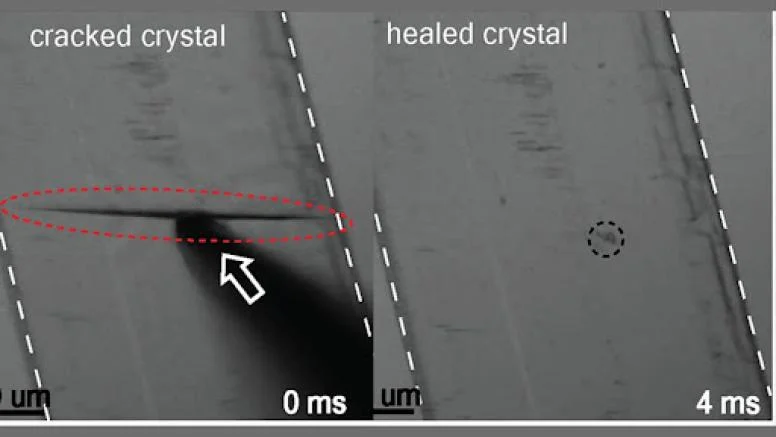
To verify this, the team utilized high-precision equipment, including specialized microscopes and nano-indentation tools. They "poked" the MNI crystal with a microscopic metal needle. Under the lens, a fascinating phenomenon unfolded: as the needle penetrated the crystal, a crack began to spread. However, the crack did not zip through the entire material. It stopped halfway.
The "Snap-Back" Moment:
The most startling discovery occurred when the needle was withdrawn. The moment the external pressure was released, the two sides of the crack "snapped" back together. To the naked eye, and even under standard magnification, the damage appeared to vanish. The timeline for this repair was clocked at less than a hundredth of a second—faster than the blink of a human eye.
Supporting Data: The Physics of Symmetry Breaking
To understand why MNI behaves this way, the researchers turned to Raman spectroscopy and laser-based optical testing. These tools allowed them to peer into the molecular architecture of the crystal during the exact moment of fracture.

Molecular Architecture:
MNI is a centrosymmetric molecule, meaning its structure is perfectly balanced around a central point. Under normal conditions, this symmetry results in a neutral electrical state. The crystal is built in stacked sheets, much like a microscopic deck of cards held together by intermolecular forces.
The Mechanism of "Symmetry Breaking":
The team discovered that when the metal needle forces these sheets apart, the perfect symmetry of the crystal is momentarily destroyed. This is known as "stress-induced symmetry breaking." At the surface of the crack, the sudden distortion of the molecular layers generates a temporary, localized electrical charge—essentially creating a microscopic dipoles.
The Electrostatic Pull:
These temporary charges create a powerful attractive force between the two split surfaces. Furthermore, the tip of the crack in MNI doesn’t stay sharp; it slightly bends, acting as a miniature mechanical shock absorber that prevents the total separation of the crystal lattice.
Data Synthesis:
The Raman spectroscopy data confirmed that once the needle (the external stressor) is removed, the internal electrostatic attraction takes over. The distorted layers are pulled back into their original positions with such precision that the molecular bonds are reformed almost perfectly. The crystal returns to its original centrosymmetric state, effectively erasing the "memory" of the damage.
Official Responses and Academic Significance
While the study was published in a high-impact scientific journal (Nature Communications), the implications have resonated throughout the Indian scientific community.
Lead researchers from IISER Kolkata emphasized that this discovery bridges a crucial gap between mechanical hardness and flexible self-repair. "Previously, we thought that to have self-healing, we had to sacrifice rigidity," the team noted in their findings. "MNI proves that we can engineer materials that are both structurally sound and capable of autonomous restoration."

Experts from the Indian Institute of Science (IISc) highlighted the precision of the healing. Unlike polymer healing, which can often leave a "scar" or a weakened area, the MNI crystal’s healing is guided by its own lattice structure. Because the molecules are pulled back into a pre-defined grid, the structural integrity of the healed area remains remarkably high.
The collaboration between IISER, IISc, IIT Indore, and CSIR-NCL underscores the growing prowess of Indian materials science in tackling fundamental physics problems that have direct industrial applications.
Implications: A Greener, More Durable Tech Future
The discovery of self-healing molecular crystals arrives at a critical juncture for the global technology industry. As we move toward an era of "ubiquitous computing," the vulnerabilities of our hardware have become a major economic and environmental burden.
1. Revolutionizing Consumer Electronics:
The most immediate application lies in the miniaturized components of smartphones, tablets, and wearables. Currently, a hairline fracture in a microchip or a microscopic solder joint can render a $1,000 device useless. Integrating MNI-like self-healing crystals into the internal circuitry could allow devices to survive drops and shocks that would currently be fatal.
2. Space and Aerospace Engineering:
In the vacuum of space, repairing hardware is nearly impossible. Satellites and spacecraft are subjected to extreme temperature fluctuations and micrometeoroid impacts that cause structural fatigue. Materials that can heal themselves in milliseconds without human intervention or external power sources would be invaluable for long-term space missions.
3. The Global E-Waste Crisis:
Perhaps the most significant impact is environmental. The world generates over 50 million metric tons of electronic waste annually, much of it due to non-repairable mechanical failures. If the lifespan of a smartphone could be doubled or tripled through self-healing internal components, the reduction in global e-waste would be staggering.

Challenges and the Road Ahead
Despite the excitement, the researchers are careful to manage expectations. The self-healing property of MNI, while miraculous, has its limits.
The team noted that the mechanism relies on the crack being "contained." If a massive, overwhelming force is applied—such as a high-velocity impact that shatters the crystal into separate, distant fragments—the material cannot reassemble. The attractive forces are short-range; once the pieces are completely separated from the main body, the "magic" of the snap-back effect is lost.
Furthermore, the electrical charges that drive the healing are so minuscule and transient that they cannot be measured by standard laboratory force sensors. The team had to rely on secondary optical tests to confirm their presence, suggesting that engineering these materials into macro-scale products will require sophisticated new manufacturing techniques.
The next phase of research will likely involve "doping" or alloying these crystals to see if the self-healing property can be transferred to other materials or made even more robust against total fracture.
Conclusion
The discovery of millisecond self-healing in rigid MNI crystals by Indian scientists is more than just a laboratory curiosity; it is a glimpse into a future of "resilient technology." By harnessing the fundamental laws of symmetry and electrostatics, the team has shown that the line between the biological and the mineral is thinner than we once thought. As this research moves from the microscope to the production line, it may eventually lead to a generation of machines that, like the organisms that created them, possess the remarkable ability to heal themselves.
