

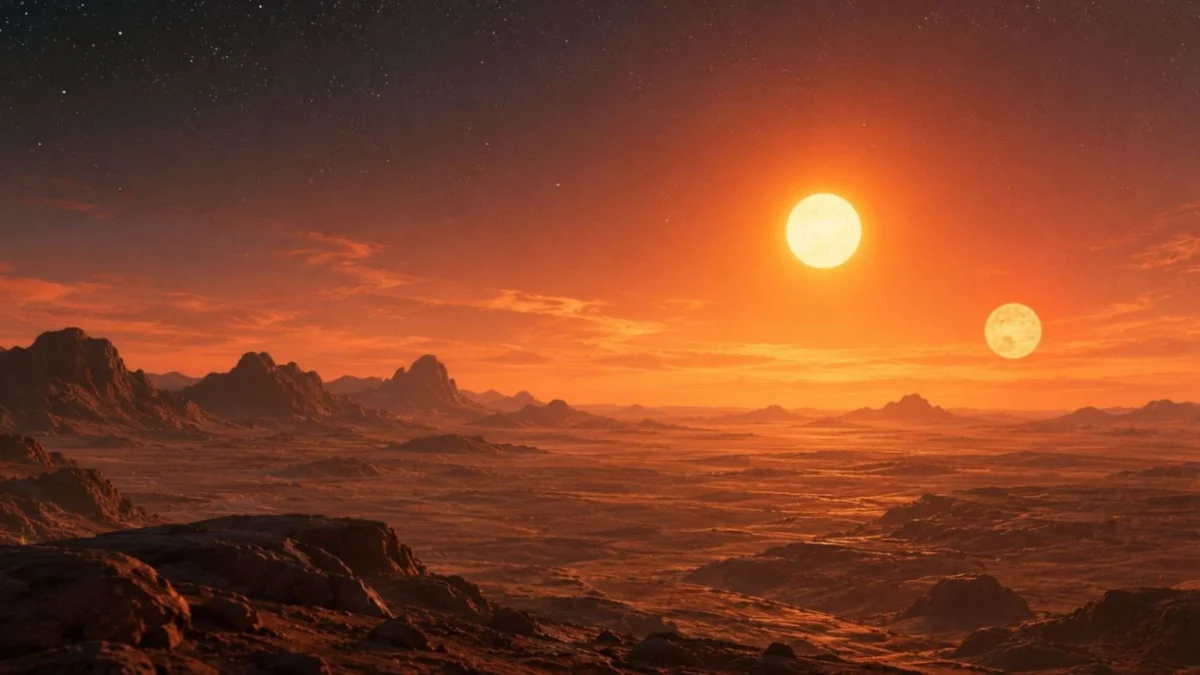
SYDNEY — In a discovery that bridges the gap between cinematic imagination and rigorous astrophysics, a team of researchers has identified 27 potential "circumbinary" planets—worlds that orbit two stars rather than one. The findings, reminiscent of the iconic desert planet Tatooine from the Star Wars saga, represent a significant leap in our understanding of planetary systems beyond our own solar system.
The research, led by scientists at the University of New South Wales (UNSW) and published in the Monthly Notices of the Royal Astronomical Society, utilizes innovative detection techniques to sift through data from NASA’s Transiting Exoplanet Survey Satellite (TESS). While more than 6,000 exoplanets have been confirmed to date, the vast majority orbit a single host star. The discovery of these 27 candidates suggests that the "two-sun" configuration may be far more common than previously documented.
Main Facts: A New Frontier in Exoplanet Research
The core of the discovery lies in the sheer scale of the potential find. Until now, only about 18 circumbinary planets had been definitively confirmed. The addition of 27 new candidates—if confirmed—would more than double the known population of these exotic worlds.
The candidate planets are located at distances ranging from 650 to 18,000 light-years from Earth. According to the study, these worlds are not small, rocky outposts like Earth; instead, they are gas giants ranging in size from Neptune-like spheres to massive "Super-Jupiters" up to ten times the mass of our solar system’s largest planet.
The detection was made possible by observing "binary star systems"—systems where two stars orbit a common center of mass. Because more than half of the stars in the observable universe exist in multiple or binary systems, the potential for finding planets in these environments is mathematically immense, yet historically difficult to achieve due to the complex gravitational dance between the two stars.
Chronology: From Science Fiction to Satellite Data
The timeline of this discovery reflects both the advancement of space-based telescopes and a poetic nod to pop culture history.
- 1977: The world is introduced to Tatooine in Star Wars: A New Hope. At this time, no exoplanets of any kind had been discovered, and the idea of a planet orbiting two suns was relegated to the realm of fantasy.
- 2011: NASA’s Kepler mission confirms the first real-life circumbinary planet, Kepler-16b, proving that such systems are physically possible.
- 2018: NASA launches the Transiting Exoplanet Survey Satellite (TESS). Unlike its predecessor Kepler, which focused on a small patch of the sky, TESS was designed to survey the entire sky to find planets orbiting the brightest stars.
- 2022–2024: Researchers at UNSW, led by PhD candidate Margo Thornton and Associate Professor Ben Montet, begin an exhaustive search through TESS data, specifically looking for anomalies in binary star systems.
- May 4, 2024 (Star Wars Day): The team chooses the symbolic date of May 4th to highlight their findings, emphasizing the link between scientific discovery and the public’s fascination with "Tatooine-like" worlds.
- Present: The study is formally published, initiating a new phase of "follow-up" observations to confirm the mass and composition of the 27 candidates.
Supporting Data: The Mechanics of the "Tug"
Detecting a planet around a single star is already a monumental task. Astronomers typically look for a "transit"—a slight dip in a star’s brightness as a planet passes in front of it. However, in a binary system, the two stars are constantly eclipsing each other, making the light data incredibly "noisy."
To overcome this, the UNSW team employed a method known as Eclipse Timing Variations (ETVs) and Apsidal Precession.
The Math of Motion
The team screened 1,590 binary star systems. They were looking for precise irregularities in the timing of the stars’ mutual eclipses. In a perfect binary system, the eclipses happen with clockwork regularity. However, if a third body—a planet—is orbiting those stars, its gravitational pull causes the stars to "wobble" slightly.
"If we monitor the exact timing of these eclipses, that can tell us that there’s something else going on in the system," explained lead author Margo Thornton. Out of the 1,590 systems studied, 36 showed behavior that could only be explained by the presence of a third body. After eliminating the possibility of other stars or brown dwarfs, 27 remained as high-probability planet candidates.
Apsidal Precession
The team also looked for "apsidal precession," which refers to the rotation of the orbit itself over time. The presence of a planet accelerates this rotation. By measuring how the orbital path of the two stars shifted, the researchers could infer the mass of the hidden planet tugging on them.
Official Responses: Insights from the Scientific Community
The discovery has sparked excitement among astrophysicists, both for the results themselves and the methodology used.
Ben Montet, Associate Professor at UNSW:
Montet emphasized the human connection to these distant worlds. "There are many things in astronomy that aren’t very tangible… Everyone has a picture of what a circumbinary planet looks like and what it would mean to stand on a planet with two suns," he told The Guardian. He noted that while the "transit" method is effective, it requires a perfect alignment between the planet, the stars, and Earth’s line of sight. "We’re missing lots of systems, potentially," he added, highlighting that the ETV method allows them to find planets that don’t necessarily cross directly in front of their stars.
Margo Thornton, Lead Author and PhD Candidate:
Thornton noted that the work is not yet finished. The 27 objects are currently classified as "candidates" because their exact nature—whether they are planets, brown dwarfs (failed stars), or very small stars—depends on a precise measurement of their mass. "It’s just a matter of: what is the mass of it? More research into their spectra—the light they emit—is needed to formally confirm them."
Dr. Sara Webb, Astrophysicist at Swinburne University of Technology:
Dr. Webb, who was not involved in the study, praised the "very clever techniques" used by the UNSW team. She pointed out the philosophical shift in science since the 1970s. "When the original Star Wars films were released, scientists had not yet discovered exoplanets," she said. Webb also noted that these planets likely exist in "extreme environments," but theoretically, a Tatooine-like planet could exist in a "habitable zone"—the "Goldilocks" region where liquid water could persist on a surface.
Implications: Redefining the Search for Life
The identification of these 27 candidates has profound implications for the future of astronomy and the search for extraterrestrial life.
1. The Prevalence of Planetary Systems
For decades, astronomers focused on single-star systems like our own because they were simpler to model. However, since binary systems make up the majority of the stellar population, the UNSW study suggests that we have been looking for planets in the "wrong" places. If circumbinary planets are common, the total number of planets in the Milky Way could be significantly higher than current estimates.
2. New Habitability Models
The "Habitable Zone" in a binary system is much more complex than in our solar system. A planet must be far enough away to avoid being gravitationally ejected by the dancing stars, but close enough to receive warmth. Furthermore, the temperature on such a planet would fluctuate based on whether the stars were aligned or spread apart. Studying these 27 candidates will help climate scientists model how atmospheres might behave under the radiation of two different suns.
3. Future Instrumentation
The discovery sets the stage for follow-up missions using the James Webb Space Telescope (JWST) and the upcoming European Space Agency’s PLATO mission. These instruments will be able to look at the "spectra" of these candidates—analyzing the light filtered through their atmospheres to look for chemical signatures like oxygen, methane, or water vapor.
4. The Bridge Between Art and Science
As Dr. Sara Webb noted, the discovery reinforces the idea that science fiction often serves as a precursor to scientific reality. By proving that the "Tatooine" configuration is a viable stable environment for planet formation, researchers are validating decades of speculative fiction and inspiring a new generation of astronomers to look toward the stars.
The 27 candidates found by the UNSW team represent more than just data points; they are potential milestones in our journey to understand the diversity of the universe. As we move from detection to confirmation, the dream of standing on a world with a double sunset moves one step closer to a scientific fact.
