

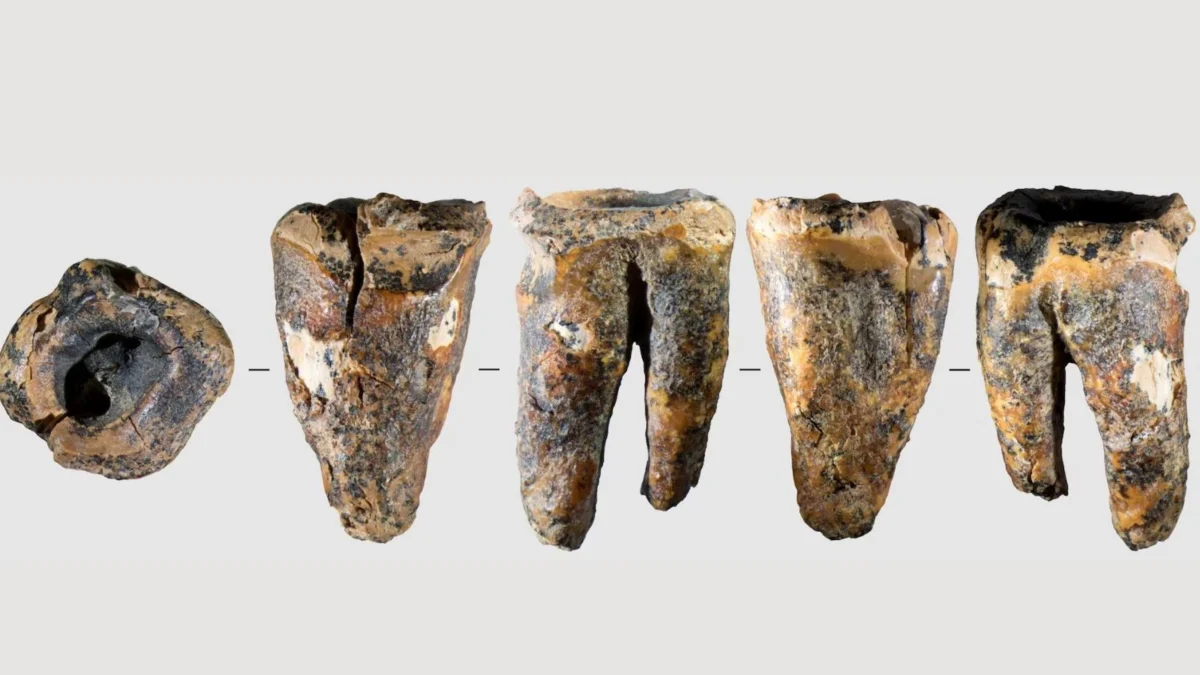
NEW DELHI — In a discovery that challenges the long-held narrative of human exceptionalism and the perceived "primitivism" of our extinct cousins, researchers have identified what appears to be the earliest known instance of dental surgery. Located in the frozen depths of a Siberian cave, a 59,000-year-old Neanderthal molar has revealed evidence of a deliberate, sophisticated medical intervention—predating the previous record for dentistry by a staggering 45,000 years.
The study, led by a team of paleoanthropologists from the Russian Academy of Sciences, suggests that Neanderthals were not merely surviving the harsh climates of the Middle Palaeolithic but were actively managing complex health issues through surgical means. The finding provides a rare glimpse into the cognitive and social lives of a species that continues to surprise modern science.
I. Main Facts: The Siberian Discovery
The focal point of this revolutionary study is a single molar unearthed from Chagyrskaya Cave, located in the Altai Mountains of Siberia, Russia. This region has long been a treasure trove for paleoanthropologists, having previously yielded remains of both Neanderthals and their mysterious cousins, the Denisovans.
The Specimen
The tooth in question belonged to an adult Neanderthal who lived approximately 59,000 years ago. Upon initial inspection, the molar appeared to have suffered from severe pathology. However, closer examination revealed a feature that was not the result of natural erosion or dental caries (cavities). A deep, precise hole had been bored into the center of the tooth, penetrating through the enamel and into the dentin.
The Intervention
Researchers conclude that this was not an accidental injury or a byproduct of chewing hard materials. Instead, the evidence points to a deliberate "drilling" procedure. The goal, according to the study, was likely to remove infected pulp tissue and relieve the agonizing pressure caused by an abscess or deep-seated decay. By boring into the tooth, the prehistoric "dentist" would have allowed pus to drain and inflammation to subside, effectively performing an emergency root canal or drainage procedure.
The Toolset
The markings on the tooth suggest the use of a micro-lithic tool—a small, sharp stone implement likely made of flint or chalcedony. The precision required to perform such a task inside a living patient’s mouth indicates a level of manual dexterity and anatomical knowledge previously unassociated with this time period.
II. Chronology: Shifting the Timeline of Medicine
To understand the magnitude of this discovery, one must look at the established timeline of medical history. For decades, the "birth of dentistry" was attributed to early Homo sapiens during the late Upper Palaeolithic or early Neolithic periods.
- Prior Record (14,000 Years Ago): Before the Siberian find, the oldest evidence of dental surgery came from the Villabruna specimen in Italy. This Homo sapiens individual showed signs of a cavity being "scraped" out with a flint tool, dating back roughly 14,000 years.
- Neolithic Advancements (9,000 Years Ago): Evidence from Mehrgarh, Pakistan, showed that early farmers used bow drills to remove decay, a significant leap in technology, but still tens of thousands of years after the Neanderthals of Siberia.
- The New Benchmark (59,000 Years Ago): The Chagyrskaya Cave discovery pushes the origin of dental intervention back by more than 40,000 years. Crucially, it shifts the credit for this innovation from modern humans to Neanderthals.
This chronological shift suggests that the foundations of healthcare—identifying a source of pain and using tools to intervene—were laid long before Homo sapiens became the dominant hominid on the planet.
III. Supporting Data: Microtomography and Experimental Archaeology
The researchers did not arrive at their conclusions lightly. To distinguish between natural wear and intentional surgery, the Russian Academy of Sciences employed a rigorous multi-disciplinary approach.
High-Resolution Microtomography
The team utilized advanced micro-CT scanning (microtomography) to create a three-dimensional reconstruction of the tooth’s internal structure. This allowed them to examine the "walls" of the hole at a microscopic level. They discovered parallel grooves and striations—mechanical signatures left by a rotating or scraping tool. These marks are distinct from the irregular, smooth surfaces created by acid-producing bacteria during natural decay.
Experimental Reconstruction
To validate their hypothesis, the researchers engaged in experimental archaeology. They fashioned replica stone tools using the same materials and techniques available to Neanderthals 60,000 years ago. Using these flint "drills," they performed similar procedures on modern human teeth.
The results were striking: the microscopic wear patterns on the experimental teeth almost perfectly mirrored those found on the Siberian molar. The tests confirmed that a sharp, hand-held stone point, when rotated with sufficient pressure, could indeed penetrate tooth enamel and produce the exact morphology observed in the ancient specimen.
Pathological Analysis
The study also analyzed the surrounding bone structure (where available) and the wear on the molar’s crown. The patient had clearly been using the tooth for years despite the decay, but the "surgical" hole showed signs of slight smoothing around the edges, suggesting the individual survived for some time after the procedure was performed.
IV. Official Responses: Insights from the Lead Researchers
The discovery has sent ripples through the international archaeological community. Dr. Aliza Zubova, the lead researcher on the project, emphasized that this find forces a total reassessment of Neanderthal cognition.
"The most striking aspect of this discovery is the evidence of clear, logical reasoning," Dr. Zubova stated in a briefing. "The individual, or their ‘dentist,’ understood that the pain was coming from inside the tooth. They recognized that the only way to stop the suffering was to breach the hard outer shell and remove the source of the infection. This is an empirical approach to medicine."
Social Cooperation
Dr. Zubova also pointed out the social implications of the find. "Performing a procedure like this is nearly impossible to do on oneself. It requires a patient who is willing to stay still despite immense pain and a practitioner with a steady hand and the trust of their peer. It suggests a high level of social cohesion and a communal commitment to the welfare of the sick."
Academic Context
Other experts from the Russian Academy of Sciences noted that while Neanderthals have been found with evidence of herbal medicine (such as traces of poplar—which contains salicylic acid, the active ingredient in aspirin—in their dental plaque), this is the first definitive evidence of "invasive" surgery. It indicates that their medical repertoire was not limited to the use of plants but included mechanical interventions.
V. Implications: The "Humanity" of Neanderthals
The Siberian tooth discovery serves as a powerful piece of evidence in the ongoing "Neanderthal Renaissance"—a shift in scientific consensus from viewing Neanderthals as brutish "knuckle-draggers" to seeing them as a sophisticated, sentient species.
Cognitive Complexity
To perform dentistry, one needs more than just a tool. One needs a concept of cause and effect, an understanding of anatomy, and the ability to plan a multi-step procedure. This find aligns with recent discoveries of Neanderthal cave art in Spain and complex tool-making in France, suggesting their brains were wired for complex problem-solving and symbolic thought.
The "Care" Model of Evolution
For decades, the survival of the fittest was interpreted as the "survival of the healthiest." However, the Chagyrskaya molar supports the "Care Model," which posits that the survival of our ancestors was dependent on their ability to care for the injured and elderly. If a Neanderthal was willing to spend hours carefully drilling a hole in a companion’s tooth to save them from pain, it implies a capacity for empathy that we once thought was uniquely human.
The Evolutionary Gap
The fact that this technology appeared 59,000 years ago and then seemingly "disappeared" or remained extremely rare for the next 40,000 years raises fascinating questions. Did Neanderthals lose this knowledge during climate shifts? Or have we simply not found enough specimens to see the continuity of this practice? It suggests that the history of technology is not a straight line of progress, but a series of "starts and stops" influenced by environmental and demographic pressures.
Conclusion: A New Lens on the Past
The discovery in Chagyrskaya Cave is more than just a footnote in dental history; it is a profound testament to the resilience and intelligence of the Neanderthal people. It reminds us that tens of thousands of years before the first cities were built or the first words were written, a group of individuals sat in a cave in the Altai Mountains, using stone and ingenuity to fight back against the universal human experience of pain.
As modern science continues to peel back the layers of the Palaeolithic, the line between "us" and "them" continues to blur. The 59,000-year-old dentist of Siberia stands as a reminder that the quest for healing is as old as humanity itself—regardless of which branch of the evolutionary tree we belong to.
References & Further Reading:
- Journal of Archaeological Science: Reports (May 2026 Edition)
- Proceedings of the Russian Academy of Sciences (Paleoanthropology Series)
- Comparative Studies of Middle Palaeolithic Stone Tools and Medical Evolution
