

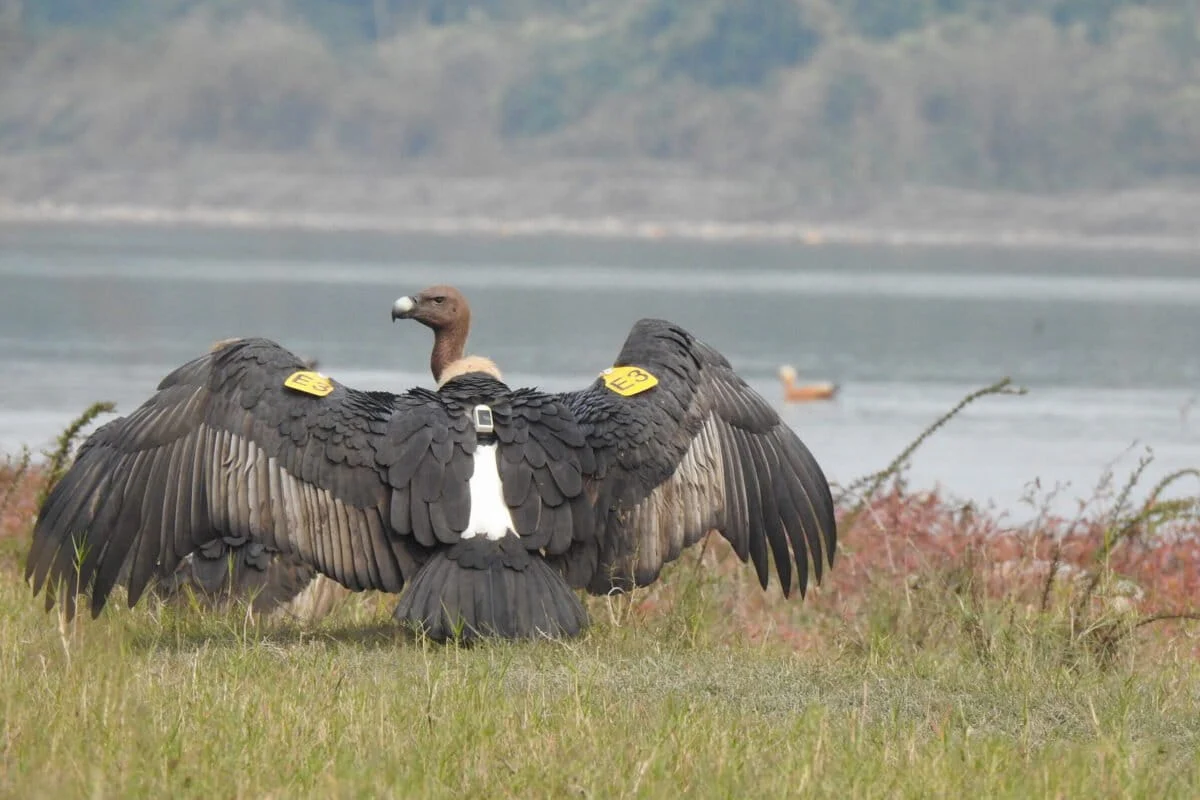
BHOPAL, INDIA — In the high-altitude thermal currents that bridge the Indian subcontinent with Central Asia, borders are invisible. For the cinereous vulture (Aegypius monachus), a massive raptor with a wingspan reaching nearly three meters, the geopolitical boundaries between India and Pakistan are merely landscapes to be traversed in a centuries-old migratory rhythm.
Recently, a single female cinereous vulture became the face of this transboundary ecological reality. Rescued from the brink of death in the plains of Madhya Pradesh, rehabilitated through months of intensive veterinary care, and released with state-of-the-art tracking technology, the bird embarked on a journey that would eventually lead it across one of the world’s most militarized borders, only to be found injured once again in Pakistan.
The case has ignited a fresh dialogue among conservationists regarding the necessity of regional cooperation in wildlife management. As telemetry data provides an increasingly granular look at the movement of these "sentinels of the sky," it becomes clear that the survival of the species depends not on the efforts of a single nation, but on a unified South Asian conservation strategy.
The Core Narrative: From Parsulia to Khanewal
The saga began on January 22, 2026, in the quiet village of Parsulia, located in the Shajapur district of Madhya Pradesh. Local villagers discovered a two-year-old female cinereous vulture grounded and unable to fly. The bird, a juvenile of a species often referred to as the "monk vulture" due to its ruff of feathers resembling a cowl, was suffering from a debilitating leg injury.
The bird was immediately transported to Van Vihar National Park in Bhopal, a premier facility known for its Vulture Conservation Breeding Centre. Under the watchful eyes of government veterinarians and raptor specialists, the vulture underwent a rigorous rehabilitation process. This included stabilization, nutritional support, and physical therapy to ensure its leg had regained the strength necessary for the grueling demands of migration.
By late March, the bird was deemed fit for release. To turn her journey into a scientific opportunity, officials from the Madhya Pradesh Forest Department, in collaboration with WWF-India and the Bombay Natural History Society (BNHS), fitted her with a GPS-GSM telemetry device. This backpack-like unit allows researchers to track a bird’s location, altitude, and speed in real-time.

On March 25, 2026, the vulture was released near the Halali Dam in the Raisen district. For several days, the signals showed a healthy, active bird navigating the Indian landscape. However, by April 6, the data confirmed she had crossed the international border into Pakistan. Shortly thereafter, the signal went dark, sparking fears among the tracking team.
The mystery was resolved when residents in Pakistan’s Khanewal district located the bird. She was once again injured and unable to sustain flight. Local wildlife officials were alerted, and the vulture was moved to a rehabilitation facility in Pakistan, where she is currently recuperating.
A Chronology of Conservation and Movement
The timeline of this vulture’s journey highlights the efficiency of modern rescue networks and the unpredictable nature of wildlife rehabilitation:
- January 22, 2026: Rescue from Parsulia village, Shajapur, MP. Initial diagnosis: severe leg injury.
- January – March 2026: Intensive rehabilitation at Van Vihar National Park, Bhopal. The bird is microchipped, ringed, and monitored for behavioral readiness.
- March 25, 2026: Fitting of the GPS-GSM telemetry device and official release at Halali Dam.
- March 26 – April 5, 2026: The vulture moves northwest across India, utilizing thermal currents to gain altitude.
- April 6, 2026: Telemetry confirms the bird has entered Pakistani airspace.
- Mid-April 2026: The tracking signal ceases.
- Late April 2026: The bird is recovered by locals in Khanewal, Pakistan, and placed under the care of Pakistani wildlife authorities.
This sequence is not an isolated incident. In 2025, a Eurasian griffon vulture followed a similar trajectory, traveling over 4,300 kilometers from Madhya Pradesh to Kazakhstan before eventually returning to India. These recurring patterns underscore that the Indian heartland serves as a vital hub in a vast, international avian highway.
Supporting Data: The Resurgence of Vultures in Madhya Pradesh
While the individual story of the cinereous vulture is a dramatic one, it takes place against a backdrop of broader ecological recovery in Central India. According to the latest state vulture census conducted between February 17 and 19, 2025, Madhya Pradesh has emerged as a stronghold for these scavengers.
The census recorded a total of 12,981 vultures across the state, representing a staggering 19% increase in just one year. This growth is attributed to improved habitat protection, the establishment of "vulture restaurants" (safe feeding sites), and a crackdown on the use of diclofenac—a veterinary drug that is lethal to vultures who consume the carcasses of treated cattle.

The Cinereous Vulture: A Species at a Crossroads
The cinereous vulture is currently listed as "Near Threatened" on the IUCN Red List. Unlike the more common white-rumped vulture, the cinereous is a full migrant. BirdLife International’s 2021 assessment notes a decreasing global population, making every rehabilitated individual vital to the species’ genetic diversity.
In India, the bird is afforded the highest level of legal protection under Schedule I of the Wild Life (Protection) Act. Internationally, it is protected under Appendix II of the Convention on Migratory Species (CMS), a treaty that Pakistan and India are both signatories to, emphasizing the shared responsibility for the bird’s safety.
Expert Insights: The Biology of Migration
Vulture biologist Vibhu Prakash, a former deputy director of the BNHS and a leading authority on South Asian raptors, explains that the movement of the Shajapur vulture was entirely consistent with natural instincts.
"The cinereous or black vulture is largely a wintering bird in India," Prakash noted in an email correspondence. "They typically arrive from North Pakistan, Baluchistan, and Central Asia by October and begin their return journey by March or April. This bird was simply following its internal compass, attempting to return to its breeding grounds in the Himalayas or Central Asia."
Prakash emphasizes that the rescue and rehabilitation process, while intensive, does not override these deep-seated biological urges. "The instinct to migrate is powerful. Once the physical injury was healed, her first priority was to head north."
Ornithologist Alyona Kaptyonkina, of the Biodiversity Research and Conservation Center in Astana, Kazakhstan, points out that the Indo-Pakistani plains are "absolutely critical" for the survival of the Central Asian population.

"Our tracking studies in 2024 showed that vultures from Kazakhstan and Uzbekistan return to the exact same wintering sites in India and Pakistan year after year," Kaptyonkina said. "Places like Bikaner in Rajasthan provide a predictable food supply in the form of livestock carcasses. These are not random stops; they are permanent, essential fixtures in their life cycle."
Official Responses and Cross-Border Collaboration
The recovery of the Indian-tagged vulture in Pakistan has highlighted the informal but effective communication channels between the scientific communities of the two nations. While political tensions often complicate official cooperation, wildlife biologists frequently exchange data to track migratory species.
In Nepal, conservation biologist Krishna Prasad Bhusal has seen similar patterns. Working with the IUCN SSC Vulture Specialist Group, Bhusal has tracked white-rumped and slender-billed vultures from Nepal’s Chitwan region into Uttar Pradesh and northern India.
"Telemetry has changed our understanding of these birds," Bhusal says. "They do not see the border. They see the landscape. Our data shows that vultures routinely cross between Nepal, India, and Pakistan as part of their normal ecology. This makes a regional approach to conservation—specifically the banning of toxic NSAIDs (Non-Steroidal Anti-Inflammatory Drugs) across all these countries—non-negotiable."
Implications: The Road Ahead for Avian Diplomacy
The journey of the Shajapur vulture serves as a stark reminder of the threats that persist despite successful rehabilitation. While the bird was saved from a leg injury in India, it faced unknown perils in Pakistan that led to its second grounding.
Identifying the Threats
Telemetry data from this and other birds have helped researchers identify several "silent killers" that operate across borders:

- NSAID Contamination: While diclofenac is banned, other vulture-toxic drugs like aceclofenac and ketoprofen are still in use in some regions.
- Electrocution: Uninsulated power lines and poorly designed electric poles are a major cause of mortality for large raptors.
- Poisoned Carcasses: In some areas, farmers lace carcasses with pesticides to kill predators like feral dogs or leopards; vultures often become the unintended victims.
- Habitat Fragmentation: The loss of large, old-growth trees for nesting and the closure of traditional carcass-dumping grounds (Hadda-Roris) limit their survival options.
The Need for a "One-Region" Strategy
The fact that a bird rescued in the heart of India can be recovered by villagers in Pakistan’s Punjab province underscores the necessity of a South Asian Vulture Recovery Plan. This would involve:
- Data Sharing: Establishing a formal framework for sharing telemetry data between India, Pakistan, Nepal, and Central Asian republics.
- Harmonized Policy: Ensuring that bans on toxic veterinary drugs are enforced uniformly across the migratory corridor.
- Coordinated Rescue Networks: Creating a protocol for the safe return or shared care of "trans-border" wildlife patients.
Conclusion
The two-year-old cinereous vulture currently sitting in a Pakistani rehabilitation center is more than just a biological specimen; she is a messenger. Her flight from the forests of Madhya Pradesh to the fields of Khanewal demonstrates the profound connectivity of the natural world.
As she recovers for the second time in her short life, her journey remains a testament to the dedication of the veterinarians at Van Vihar and the scientists at BNHS and WWF. However, it also serves as a warning. Without a coordinated, international effort to secure the skies and the food sources of South Asia, the survival of these magnificent "monks of the air" will remain precarious, regardless of how many borders they manage to cross.
For now, conservationists on both sides of the border wait for the day she can take to the skies again, hoping that her next journey will be one of safety rather than struggle.
