

The Rann of Kutch is a landscape that defies the traditional definitions of geography. Spanning approximately 26,000 square kilometers across the Indo-Pakistan border, it is a place where the earth breathes in cycles of salt and water. For part of the year, it is a blindingly white salt desert, so flat that the horizon appears to curve into infinity. For another part, it is a shallow, churning inland sea, reclaimed by the tides of the Gulf of Kutch and the monsoon rains.
This article explores the multifaceted identity of the Rann—from its origins as a navigable ancient waterway to its current status as a site of intense industrial development and ecological fragility.
Main Facts: A Desert of Dualities
The term Rann is derived from the Hindi word for salt marsh, while Kutch refers to a region that alternates between wet and dry states. Geographically, the region is divided into the Great Rann and the Little Rann, forming one of the most extensive salt plains in the world.
A Seasonal Metamorphosis
The Rann’s most striking characteristic is its annual disappearance. During the monsoon months, tidal currents from the Gulf of Kutch surge northward, flooding the low-lying plains. This transformation turns the "White Desert" into a massive, shallow lake. As the waters recede with the retreat of the monsoon, they leave behind a thick crust of salt crystals that shimmer like snow under the relentless Gujarati sun.
Biodiversity and Ecology
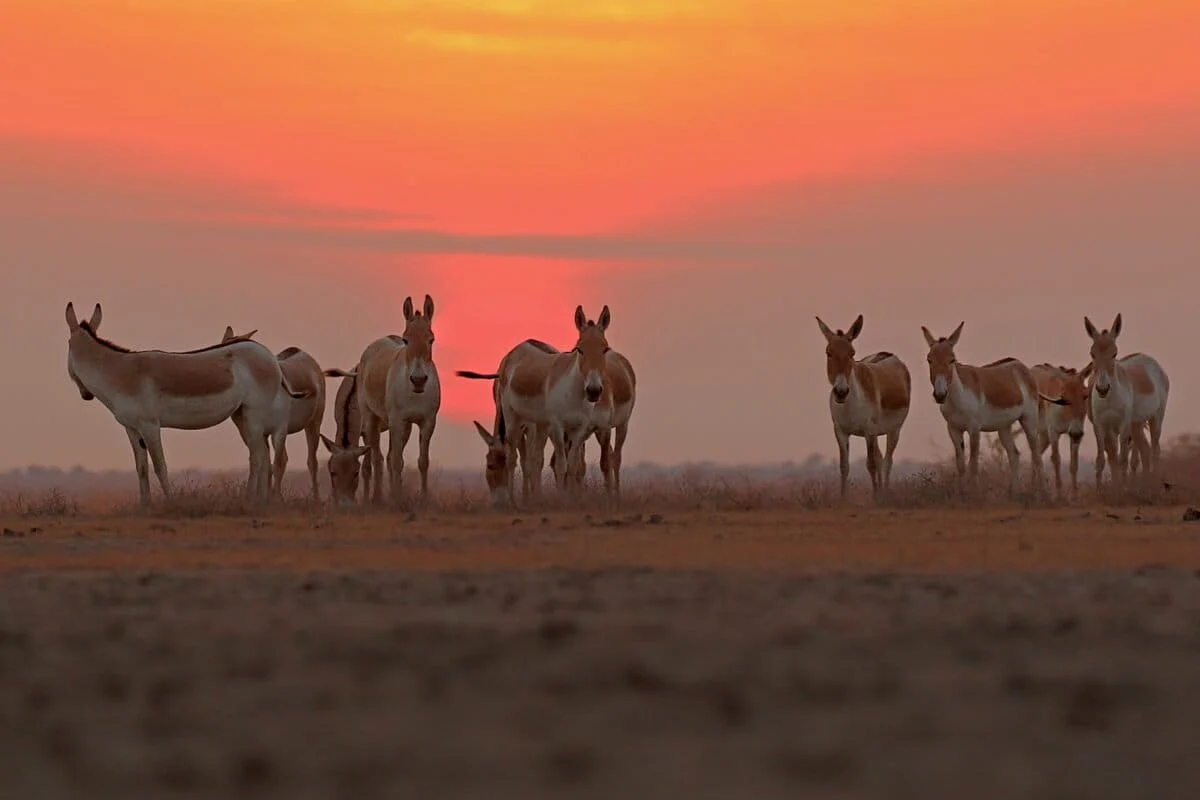
This shifting environment creates a unique niche for migratory species. The newly formed seasonal lakes become a sanctuary for Greater Flamingos, which nest in the marshes. The region is also the final refuge for the Indian Wild Ass (Khur), a species adapted to the harsh, saline environment of the Little Rann.
![A salt marsh through time [Commentary]](https://imgs.mongabay.com/wp-content/uploads/sites/30/2026/05/14125046/Asiatic_Wild_Ass_at_sunset-1200x800.jpg)
Economic Significance
The Rann is the backbone of India’s salt industry. The state of Gujarat produces roughly 76% of India’s salt, with the Little Rann alone contributing nearly one-third of that total. This production relies on the Agariyas, a traditional community of salt farmers who have lived and worked on these flats for generations.
Chronology: From Ancient Sea to Tectonic Architect
The history of the Rann is a timeline of radical geological and human shifts. What is today a salt marsh was once a vital maritime corridor.
The Harappan and Classical Eras (2500 BCE – 325 BCE)
Approximately 4,500 years ago, the Harappan settlers of Dholavira thrived on the eastern edge of the Rann. Archaeological evidence suggests that the Rann was then a navigable arm of the Arabian Sea, allowing Dholavira to function as a major port for trade with Mesopotamia. Even during Alexander the Great’s campaign in 326 BCE, the region remained a significant body of water, though records from the time already noted the treacherous, shifting nature of the Indus Delta’s tides.
The Medieval Transition (712 CE – 1800s)
Following the Arab conquest of Sindh in 712 CE, chroniclers noted that the Rann was gradually becoming shallower. Over centuries, a combination of siltation from the Indus River system and slow tectonic uplift began to reclaim the land from the sea. By the late 18th century, the region had largely transitioned into the tidal flat we recognize today, though it remained crisscrossed by distributaries of the Indus, such as the Puran River.
The Catalyst of Change: June 16, 1819
The most defining moment in the Rann’s modern geological history occurred on the evening of June 16, 1819. A massive earthquake, estimated at a magnitude of 7.7 to 8.2, struck the region. Captain MacMurdo, a British Political Resident in Bhuj, recorded that the ground shifted just before 7:00 p.m. following a deceptively cool and pleasant day.
![A salt marsh through time [Commentary]](https://imgs.mongabay.com/wp-content/uploads/sites/30/2026/05/14125341/White_salt_desert_at_Rann_of_Kutch-768x512.jpg)
The earthquake did more than destroy buildings; it physically reshaped the earth. It created the "Allah Bund" (Mound of God), an 80-kilometer-long scarp that rose three to five meters out of the flat plains. This natural dam blocked the Puran River, permanently altering the hydrology of the region and ending its history as a navigable inland waterway.
Supporting Data: The Science of Seismic Reshaping
The 1819 earthquake remains a cornerstone of seismological study. It was one of the first historically documented instances of surface faulting, where the movement of tectonic plates was visible to the naked eye.
Tectonic Architecture
The Rann sits atop a complex network of faults. The 1819 event demonstrated the "duality of destruction and construction." While 1,500 people lost their lives and 7,000 houses were destroyed in Bhuj and Anjar, the earthquake acted as a "natural architect."
- The Allah Bund: This feature served as a textbook example for Charles Lyell, the father of modern geology, in his seminal work Principles of Geology (1830-1833).
- Liquefaction: The earthquake induced high pore pressure in the sandy soil, creating "quicksand" conditions that caused the Sindhri Fort to sink into the earth, while other areas were uplifted.
Resilience in Design: The Bhunga
In the aftermath of the 1819 disaster, the people of Kutch developed the bhunga—a circular mud hut with a conical roof. The aerodynamic and structural properties of the circular walls allow these buildings to withstand seismic shocks that topple rectangular structures. During the 2001 Bhuj earthquake, many modern concrete buildings collapsed, while centuries-old bhungas remained standing, proving the enduring value of indigenous engineering.
Official Context and Modern Challenges: The Green Energy Conflict
Today, the Rann of Kutch is at the center of a new transformation: the transition to renewable energy. However, this industrial push has brought local communities and environmentalists into conflict with large-scale development.
![A salt marsh through time [Commentary]](https://imgs.mongabay.com/wp-content/uploads/sites/30/2026/05/14130703/Rann_of_Kutch_-_White_Desert-scaled-e1778744291562-768x512.jpg)
The Hybrid Renewable Energy Park
The Indian government has sanctioned the development of a massive hybrid renewable energy park in the Kutch district. Aimed at helping India meet its global climate commitments, the project involves thousands of hectares of solar panels and wind turbines.
Industrial vs. Traditional Salt Farming
While major corporations utilize intensive brine extraction methods, the traditional Agariyas continue to work on small family plots.
- Socio-Economic Displacement: The Agariyas often lack formal titles to the land they have worked for centuries. As industrial zones expand, these salt farmers are frequently excluded from land-use negotiations.
- The Health Burden: Working under a fierce sun with the glare of white salt leads to severe skin and eye issues for the Agariya families, who often live in makeshift huts without access to clean water or healthcare.
Environmental Degradation
Experts have raised alarms regarding the impact of large-scale industrialization on the Rann’s fragile ecosystem.
- Corrosion Risks: The hyper-saline environment of the Rann is incredibly corrosive. There are concerns that solar panel structures will degrade rapidly, leading to heavy metal contamination of the soil as components fail and break down.
- Habitat Fragmentation: The construction of roads and power lines for the energy park threatens the migratory paths of flamingos and the roaming grounds of the Indian Wild Ass.
Implications: The Future of a Disappearing Landscape
The Rann of Kutch stands at a precarious crossroads. Its future depends on whether the "Kutch model" of development can integrate conservation with industrial progress.
Climate Change Vulnerability
The "delicate balance" of the Rann is being upended by erratic weather patterns. Unseasonal rains in March or April—once a rarity—can now dissolve months of salt cultivation in a single afternoon. For an Agariya family, a single day of unseasonal rain can mean the loss of an entire year’s income.
![A salt marsh through time [Commentary]](https://imgs.mongabay.com/wp-content/uploads/sites/30/2026/05/14125912/Greater_Flamingos_at_Rann_of_Kutch-768x512.jpg)
Community-Led Conservation
There is a growing movement to recognize the role of traditional salt workers in conservation. Recent initiatives have sought to grant Agariyas regulated access to the Little Rann of Kutch, acknowledging that their presence is not necessarily detrimental to the Wild Ass population. In fact, the shallow pans created by traditional methods often support local birdlife in ways that industrial deep-brine extraction does not.
Conclusion: A Lesson in Coexistence
The story of the Rann of Kutch is a reminder that landscapes are not static. They are shaped by the slow grind of tectonic plates, the sudden violence of earthquakes, and the persistent labor of human hands.
As the Rann continues to change, the challenge for policymakers will be to ensure that the drive for "green" energy does not destroy the very environment it seeks to save. The survival of the Agariyas, the flamingos, and the unique saline hydrology of Kutch requires a move away from exclusionary industrial models toward a framework of community-led, ecologically sensitive coexistence. The Rann has survived the rising of mounds and the sinking of forts; its next chapter will be determined by how we value the "elemental significance" of this white, crystalline wilderness.
