

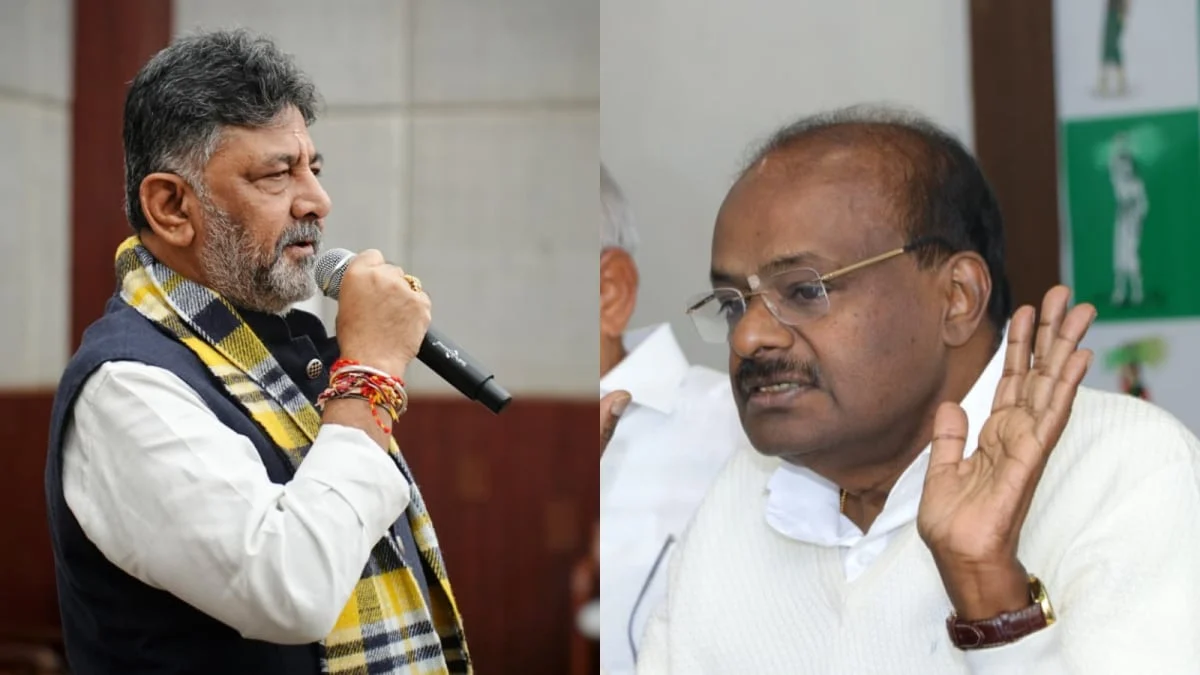
Bengaluru, India – What began as a contentious dispute between Karnataka Deputy Chief Minister D.K. Shivakumar and Union Minister H.D. Kumaraswamy over the proposed Bidadi township project has dramatically escalated into a full-scale offensive spearheaded by the powerful Gowda family. The entry of former Prime Minister H.D. Deve Gowda, patriarch of the Janata Dal (Secular) [JD(S)] and father to Kumaraswamy, has transformed a policy disagreement into a deeply personal and politically charged war, casting a long shadow over Karnataka’s development agenda and its intricate political landscape.
The political temperature in the state capital of Bengaluru soared as Deve Gowda, a seasoned political warhorse, threw his considerable weight behind his son. His scathing critique of Shivakumar and the ruling Congress government in Karnataka signals a definitive shift in the confrontation, moving beyond mere policy debate to encompass allegations of land impropriety, political opportunism, and a battle for regional supremacy. The stakes are immense: control over a crucial development project, the political future of key leaders, and potentially, the direction of state governance.
The Bidadi Battlefield: Genesis of a Conflict
The Bidadi township project, conceived as a satellite town to alleviate the ever-growing pressure on Bengaluru’s infrastructure and population, has become the flashpoint for this political maelstrom. Its strategic location, approximately 35 kilometres southwest of Bengaluru, makes it a prime candidate for urban expansion and industrial development, offering a potential blueprint for decongesting the state capital.
A Project’s Troubled Legacy
The roots of the current controversy trace back to H.D. Kumaraswamy’s tenure as Chief Minister between 2006 and 2007, when the Bidadi township project was initially conceptualized and launched. The ambitious plan aimed to create a self-sustaining urban centre, complete with residential, commercial, and industrial zones, envisioning it as a major growth corridor for South Bengaluru. However, like many large-scale land acquisition projects in Karnataka, it faced hurdles, including protests from farmers and complexities in land denotification.
Deputy Chief Minister D.K. Shivakumar, a prominent Congress leader and often seen as a rival to the Gowda family’s influence in the Vokkaliga heartland of Old Mysuru, maintains that the current Congress government is merely continuing a project that was originally initiated by Kumaraswamy. This forms the crux of his argument, portraying Kumaraswamy’s current opposition as a cynical act of political expediency rather than a genuine concern for public welfare or policy consistency.
Shivakumar’s Offensive: Challenging the Architect
Shivakumar has not shied away from sharpening his attack, directly challenging Kumaraswamy’s integrity and political stance. He argues that Kumaraswamy’s sudden volte-face on a project he himself championed exposes a deep contradiction, hinting at ulterior motives related to land, business, and political interests. "We are only taking forward the Bidadi township project started by you," Shivakumar asserted, directly countering Kumaraswamy’s criticisms. He further added, with a dismissive tone, that the Union Minister "cannot survive politically without criticising us," suggesting a fundamental dependency on opposition for political relevance.
The Karnataka Deputy CM also questioned Kumaraswamy’s current opposition to land acquisition, asking why he failed to fully denotify the land during his own time in power if he genuinely believed it was detrimental to farmers. Shivakumar positioned himself as a leader committed to long-term development and the future of the region’s populace, even if it entails facing short-term public ire. "Farmers may throw stones at me; they may shout slogans against me. Should I be scared? What matters is their future, their children’s future, and the future of their land. Twenty years from now, Bidadi and South Bengaluru will remember me," he declared, framing the issue as a matter of visionary leadership versus populist opposition. His statements reflect a willingness to take tough decisions for perceived developmental gains, even if it means confronting local sentiments and political rivals.
The Gowda Counter-Attack: From Son to Patriarch
The political narrative took a decisive turn with the forceful entry of the Gowda family into the fray, spearheaded by Kumaraswamy’s unwavering accusations and then dramatically amplified by his father, H.D. Deve Gowda.
Kumaraswamy’s Stance: Government as ‘Real Estate Broker’
H.D. Kumaraswamy, now a Union Minister, has adopted an uncompromising stance, accusing the Siddaramaiah-led Congress government of acting not as a facilitator of development but as a "real estate broker." His charges are severe, alleging that the government is engaged in a predatory land acquisition strategy, prioritizing profit over the welfare of agrarian communities. "Who are they to snatch farmers’ land? The government is acting like a broker, conducting real estate business per square foot. Siddaramaiah has emerged as the broker," he charged, explicitly targeting the Chief Minister and demanding the immediate scrapping of the Bidadi project. Kumaraswamy’s rhetoric appeals directly to the traditional JD(S) voter base, which largely comprises farmers and rural communities, painting the Congress as a party beholden to corporate interests and land sharks.
Deve Gowda Enters the Fray: A Patriarch’s Last Stand
The political temperature, already simmering, reached boiling point when H.D. Deve Gowda, the former Prime Minister and a towering figure in Indian politics, entered the debate. His intervention signaled a collective resolve from the Gowda family to confront Shivakumar and the Congress government head-on. Deve Gowda, known for his emotional speeches, chose a defiant tone, mocking Shivakumar’s earlier remarks about him. "They say I cry in meetings. Today I am laughing at this system," he retorted, turning perceived weakness into a demonstration of strength and resolve.
Declaring that his "struggle starts today," Deve Gowda, while acknowledging Siddaramaiah as a "political friend," issued a stern warning. He vowed to delve deep into the alleged irregularities of land acquisition, promising to write to the Chief Minister with "full information" on how "poor people’s land was acquired" and the aftermath of various court orders pertaining to these lands. His accusations were pointed: the government, he claimed, had utterly ignored the plight of Bidadi’s farmers, evidenced by the conspicuous absence of senior officials, including Tahsildars, DCs, or even local MLAs, visiting the affected communities. "Let Siddaramaiah come to Bidadi with me. Not one Tahsildar, DC or MLA has shown courtesy to those farmers," he challenged, exposing a perceived disconnect between the administration and the ground reality.
In a stark political warning, Deve Gowda invoked his long and storied history of protests and agitations, referencing his struggles against various political stalwarts from Devaraj Urs to S.M. Krishna to B.S. Yediyurappa. This historical context served as a powerful reminder of his resilience and his readiness for what he termed "one final agitation." "I have fought for the poor all my life. If I have to fight at the end of my life too, I am ready," he declared, cementing his image as a tireless champion of the downtrodden, even in his advanced age.
He also took a subtle but pointed swipe at the internal power dynamics within the Congress party, particularly the widely speculated rivalry between Chief Minister Siddaramaiah and Deputy Chief Minister Shivakumar over succession. "They are celebrating transfer of power on birthdays," he remarked, a thinly veiled jibe at the perceived instability and internal machinations within the ruling party. Deve Gowda further claimed to have written to Siddaramaiah, seeking a comprehensive probe into the ownership of nearly 20,000 acres of land and alleging that Bengaluru was being pushed into a crisis due to undue political pressure.
The sharpest barb, however, was reserved for Shivakumar’s assertion that he was ready to face angry farmers. Deve Gowda dismissed this claim with a cutting retort: "Will he go there and get beaten by farmers? Let him go first. I will speak after DK Shivakumar goes there and gets beaten by the farmers." This challenge not only questioned Shivakumar’s courage but also amplified the perceived anger among the farming community, leveraging it as a political weapon.
Chronology of Escalation: A Timeline of Tensions
The Bidadi battle, though seemingly sudden, has a historical trajectory that underscores its deep political roots and the long-standing rivalries in Karnataka politics.
- 2006-2007: The Bidadi township project is initially conceptualized and launched during H.D. Kumaraswamy’s first tenure as Chief Minister of Karnataka. The vision is to create a major satellite town to ease Bengaluru’s congestion.
- Post-2007 to Present: The project faces various administrative and land acquisition challenges, leading to delays and partial implementation. Political changes in the state government likely contribute to its fluctuating priority.
- Early 2026 (Implied): The current Congress government, under Chief Minister Siddaramaiah and Deputy Chief Minister D.K. Shivakumar, revives or actively pushes for the continuation of the Bidadi township project, citing the need for urban expansion and development.
- Mid-2026: D.K. Shivakumar publicly champions the project, asserting it’s a continuation of Kumaraswamy’s original vision, while H.D. Kumaraswamy (now a Union Minister) begins to voice strong opposition, accusing the Congress government of corruption and land grabbing.
- Mid-May 2026: The verbal slugfest intensifies with direct accusations from both Shivakumar and Kumaraswamy. Shivakumar challenges Kumaraswamy’s political consistency, while Kumaraswamy labels the government a "real estate broker."
- May 16, 2026: Former Prime Minister H.D. Deve Gowda enters the fray, strongly backing his son. He launches a blistering attack on Shivakumar and the Congress government, warning of a "final agitation" and escalating the conflict into a full-blown family war against the Deputy Chief Minister. His intervention adds significant weight and a historical dimension to the dispute.
Deeper Currents: Underlying Political Dynamics and Implications
The Bidadi controversy is far more than a disagreement over urban planning; it is a microcosm of Karnataka’s complex political landscape, revealing perennial issues of land politics, regional power struggles, and inter-party rivalries.
Land Politics: A Perennial Karnataka Flashpoint
Land acquisition for large-scale infrastructure and urban development projects has historically been a volatile issue in Karnataka. From the initial formation of industrial corridors to the expansion of cities, the process often pits the state’s developmental ambitions against the livelihoods and rights of its agrarian population. Issues of fair compensation, rehabilitation, and transparency in land dealings frequently lead to protests, legal battles, and political opportunism. The 20,000 acres mentioned by Deve Gowda, if true, represents a massive scale of land under contention, making the Bidadi project highly susceptible to these historical sensitivities. This conflict taps into a deep-seated distrust among farmers towards state-led land acquisition, a sentiment often exploited by opposition parties.
The Battle for South Karnataka’s Dominance
The Bidadi region lies within the politically crucial Vokkaliga heartland of South Karnataka. Both D.K. Shivakumar and the Gowda family hail from this dominant community, and their political fortunes are inextricably linked to its support. This conflict, therefore, transcends mere policy; it is a direct battle for political supremacy and leadership within the Vokkaliga community. Shivakumar, as Deputy CM, is actively trying to consolidate his position as a prominent Vokkaliga leader, challenging the long-held dominance of the Gowda family. The Gowdas, in turn, are leveraging the Bidadi issue to reassert their traditional role as protectors of farmers’ interests and to counter Shivakumar’s rising influence. The outcome of this battle could significantly reshape electoral dynamics in several assembly and parliamentary constituencies in the region.
Intra-Congress Tensions Exposed?
Deve Gowda’s veiled reference to "celebrating transfer of power on birthdays" is a telling insight into the perceived internal fissures within the Congress party. The widely reported rivalry between Chief Minister Siddaramaiah and Deputy Chief Minister D.K. Shivakumar for the top post is an open secret. While both leaders outwardly project unity, their individual ambitions often fuel speculation. Deve Gowda’s comment cleverly exploits this internal dynamic, suggesting that while the Congress presents a united front against the JD(S), it is internally preoccupied with power struggles, making it vulnerable to external attacks and distracting it from governance. Such external pressure can exacerbate existing tensions, potentially forcing the Congress high command to intervene or to solidify its internal messaging.
The JD(S) Strategy: Reasserting Influence
For the JD(S), this confrontation is a critical opportunity to re-energize its political base and reassert its relevance in Karnataka politics. Having lost significant ground in recent elections, the party, particularly under the leadership of H.D. Deve Gowda and H.D. Kumaraswamy, is keen to reclaim its narrative as the voice of farmers and the rural poor. By taking a strong stand against the Bidadi project and portraying the Congress government as corrupt and anti-farmer, the JD(S) aims to galvanize its traditional supporters and attract disillusioned voters. Deve Gowda’s threat of a "final agitation" is a strategic move to project strength and commitment, positioning the JD(S) as the primary opposition force capable of challenging the ruling party on critical issues.
Urban Development vs. Farmers’ Rights: A Policy Conundrum
At its core, the Bidadi controversy highlights a fundamental policy dilemma: how to balance the urgent need for urban expansion and economic development with the imperative to protect agricultural land and ensure the livelihoods of farmers. Bengaluru’s relentless growth necessitates the creation of new urban centres, but the process of acquiring land inevitably displaces agrarian communities. The challenge lies in formulating equitable land acquisition policies that offer fair compensation, adequate rehabilitation, and opportunities for affected farmers to integrate into the new economy, rather than merely being dispossessed. This debate forces a re-evaluation of current land laws and developmental models in Karnataka.
Expert Perspectives and Public Sentiment
Political analysts and urban planners are closely watching the unfolding drama, recognizing its far-reaching implications.
Political Analysts Weigh In
"This is clearly more than just a project dispute; it’s a proxy battle for political supremacy in the Vokkaliga heartland," observes a prominent Bengaluru-based political analyst, requesting anonymity due to the sensitivity of the issue. "D.K. Shivakumar is trying to carve out his own legacy and challenge the Gowda family’s long-standing dominance. The Gowdas, with Deve Gowda’s intervention, are using this as an opportunity to reassert their relevance and rally their base, especially with an eye on future elections, be it local body polls or even the next assembly elections." Analysts also point out that the timing of Deve Gowda’s entry, after Kumaraswamy’s initial skirmish, is a calculated move to escalate the conflict to a different plane, making it a legacy battle rather than just a spat between two individuals. "It raises the stakes from a personal rivalry to a generational fight, making it harder for Shivakumar to simply dismiss," another analyst noted.
Echoes from the Ground
On the ground, public sentiment remains complex and divided. While some sections of the urban population and business community might view Shivakumar’s push for the Bidadi project as a necessary step for Bengaluru’s future, many farmers and rural communities express deep apprehension. Echoing Kumaraswamy’s concerns, they fear displacement, inadequate compensation, and the loss of their traditional livelihoods. "We’ve seen promises of development before, but often, it’s the farmers who pay the heaviest price," remarked a farmer from a nearby village, expressing a sentiment of caution and skepticism towards government assurances. The aggressive rhetoric from both sides, while energizing their respective bases, also creates an environment of uncertainty and apprehension among those directly impacted by the project.
The Road Ahead: An Unfolding Saga
The Bidadi township project has thus transformed from a mere urban planning proposal into a fierce political weapon, exposing old decisions, present contradictions, and igniting a new three-cornered war involving D.K. Shivakumar, H.D. Kumaraswamy, and H.D. Deve Gowda. This multi-layered conflict is far from over. One can anticipate further protests, political rallies, potential legal challenges, and heated legislative debates.
The coming weeks and months will be crucial in determining the fate of the Bidadi project and, more broadly, the political landscape of Karnataka. The outcome will not only impact the future of urban development in the state but also significantly influence the power dynamics among its key political players, potentially setting the stage for future electoral battles and shaping the legacies of these prominent leaders. The saga of Bidadi serves as a stark reminder that in Karnataka, land, development, and politics are inextricably intertwined, often leading to confrontations that define eras.
