

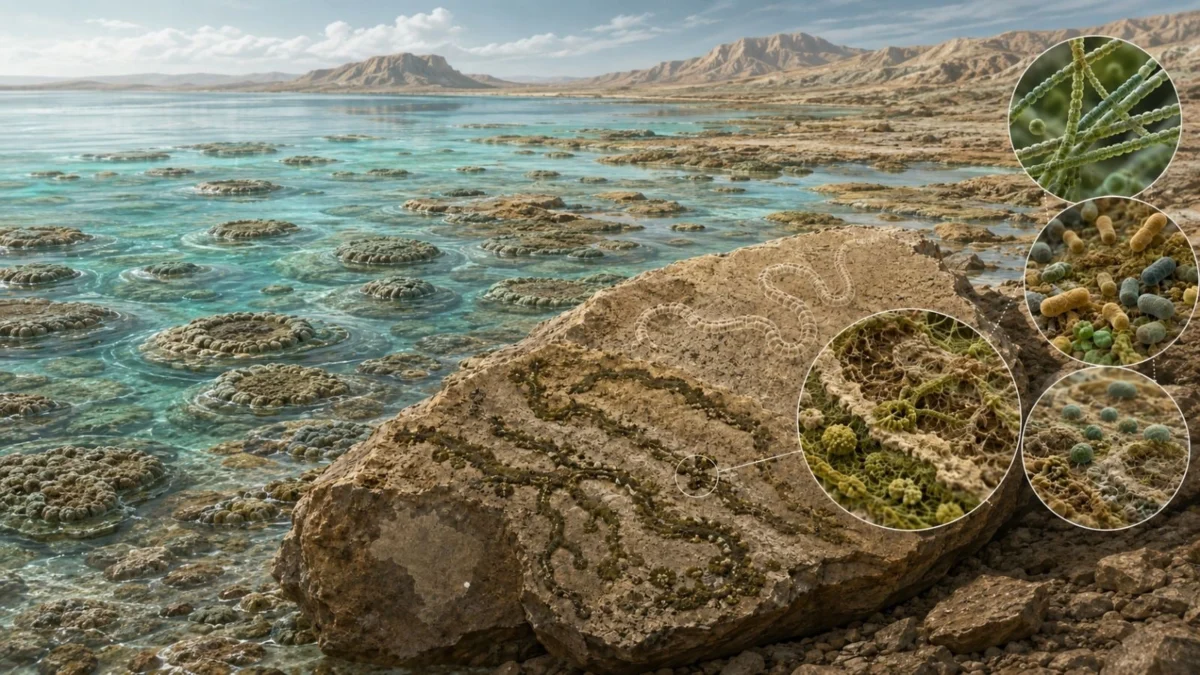
CAMPINAS, BRAZIL — In the high-stakes world of evolutionary biology, the line between a groundbreaking discovery and a case of mistaken identity can be thinner than a micrometer. For years, a series of microscopic impressions found in the ancient rock beds of Brazil were hailed as some of the earliest evidence of animal life on Earth. These "meiofauna"—tiny, multicellular invertebrates—were thought to have tunneled through the seafloor long before the famous Cambrian Explosion.
However, a landmark study published in the journal Gondwana Research has overturned this narrative. Utilizing state-of-the-art particle accelerator technology, a team of researchers has revealed that these "animal traces" are, in fact, the fossilized remains of ancient bacteria and algae. This discovery does more than just correct the record; it fundamentally shifts our understanding of when complex life first emerged and challenges long-held assumptions about the Ediacaran period.
Main Facts: A Case of Paleontological Mistaken Identity
The crux of the study centers on microfossils recovered from the Tamengo Formation in Mato Grosso do Sul, Brazil. Specifically, the samples were collected from two primary sites: Corumbá and Bonito. These regions are geologically significant as they represent the remnants of a shallow, ancient sea that existed between 541 and 635 million years ago.
For a decade, various researchers suggested that certain markings and structures within these rocks were "trace fossils"—the burrows or paths left behind by microscopic, worm-like animals. Had this been true, it would have placed complex, mobile animal life tens of millions of years earlier than currently accepted by the broader scientific community.
The new study, led by Bruno Becker-Kerber, a researcher with extensive experience in Ediacaran biota, used advanced imaging to look inside the fossils rather than just at their surface. The team’s findings were definitive: the structures possessed internal cellular walls, preserved organic matter, and structural arrangements consistent with microbial colonies, such as cyanobacteria or red and green algae, rather than the muscular or digestive tracts of animals.
Key Takeaways of the Study:
- Reclassification: What were once thought to be animal burrows are actually "body fossils" of microbes.
- Microbial Diversity: The fossils represent three distinct size classes, likely corresponding to different types of algae and bacteria.
- Technological Precision: The discovery was made possible by the Sirius particle accelerator, allowing for nanometer-scale resolution.
- Evolutionary Impact: The findings suggest that the "rise of the animals" may not have been as gradual as some theories propose, reinforcing the significance of the Cambrian Explosion.
Chronology: From the Ancient Sea to the Particle Accelerator
The journey of these fossils spans over half a billion years, but the scientific drama has unfolded over the last few decades.
1. The Ediacaran Period (approx. 635–539 Million Years Ago)
During this era, the supercontinent Gondwana was in the process of assembling. The area now known as Brazil was submerged under a shallow sea. At this time, Earth was recovering from a series of massive glaciations (the "Snowball Earth" periods). As the oceans warmed and oxygen levels began to fluctuate, life began to experiment with larger, more complex forms.
2. The Initial Discovery (2010s)
Geologists exploring the Tamengo Formation discovered strange, microscopic impressions in the siltstone and limestone. Initial analysis, conducted with traditional microscopy, led some scientists to hypothesize that these were the tracks of tiny invertebrates (meiofauna). This sparked a debate: did animals evolve much earlier than we thought, or were these just "pseudofossils"?
3. The Shift in Methodology (2023–2024)
Recognizing that traditional light microscopes could not provide the necessary detail, Bruno Becker-Kerber and his team sought access to the Brazilian Synchrotron Light Laboratory (LNLS). They moved the research to the Sirius facility, one of the most advanced particle accelerators in the world, to apply "big science" to these tiny mysteries.
4. Publication and Peer Review (May 2026)
Following rigorous testing using the MOGNO beamline, the team published their findings in Gondwana Research, effectively debunking the animal-trace theory and providing a new framework for identifying Ediacaran microfossils.
Supporting Data: The Technology Behind the Revelation
The reason this study is being hailed as a definitive "correction" in the field is the sheer volume of data produced by the Sirius particle accelerator. The researchers employed a multi-disciplinary approach to analyze the fossils from the inside out.
Microtomography and Nanotomography
The team utilized the MOGNO beamline at Sirius, which is specifically designed for high-resolution 3D imaging. While a medical CT scan can see through a human body, nanotomography can resolve structures at the scale of a billionth of a meter.
- Results: The scans revealed internal "septa" or wall divisions within the fossils. These divisions are a hallmark of colonial algae and bacteria, which grow in segmented filaments. Animals, even microscopic ones, do not fossilize into these specific, rigid geometric chambers.
Raman Spectroscopy
To ensure the structures weren’t just mineral deposits (non-biological "scratches"), the team used Raman spectroscopy. This technique uses laser light to observe vibrational modes in molecules, providing a "chemical fingerprint."
- Results: The analysis detected preserved organic carbon within the fossil walls. This proved that the structures were once living tissue. The chemical signature matched the degradation patterns of chlorophyll-bearing organisms (algae) and sulfur-oxidizing bacteria rather than the protein-heavy signatures of animal tissue.
Morphological Categorization
The researchers identified three distinct size ranges among the microfossils:
- Large (50–100 μm): Consistent with complex eukaryotes like red or green algae.
- Medium (20–50 μm): Likely various forms of cyanobacteria.
- Small (<20 μm): Consistent with sulfur-oxidizing bacteria, which are common in low-oxygen, nutrient-rich ancient marine sediments.
Official Responses: Insights from the Research Team
In interviews following the publication, the lead authors emphasized that while "losing" a record of early animals might seem like a step backward, it is actually a major leap forward for scientific accuracy.
Bruno Becker-Kerber, Lead Author:
"We observed that the microfossils have cellular structures—sometimes with preserved organic material—consistent with bacteria or algae that existed during that period. These aren’t traces of animals that may have passed through the area. By identifying these as microbial bodies, we are refining the map of life. We are no longer looking at where an animal was; we are looking at what a microbe was."
Becker-Kerber also noted the importance of the Tamengo Formation, stating that the preservation at Corumbá and Bonito is "world-class," allowing for the kind of detail that is usually lost over half a billion years of geological pressure.
Collaborating Scientists at CNPEM (National Center for Research in Energy and Materials):
Staff at the Sirius facility highlighted that this study represents a new era for paleontology. "The use of synchrotrons to study the history of life allows us to solve debates that have lasted for decades," one technician noted. "We can now see the ‘soft’ parts of life that were previously invisible."
Implications: What This Means for the History of Life
The reclassification of these Brazilian fossils has profound implications for how we view the "Cambrian Explosion"—the period roughly 538 million years ago when most major animal phyla suddenly appeared in the fossil record.
1. The "Animal Clock" Reset
If the Brazilian fossils had been animals, it would have suggested that the genetic and physical blueprints for mobility, digestion, and complex nervous systems were already well-established in the Ediacaran. By reclassifying them as algae, the study "pushes back" the confirmed appearance of mobile animals, making the Cambrian Explosion appear even more rapid and dramatic than previously thought.
2. Understanding Ancient Ecosystems
The presence of sulfur-oxidizing bacteria and various algae in the Tamengo Formation paints a picture of a "microbial world." This supports the theory that before animals took over, the Earth’s oceans were dominated by "microbial mats"—thick layers of bacteria and algae that covered the seafloor like a living carpet.
3. The Search for Life on Other Planets
The techniques used in this study—nanotomography and Raman spectroscopy—are the same methods being proposed for analyzing samples returned from Mars. The Brazilian study serves as a "test case" for how to distinguish between biological life and geological mimics. If we can misidentify a fossil on Earth with our best technology, it underscores the need for extreme caution when looking for "biosignatures" on other worlds.
4. Debunking the "Meiofauna Gap"
For years, paleontologists have searched for the "missing link" between simple cells and complex animals. Some believed the meiofauna (tiny invertebrates) were that link. This study suggests that many "trace fossils" attributed to early meiofauna might simply be misidentified microbial colonies, suggesting that the transition from single-celled to multicellular animal life may have been a much more sudden evolutionary "leap" triggered by rising oxygen levels at the end of the Ediacaran.
Conclusion
The rocks of Mato Grosso do Sul have surrendered their secrets, but they weren’t the secrets scientists originally expected. Instead of the tiny footprints of our earliest animal ancestors, they held the perfectly preserved bodies of the microbial masters of the ancient world. Through the lens of Brazil’s Sirius particle accelerator, the past has become clearer, reminding us that in the story of evolution, the smallest organisms often tell the biggest stories.
