

For millennia, the Milky Way was viewed as a static, celestial river of light—a permanent fixture of the night sky that inspired myths and guided navigators. However, modern astrophysics is painting a far more complex and turbulent picture. Far from being a rigid structure, our home galaxy is a warped, cannibalistic, and rapidly moving entity that continues to evolve billions of years after its birth.
As researchers utilize advanced space-based observatories like the European Space Agency’s Gaia mission, our understanding of the Milky Way is undergoing a radical transformation. This article explores the fundamental truths of our galaxy, the timeline of its violent history, and the scientific implications of its ongoing journey through the cosmos.
Part I: The Main Facts – A Galaxy of Contradictions
The Milky Way is classified as a barred spiral galaxy, but this label barely scratches the surface of its physical reality. Recent data reveals a structure that is far more "restless" than previously imagined.
1. The Warped Geometry of the Galactic Disk
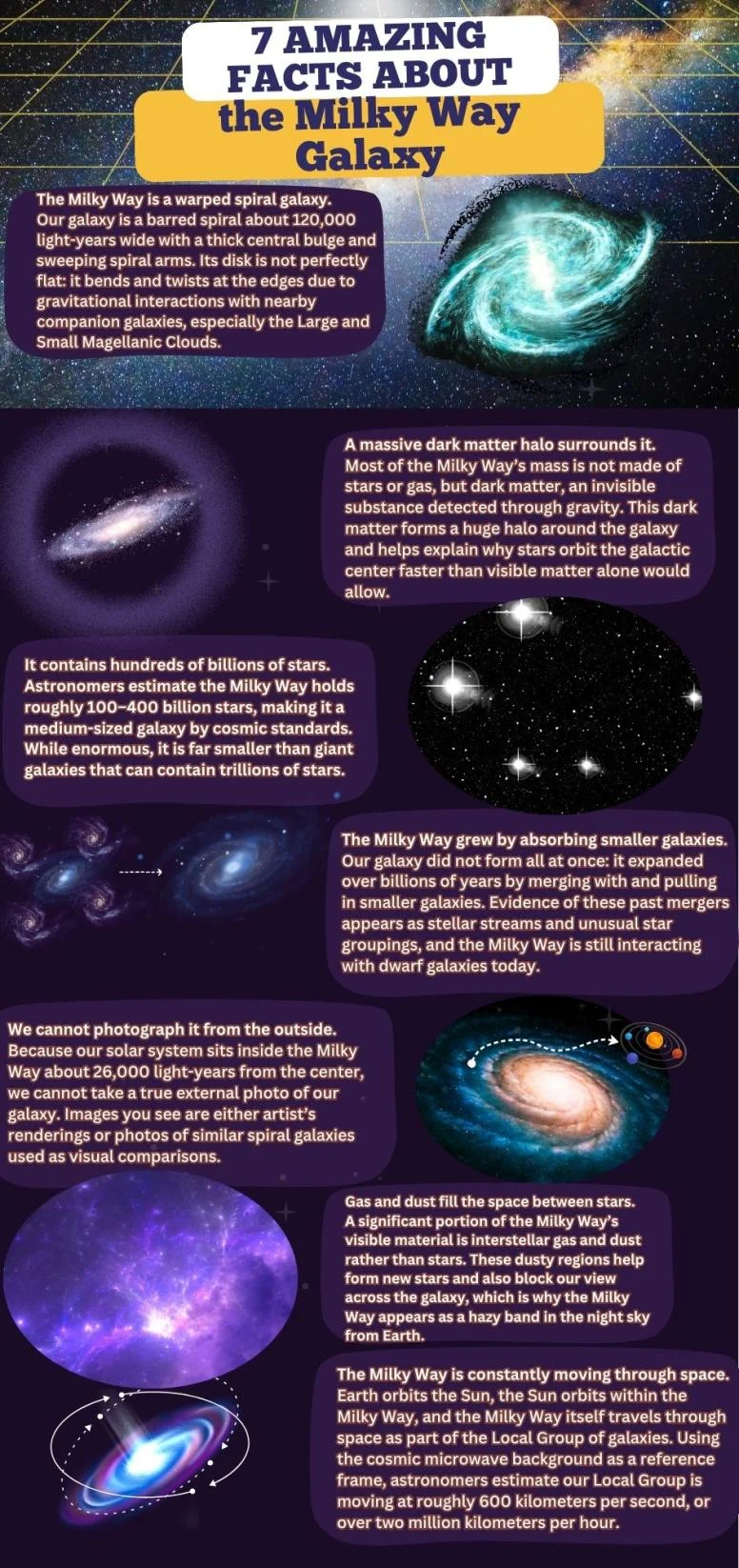
While textbook illustrations often depict the Milky Way as a flat, symmetrical disk, the reality is far more distorted. The outer edges of the galactic disk are warped and twisted, resembling a vinyl record left out in the sun. This "S-shape" warp is primarily caused by the gravitational influence of the Large and Small Magellanic Clouds—two satellite galaxies that orbit our own. As these smaller galaxies tug on the Milky Way’s outer fringes, they create a ripple effect, causing the gas and stars at the periphery to bend out of alignment with the main plane.
2. The Invisible Architecture: The Dark Matter Halo
One of the most profound realizations of modern astronomy is that the stars we see are merely the "froth on the waves." Roughly 85% to 90% of the Milky Way’s total mass is composed of dark matter. This invisible substance does not emit or reflect light, yet it exerts a massive gravitational pull. It forms a spherical "halo" that extends far beyond the visible stars, acting as a cosmic glue that prevents the galaxy from flying apart as it rotates. Without this dark matter, the stars at the galaxy’s edge would move much slower than they do; instead, they zip around the center at speeds that defy the logic of visible mass alone.
3. A Census of 400 Billion Stars
The scale of the Milky Way is difficult for the human mind to comprehend. Astronomers estimate that it contains between 100 billion and 400 billion stars. Our Sun is just one average-sized star located in the Orion Arm, approximately 26,000 light-years from the galactic center. If every star in the Milky Way were a grain of sand, they would fill a beach several miles long. Despite this density, the galaxy is mostly empty space; the distance between individual stars is so vast that collisions between them are incredibly rare.

4. The Interstellar Medium: The Breath of the Galaxy
The space between the stars is not a vacuum. It is filled with the Interstellar Medium (ISM)—a mixture of gas (mostly hydrogen and helium) and microscopic dust particles. This material serves as the "nursery" for new stars. However, for astronomers on Earth, this dust is a double-edged sword. It blocks our view of the galactic center and distant stars, creating the "Zone of Avoidance"—regions of the sky where we cannot see through the thick cosmic smog.
5. A History of Galactic Cannibalism
The Milky Way is a "survivor." It did not form in its current state but grew by consuming its neighbors. Over billions of years, the Milky Way has pulled in and shredded smaller dwarf galaxies. We can still see the "skeletons" of these past meals in the form of stellar streams—ribbons of stars that move together in patterns that don’t match the rest of the galaxy. This process of "galactic cannibalism" continues today as we slowly pull in the Sagittarius Dwarf Spheroidal Galaxy.
6. The Perspective Problem: Living Inside the Jar
One of the most surprising facts for the public is that every "photo" of the entire Milky Way is either an artist’s rendering or a photograph of a similar galaxy (like Andromeda). Because we are embedded within the disk, we cannot travel far enough "up" to look down and photograph the whole structure. It is like trying to map the exterior of a skyscraper while standing in a hallway on the 50th floor. We must rely on radio mapping and star counts to infer our home’s shape.
7. High-Speed Cosmic Transit
Nothing in the universe is still. While Earth orbits the Sun at 30 kilometers per second, the Sun orbits the center of the Milky Way at 220 kilometers per second. Even more impressively, the entire Milky Way is moving through the universe at approximately 600 kilometers per second (1.3 million miles per hour) relative to the Cosmic Microwave Background radiation. We are currently hurtling toward a massive concentration of matter known as the "Great Attractor."
Part II: Chronology of the Milky Way
To understand the current state of the galaxy, we must look at the timeline of its 13.6-billion-year existence.
- 13.6 Billion Years Ago: Shortly after the Big Bang, the first "protogalactic" clumps of gas and dark matter begin to coalesce. The oldest stars in the Milky Way’s halo date back to this era.
- 10 Billion Years Ago: A major collision occurs with a galaxy known as "Gaia-Enceladus" (often called the "Sausage" galaxy). This merger puffed up the Milky Way’s disk and provided the fuel for a massive burst of star formation.
- 8 Billion Years Ago: The "Thin Disk"—the region where the Sun now resides—begins to form as gas settles into a rotating plane.
- 4.6 Billion Years Ago: In a quiet suburb of the galaxy, a cloud of gas and dust collapses to form our Sun and the solar system.
- Present Day: The Milky Way is in a "middle-aged" state, forming about one to two new stars per year and continuing to absorb small satellite galaxies.
- 4 Billion Years into the Future: The Milky Way and the Andromeda Galaxy (M31) will begin a multi-billion-year collision, eventually merging to form a giant elliptical galaxy dubbed "Milkomeda."
Part III: Supporting Data and Research
The data supporting these facts comes from decades of observation, but the most significant leaps have occurred in the last five years.

| Metric | Value |
|---|---|
| Diameter | 100,000 to 120,000 light-years |
| Mass | ~1.5 Trillion Solar Masses (including dark matter) |
| Age | 13.6 Billion Years |
| Number of Planets | Estimated >100 Billion |
| Central Black Hole | Sagittarius A* (4 million times the mass of the Sun) |
| Orbital Period of Sun | 230 Million Years (one "Galactic Year") |
The Gaia Space Observatory has been instrumental in providing this data. By mapping the precise positions and velocities of over a billion stars, Gaia has allowed researchers to "rewind" the clock, tracing stellar motions back to their origins and proving the theory of galactic mergers.
Part IV: Expert Perspectives and Official Responses
Astrophysicists emphasize that the Milky Way is the only "laboratory" where we can study galactic evolution in high resolution.
Dr. Amina Helmi, a pioneer in galactic archaeology at the University of Groningen, has noted that the Milky Way’s history is written in the motions of its stars. "The stars remember where they came from," she suggests in various research papers. "By looking at the chemical composition and the paths they take, we can reconstruct the family tree of our entire galaxy."
Officials from NASA and the ESA have highlighted that the Milky Way is not an isolated island. The "Local Group"—a collection of about 50 galaxies including Andromeda and the Triangulum Galaxy—is a bound gravitational unit. The consensus among the scientific community is that we are living through a period of "galactic transition," where the Milky Way is depleting its raw gas reserves and moving toward a more stable, but less active, phase of life.
Part V: Implications for Science and Humanity
The study of the Milky Way carries profound implications for our understanding of the universe and our place within it.
The Search for Life
Understanding the "Galactic Habitable Zone" is crucial for astrobiology. Just as a solar system has a habitable zone where water can exist, a galaxy has a habitable zone where radiation isn’t too intense (unlike the crowded center) and heavy elements are abundant enough to form rocky planets (unlike the sparse outer edges). Mapping the Milky Way helps us narrow down where we should look for extraterrestrial life.

Dark Matter and Fundamental Physics
Because the Milky Way is our closest example of a dark-matter-dominated system, it serves as the primary testing ground for theories of gravity. If our calculations of the Milky Way’s mass are wrong, it could mean our entire understanding of physics needs a rewrite.
Philosophical Perspective
The realization that our galaxy is moving at millions of miles per hour, warping under the weight of invisible matter, and destined to collide with Andromeda, shifts the human perspective. It reinforces the idea that Earth is not a static observer of the universe but an active participant in a grand, violent, and beautiful cosmic dance.
As we continue to peer through the dust of the interstellar medium, the Milky Way remains our greatest mystery. It is a structure of nearly infinite complexity, a 13-billion-year-old record of the universe’s evolution, and most importantly, it is the only home we have ever known.
