

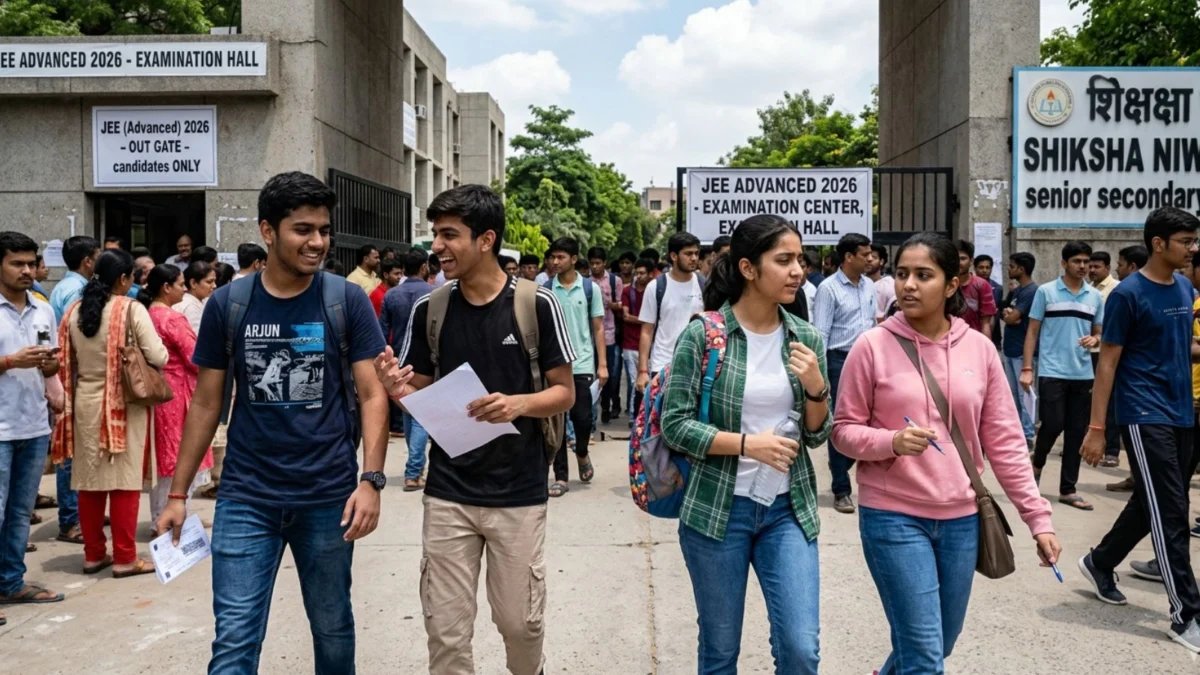
New Delhi, India – [Date of Publication] – The highly anticipated Joint Entrance Examination (JEE) Advanced 2026, conducted by the Indian Institute of Technology (IIT) Roorkee, has drawn to a close, leaving aspiring engineers to ponder their performance and the challenging nature of the tests. Preliminary feedback from students and leading educational experts paints a consistent picture: both Paper 1 and Paper 2 presented a formidable intellectual hurdle, with Mathematics emerging as a particularly daunting subject across both sessions.
The examination, a gateway to the prestigious IITs, is known for its rigor, but this year’s iteration appears to have pushed the boundaries of conceptual understanding and problem-solving prowess. Students reported that Paper 1 was generally perceived as moderate to highly challenging. While Physics demanded a profound grasp of fundamental concepts, and Chemistry presented intricate, tricky questions, it was Mathematics that stood out for its length and difficulty, leaving many candidates grappling with complex problems. Paper 2, in turn, was characterized by its conceptual intensity and time-consuming nature, with Mathematics again singled out as exceptionally tough.
A Deep Dive into the Examination Structure and Student Experiences
The JEE Advanced 2026 examination was meticulously designed to assess a broad spectrum of a student’s analytical and problem-solving capabilities. The paper pattern incorporated a diverse range of question formats, including 4-Mark Single-Correct Objective (SCQ) questions, 4-Mark Multiple-Correct Objective (MCQ) questions, 4-Mark Matrix Match questions, and 4-Mark Integer Type questions. A crucial aspect of the marking scheme involved no negative marking for integer-type questions, while MCQ, SCQ, and Matrix Match questions incurred a deduction of -1 mark for incorrect answers. This nuanced marking structure underscored the importance of accuracy and strategic decision-making during the examination.
Paper 1: A Gauntlet of Conceptual and Analytical Challenges
Physics: A Test of Deep Conceptual Clarity
The Physics section of Paper 1 was a significant talking point among students and educators alike. Dr. Saurabh Kumar, CEO and Founder of Shiksha Nation, described the section as both difficult and lengthy. He highlighted the prevalence of multi-concept problems drawn from critical areas such as Modern Physics (specifically the photoelectric effect and radioactive decay), Current Electricity (a blend of conceptual and numerical challenges), Electrostatics (with a focus on capacitor-based problems), Magnetism and Electromagnetic Induction (requiring application-based understanding of induced currents), and Rotation, which proved to be particularly arduous.
However, offering a slightly different perspective, Ajay Sharma, National Academic Director of Engineering at the Akash Institute, characterized the Physics section as moderate to difficult. Sharma noted that questions spanned most major chapters, with a few being time-consuming. Despite this, he opined that the section remained manageable for students who had prepared thoroughly and possessed a strong foundation in the subject. This divergence in opinion suggests that the perceived difficulty might have been influenced by individual student preparation strategies and their comfort levels with specific topics.
Chemistry: A Balancing Act of Trickiness and Familiarity
The Chemistry paper was generally rated as moderate by both Sharma and Kumar. The syllabus covered a comprehensive range of topics. In Physical Chemistry, students encountered questions on ionic equilibrium, electrochemistry, thermodynamics, chemical kinetics, and solutions with colligative properties. Organic Chemistry delved into named reactions, mechanism-based questions, stereochemistry, and touched upon biomolecules, polymers, and practical organic chemistry with a relatively minor weightage. This balanced approach aimed to test a student’s ability to recall, apply, and analyze chemical principles across various domains.
Mathematics: The Lengthy and Labyrinthine Challenge
The Mathematics section in Paper 1 was consistently described as ranging from moderate to difficult. Students reported encountering problems from definite integration, differential equations, vectors and 3D geometry, matrices and determinants, probability, complex numbers, conic sections, functions and inverse trigonometric functions, and sequence and series. A notable observation from coaching institute ALLEN was that approximately two questions were posed from each newly added topic in the syllabus. While the questions were generally solvable, their length and the computational demands made them highly time-consuming, posing a significant challenge for students aiming to complete the section within the allotted time.
Paper 2: Intensified Conceptual Demands and Time Constraints
A Shift in Format and Increased Complexity
Paper 2 of JEE Advanced 2026, according to Dr. Kumar, comprised 18 questions structured into two paragraphs. The question types included 4 single-correct (SCQ) questions carrying (+3, -1) marks, 5 multiple-correct (MCQ) questions (+4, -1), 5 integer-type questions (+4, -1), and 4 paragraph-based questions (+2, 0). This varied format, particularly the inclusion of multiple-correct questions, demanded a deeper level of understanding and the ability to identify all correct options, often leading to increased complexity.
Student Reactions: A Consensus on Difficulty and Time Intensity
Student feedback consistently pointed towards Paper 2 being highly conceptual and demanding in terms of time management, with Mathematics once again being identified as exceptionally tough. This sentiment was echoed across various coaching platforms and student forums.
Physics: Demanding Multi-Step Problem Solving
The Physics section in Paper 2 was rated as moderate to difficult, characterized by deeply conceptual problems that often required lengthy calculations. Topics covered included mechanics, Electrodynamics, Optics, Thermodynamics, and Modern Physics. Ajay Sharma of Akash Institute commented that "several problems involved lengthy calculations and multi-step concepts, making the section time-consuming for students." He emphasized that the paper covered almost all important topics, and success often hinged on the ability to integrate multiple concepts rather than relying on straightforward formula application.
Vinod Kumar, President of ALLEN, went further to suggest that the Physics section, due to its perceived difficulty, would likely be the "primary factor" in determining the rank of students. He also asserted that Paper 2 was demonstrably tougher and more lengthy than Paper 1.
Chemistry: The Relatively Accessible Section
In contrast to Physics and Mathematics, Chemistry emerged as the most balanced and potentially scoring section in Paper 2. NCERT-based Organic and Inorganic questions provided a degree of accessibility for well-prepared candidates. However, Physical Chemistry continued to present calculation-heavy problems. Notably, as reported by ALLEN, there were no questions asked from the Solid State or Real Gases chapters, indicating a targeted approach within the syllabus. The paper adhered closely to the broader JEE Advanced syllabus.
Mathematics: The Ultimate Test of Endurance
The consensus remained that Mathematics in Paper 2 was particularly demanding. The conceptual depth and the time required to solve the problems left many students feeling the pressure of the clock.
Concluding Remarks: The Reign of Conceptual Clarity and Time Management
Dr. Kumar concluded by reiterating that Paper 2 was reportedly tougher than Paper 1 for a significant number of students, and effective time management proved to be a critical determinant of success. He highlighted the importance of accuracy due to the "tricky negative marking patterns," suggesting that students with a robust conceptual understanding, especially in Physics, would have had a distinct advantage.
Supporting Data and Expert Analysis
The analysis from various coaching institutes provides valuable insights into the difficulty level and topic distribution of the JEE Advanced 2026 examination.
-
Shiksha Nation (Dr. Saurabh Kumar):
- Paper 1 Physics: Difficult and lengthy; multi-concept problems.
- Paper 2 Physics: Deeply concept-based, lengthy calculations.
- Overall Paper 2: Tougher and lengthier than Paper 1.
-
Akash Institute (Ajay Sharma):
- Paper 1 Physics: Moderate to difficult, manageable for well-prepared students.
- Paper 2 Physics: Time-consuming due to lengthy calculations and multi-step concepts.
-
ALLEN:
- Paper 1 Mathematics: Two questions from each new syllabus topic. Lengthy but solvable, calculation-intensive.
- Paper 2 Chemistry: No questions from Solid State or Real Gases.
- Paper 2 Physics: Most difficult section, likely rank-deciding.
- Paper 2 Overall: More tough and lengthy than Paper 1.
The consistent feedback regarding the challenging nature of Mathematics across both papers suggests a strategic emphasis on this subject by the examination setters. The intricate nature of the problems, coupled with the time constraints, likely tested not just a student’s knowledge but also their ability to remain calm and methodical under pressure. The inclusion of multi-concept and multi-step problems in Physics and the conceptual rigor in Mathematics indicate a shift towards assessing higher-order thinking skills rather than rote memorization.
Implications for Aspiring Engineers and Future Examinations
The JEE Advanced 2026 examination results will undoubtedly be closely watched, as the perceived difficulty of the papers could lead to a more competitive cut-off. For students who appeared for the exam, the immediate implication is the anticipation of results and the subsequent admission process into IITs.
Looking ahead, the trends observed in JEE Advanced 2026 offer valuable lessons for future aspirants. The emphasis on deep conceptual understanding, the ability to integrate knowledge from multiple topics, and robust time management skills are paramount. Students preparing for subsequent JEE Advanced examinations should:
- Prioritize Conceptual Clarity: Focus on understanding the underlying principles rather than memorizing formulas.
- Practice Time Management: Regularly simulate exam conditions during practice to improve speed and efficiency.
- Master Mathematics: Dedicate significant time to solving complex and lengthy problems in Mathematics.
- Develop Multi-Concept Problem-Solving Skills: Practice questions that require the application of knowledge from different areas of a subject.
- Stay Updated with Syllabus Changes: Be aware of any new topics introduced and their potential weightage.
The IIT Roorkee-conducted JEE Advanced 2026 has undoubtedly set a high bar, challenging the brightest young minds in India. The examination has reaffirmed its position as a rigorous test of intellect, perseverance, and strategic preparation, shaping the future trajectory of aspiring engineers. The coming weeks will reveal the success stories and the revised cut-offs that will define the intake for the prestigious Indian Institutes of Technology.
