

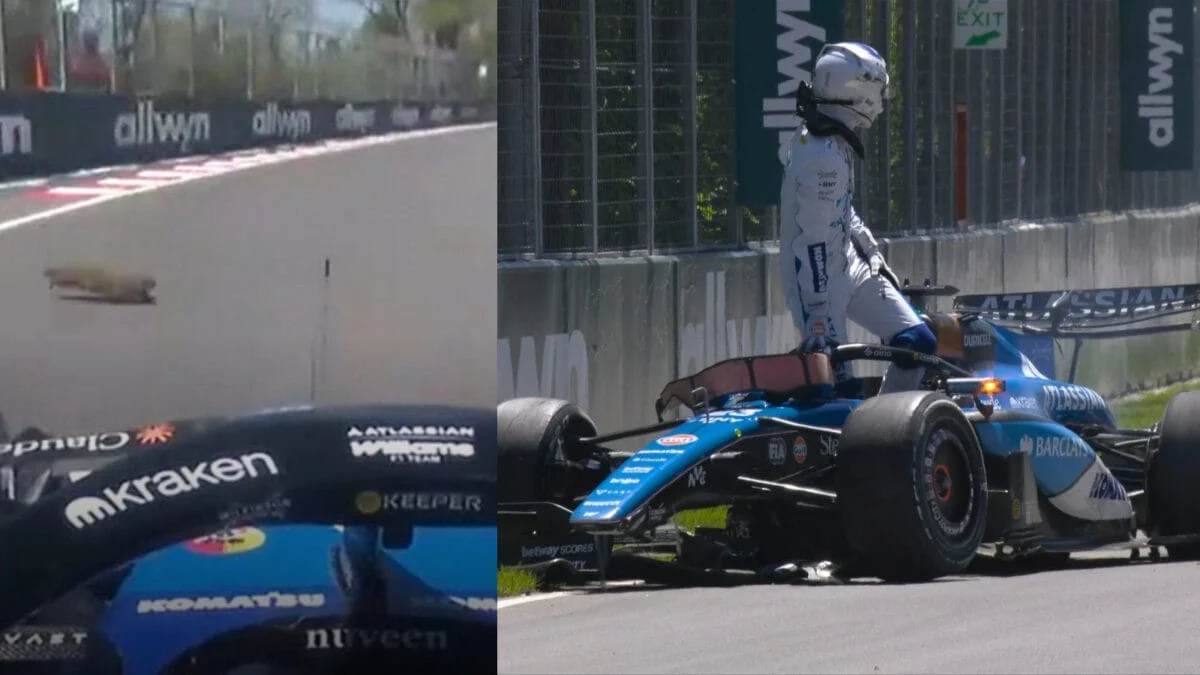
Montreal, Canada – May 23, 2026 – In a bizarre and unfortunate turn of events reminiscent of a classic cinematic loop, Alex Albon’s preparations for the Canadian Grand Prix were dramatically cut short today when his Williams FW48 collided with a marmot, sending the car heavily into the wall during the sole practice session. The incident at Circuit Gilles Villeneuve not only triggered a second red flag in an already chaotic session but left the British-Thai driver’s team facing a monumental repair challenge against the clock.
The surreal encounter, which occurred at Turn 7, left Albon physically unscathed but his machine extensively damaged, casting a shadow over his participation in the crucial sprint qualifying later this afternoon. While the immediate focus remains on the rapid repair efforts by the Williams mechanics, the incident has sparked discussions on track safety, wildlife management, and the unforgiving nature of the Formula 1 sprint weekend format.
The Unforeseen Collision: Nature’s Unscripted Intervention
The Friday practice session, often a meticulously planned dance between driver and machine, descended into an unexpected drama for Alex Albon. As the Williams driver navigated the challenging Circuit Gilles Villeneuve, a local marmot — a common sight in the parkland setting of the track — darted across the tarmac. At the incredible speeds of Formula 1, even a momentary obstruction can have catastrophic consequences.
Onboard footage, which later circulated widely across social media after broadcasters initially hesitated to show replays, appeared to capture Albon’s instinctive attempt to swerve and avoid the small animal. However, the sheer velocity and the delicate balance of an F1 car at its limit meant that even a slight correction could be enough to destabilize it. The impact with the marmot, though brief, was enough to disrupt the car’s aerodynamics or suspension, sending the FW48 into an uncontrollable slide.
What followed was a brutal and sickening collision with the unforgiving concrete barriers exiting Turn 7. The impact was significant, ripping off parts of the car and scattering debris across the track. The speed at which an F1 car travels transforms even a minor collision into a major structural event, highlighting the inherent dangers of the sport. While Albon was thankfully able to extricate himself from the wreckage, signaling his physical well-being, the sight of the heavily damaged car underscored the severity of the incident. Tragically, the marmot did not survive the collision.
A Session Plagued by Interruptions: Chaos on the Circuit
The marmot-induced crash was not an isolated incident in what proved to be an exceptionally challenging practice session. The 60-minute window, already compressed due to the sprint weekend format, was repeatedly interrupted, testing the patience of teams and drivers alike. Before Albon’s dramatic exit, the session had already seen its fair share of yellow and red flags.
Early in the session, Liam Lawson, driving for RB, brought out the first red flag after spinning and making contact with the wall, causing minor damage to his car. Shortly after, Esteban Ocon of Alpine also encountered issues, contributing to further delays. These stoppages fragmented the precious track time available, making it exceedingly difficult for teams to gather meaningful data, test setup changes, and give their drivers crucial laps to acclimatize to the circuit’s unique characteristics.
The cumulative effect of these incidents forced race officials to extend the session by an additional 19 minutes, a rare but necessary measure to compensate for the lost running. However, for Albon and Williams, even this extension was moot, as their car was already a mangled mess, requiring extensive recovery and immediate repair efforts back in the garage. The sequence of events painted a picture of a practice session that was less about fine-tuning performance and more about navigating an obstacle course of unforeseen challenges.
The FW48’s Plight: Extensive Damage and a Race Against Time
The sight of Albon’s Williams FW48 being recovered from the track presented a grim prognosis for the team. Team Principal James Vowles, speaking to Sky Sports F1 after the session, confirmed the extent of the damage, listing critical components that would require immediate attention: "Front corner, rear corner, floor, front wing, suspension." This comprehensive list underscores the severity of the impact and the complex nature of the repairs ahead.
Each item on Vowles’s list represents a significant engineering challenge. The front and rear corners encompass intricate suspension assemblies, brake ducts, and aerodynamic elements, all designed with precision and often made from lightweight, high-strength carbon fiber composites. The floor, a vital aerodynamic component responsible for generating a substantial portion of the car’s downforce, is a complex structure that is both expensive and time-consuming to repair or replace. A damaged front wing alone can cost tens of thousands of dollars and requires meticulous re-calibration to maintain aerodynamic balance.
Williams’s mechanics are now embroiled in a desperate "race against time" to rebuild the car before sprint qualifying. This is not merely a matter of bolting on new parts; it involves stripping down the damaged sections, meticulously inspecting the chassis for any underlying structural integrity issues, and then assembling new components with absolute precision. The tight turnaround, coupled with the specialized nature of F1 engineering, places immense pressure on every member of the garage crew. Any misstep or delay could jeopardize Albon’s participation in the crucial sprint qualifying session, which directly impacts his starting position for the main Grand Prix.
Furthermore, such extensive damage carries significant financial implications for a team like Williams, which operates within the stringent budget cap regulations of Formula 1. Every replacement part, every hour of mechanic’s time, eats into their allocated budget, potentially impacting future development or upgrades. The cost of a major F1 crash can run into hundreds of thousands, if not millions, of dollars, making this incident a substantial setback not just for Albon’s weekend but potentially for the team’s broader financial planning.
Alex Albon’s Perspective: Frustration Amidst Relief
Emerging from the wreckage under his own power, Alex Albon’s immediate relief at his physical well-being was palpable. However, this was quickly tempered by the immense frustration of losing crucial track time during the only practice session of a sprint weekend. "In these sprint sessions, you get 60 minutes. That’s it," Vowles explained, encapsulating the driver’s exasperation. "To lose over half of it is frustrating."
For Albon, a driver known for his meticulous approach and ability to extract performance from challenging machinery, missing out on valuable setup work and understanding the circuit’s nuances is a significant blow. The Canadian Grand Prix circuit is notoriously demanding, with its unforgiving walls, tricky chicanes, and varying grip levels. Every lap is an opportunity to fine-tune the car and build confidence, and Albon was denied much of that opportunity.
Despite the gravity of the situation, Albon reportedly managed to inject a touch of gallows humor into the grim atmosphere back in the garage. Vowles light-heartedly recounted Albon’s concern: "He’s more worried about his mum, but suspects he’s going to have to pay to adopt a family of marmots." This quip, while demonstrating Albon’s character and ability to find lightness in adversity, also underscores the bizarre nature of the incident that will undoubtedly become a unique anecdote in his career. His resilience will be tested as he potentially faces qualifying with minimal data and a car rebuilt under extreme duress.
Circuit Gilles Villeneuve: A Unique Challenge Where Nature Intervenes
The Circuit Gilles Villeneuve, nestled on Notre Dame Island in the heart of Montreal, is renowned for its thrilling layout and iconic "Wall of Champions." However, its location within a large parkland area also makes it susceptible to wildlife intrusions, a peculiar hazard not commonly associated with modern, purpose-built F1 tracks. James Vowles confirmed this recurring issue, stating, "It’s one of the risks of this circuit. I know that sounds strange perhaps to people who aren’t used to it, but there are marmots across the 26 years or so we’ve been coming here."
Marmots, also known as groundhogs, are large ground squirrels native to North America. They are active during the day and are known to burrow extensively, making their presence difficult to completely deter from an open parkland environment. While track marshals and circuit management typically employ measures to keep the circuit clear, the sheer unpredictability of wildlife means that incidents, though rare, are never entirely preventable.
This is not the first time wildlife has made an unwelcome appearance on a Formula 1 track. Over the years, incidents involving various animals – from birds and rabbits to even larger deer – have occasionally disrupted sessions or caused minor damage. However, a collision of this severity, leading to a major crash, is thankfully uncommon. The unique environment of Circuit Gilles Villeneuve, with its blend of urban landscape and natural habitat, creates a constant, albeit low-probability, risk of such encounters. This incident serves as a stark reminder that even in the highly controlled world of Formula 1, nature can still deliver an unexpected curveball.
The Sprint Weekend Conundrum: Magnifying the Impact
The Formula 1 sprint weekend format, designed to inject more excitement into the race weekend by compressing the schedule and introducing a standalone sprint race, significantly magnified the impact of Albon’s incident. In a traditional Grand Prix weekend, teams have three practice sessions totaling three hours to fine-tune their cars, gather data, and allow drivers to get comfortable with the track. This offers a substantial buffer for unexpected issues or minor crashes.
However, under the sprint format, this is drastically reduced to a single 60-minute practice session before sprint qualifying. This singular window is all teams have to validate simulations, test aerodynamic setups, check tire degradation, and provide drivers with essential mileage. For Albon, losing the majority of this session means he will go into sprint qualifying virtually blind, with minimal understanding of his car’s behavior on a high-speed, demanding circuit.
This lack of preparation could be a severe handicap. Every thousandth of a second counts in F1 qualifying, and without the benefit of practice laps, Albon will be at a significant disadvantage against competitors who have had uninterrupted running. It also places immense pressure on the team’s engineers to make educated guesses on setup, relying heavily on simulator data and the limited feedback Albon could provide from his brief running. The sprint format, while thrilling for spectators, undeniably heightens the stakes for any unforeseen circumstances, as demonstrated emphatically by today’s marmot mishap.
Team Williams: Resilience Under Pressure
Williams Racing, one of the most storied names in Formula 1 history, has been on a challenging journey in recent years, working tirelessly to climb back up the grid. Under the leadership of James Vowles, the team has shown signs of progress, with Albon often punching above the car’s weight to deliver impressive results. This incident, therefore, comes at a particularly unwelcome time, testing the team’s resilience and resourcefulness.
The mechanics, often the unsung heroes of Formula 1, are now thrust into the spotlight, facing an arduous task with an unforgiving deadline. Their ability to quickly and accurately rebuild a sophisticated F1 machine under immense pressure is a testament to their skill and dedication. The incident will undoubtedly stretch the team’s spare parts inventory, a critical consideration for smaller teams operating within tight budgets.
Historically, Williams has faced numerous challenges, and their ability to overcome adversity has been a hallmark of their legacy. This "Groundhog Day" moment, while unusual, is another test of their resolve. How they respond in the coming hours will be crucial, not just for Alex Albon’s weekend but for the morale and momentum they have been steadily building. The expectation will be for them to complete the repairs, allowing Albon to at least attempt sprint qualifying, even if it means starting from a significant disadvantage.
Looking Ahead: The Road to Sprint Qualifying and Beyond
As the sun begins to set over Montreal, the Williams garage will be a hive of activity, with mechanics working feverishly to piece together the damaged FW48. The clock is ticking relentlessly towards sprint qualifying, where Albon will face the daunting prospect of setting a competitive lap time with a car that has undergone emergency surgery and with minimal prior running.
His performance in sprint qualifying will determine his grid position for tomorrow’s Sprint Race, which in turn influences his starting spot for Sunday’s main Canadian Grand Prix. A poor showing in qualifying due to the incident could relegate him to the back of the grid, making points-scoring a significantly harder challenge.
Beyond the immediate racing implications, the incident also raises broader questions about track safety and wildlife management at circuits like Montreal. While complete eradication of wildlife is neither feasible nor desirable, the balance between motorsport spectacle and environmental coexistence is a delicate one. For now, however, all eyes will be on the Williams garage, hoping for a successful rebuild and a fighting chance for Alex Albon to overcome this bizarre, "Groundhog Day" setback and salvage his Canadian Grand Prix weekend. The unique tale of the marmot crash will undoubtedly be a talking point for seasons to come, a stark reminder that in Formula 1, the unexpected is always just a lap away.
