

By [Your Publication Name] News Desk
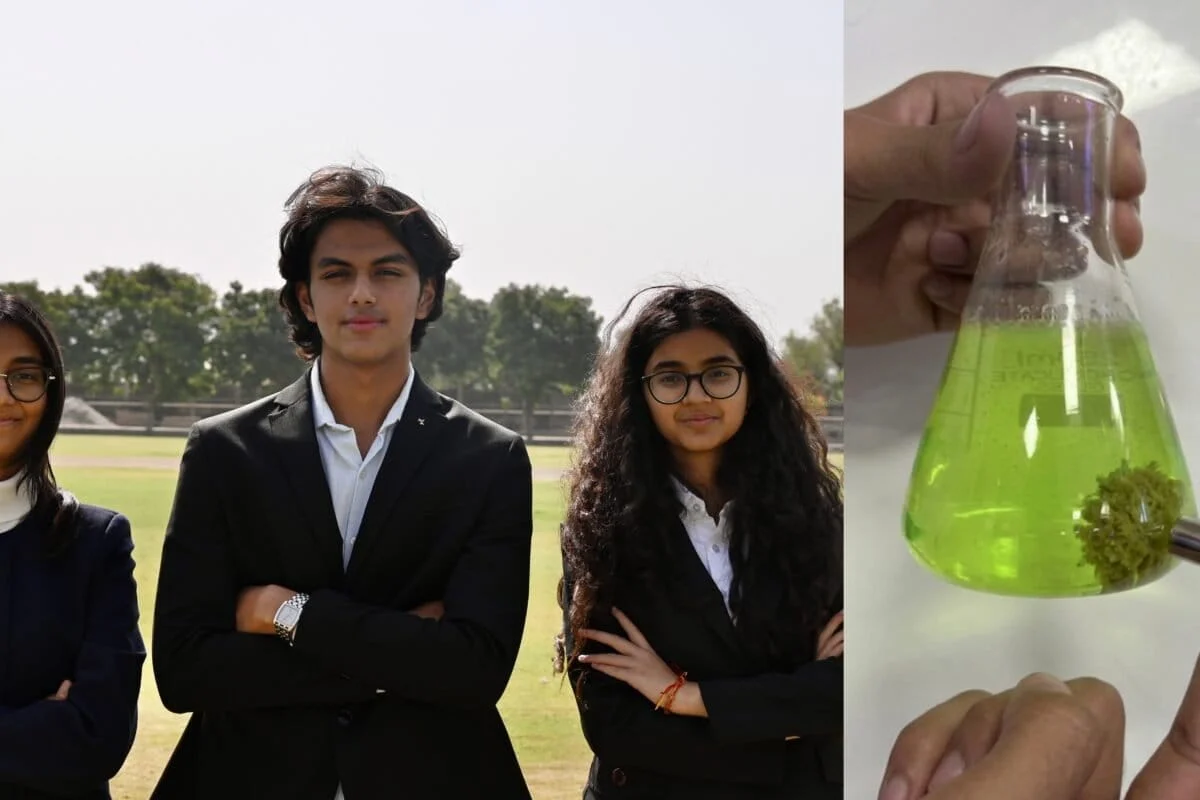
In a landmark achievement for youth-led environmental innovation, three 16-year-old students from India have been crowned the winners of The Earth Prize 2026. Avyana Mehta, Vivaan Chhawchharia, and Ariana Agarwal have captured global attention with "Plas-Stick," a low-cost, biodegradable solution designed to eradicate microplastics from shared water sources using an unlikely hero: the humble tamarind seed.
Their victory, announced by the Geneva-based Earth Foundation, marks a pivotal moment in the fight against "invisible" pollutants. By transforming agricultural waste into a magnetic filtration tool, the trio has bridged the gap between advanced environmental science and the practical needs of rural communities that lack access to expensive infrastructure.
Main Facts: The Plas-Stick Innovation
The core of the students’ achievement lies in the development of a specialized powder derived from discarded tamarind seeds. This powder, when introduced to water, acts as a natural flocculant—a substance that promotes the clumping of particles. Specifically, it targets microplastics, which are plastic fragments less than five millimeters in size that often evade traditional filtration methods.
How It Works
The "Plas-Stick" system operates through a three-stage process:
- Application: The tamarind seed powder is added to a water container.
- Aggregation: Due to the natural binding properties of the tamarind seeds, the powder attracts microplastic particles, causing them to bond and form larger, heavier clumps.
- Extraction: These clumps are sensitized to magnetic forces, allowing them to be efficiently removed from the water using a simple handheld magnet.
Unlike Reverse Osmosis (RO) or Ultraviolet (UV) filtration systems, Plas-Stick requires no electricity, no high-pressure plumbing, and no expensive replacement cartridges. This makes it uniquely suited for the "shared water container" culture prevalent in many parts of the Global South.
Chronology: From Classroom Curiosity to Global Recognition
The journey of Team Plas-Stick began not in a high-tech laboratory, but in the observation of daily life and the rigors of an environmental science curriculum.
Phase 1: The Spark of Inquiry (Early 2025)
The team’s interest was piqued during their environmental science studies, where they learned about the pervasive nature of microplastics. However, the theoretical knowledge turned into a practical mission during a field visit to a rural community in India. There, they observed that while residents were diligent about traditional water hygiene, they were unknowingly consuming microplastics stored in large, communal containers.
"Microplastics stood out to us because they are invisible, but the risk is very real," the team explained. "In many rural communities, people drink water without knowing what may be present in it."
Phase 2: Material Scouting and Prototyping (Mid-2025)
The students set a strict criterion for their solution: it had to be "accessible, affordable, and sustainable." They began looking for local materials with natural adhesive properties. Tamarind seeds, often discarded as a byproduct of the food industry in India, became the primary focus.
The students spent months testing the binding properties of the seeds, eventually refining a process to turn the seeds into a powder that could effectively "trap" plastic polymers.
Phase 3: Academic Validation and Deployment (Late 2025)
To ensure the scientific validity of their invention, the team collaborated with professionals and researchers from the Indian Institute of Technology (IIT) Guwahati. This partnership allowed them to test the efficacy of Plas-Stick against various types of microplastics, including polyethylene and polystyrene.
Following successful lab results, the team moved to the "Proof of Concept" stage, deploying the solution in local schools and community centers. To date, their initiative has reached over 8,000 students and teachers, providing both clean water and environmental education.
Phase 4: The Earth Prize 2026 (Early 2026)
After a rigorous selection process involving thousands of schools from across the globe, the Indian trio was invited to present their project to The Earth Foundation. Their combination of scientific ingenuity and social empathy led them to secure the top honors, providing them with the platform and funding needed for national expansion.

Supporting Data: The Microplastic Crisis in India
The Plas-Stick innovation addresses one of the most pressing environmental health crises of the 21st century.
The Scale of the Problem
Recent studies indicate that the average human may ingest approximately five grams of plastic every week—the equivalent of a credit card. In India, the problem is compounded by inadequate waste management systems. Research conducted in major Indian river basins, including the Ganges and the Brahmaputra, has shown alarming concentrations of microplastics, which eventually find their way into groundwater and tap water.
Why Tamarind?
The choice of tamarind seeds is scientifically sound. Tamarind Kernel Powder (TKP) contains a high concentration of a polysaccharide called xyloglucan. This substance is widely used in the textile and pharmaceutical industries for its thickening and binding properties. By repurposing this "waste" product, the students have created a circular economy model. India is one of the world’s largest producers of tamarind, ensuring a nearly inexhaustible supply of raw material for Plas-Stick.
Economic Impact
Traditional filtration systems in India can cost anywhere from ₹10,000 to ₹25,000 ($120 – $300 USD), with recurring maintenance costs. Plas-Stick, by contrast, utilizes a waste product and a simple magnet, reducing the cost of microplastic removal to a fraction of a cent per liter.
Official Responses: A Global Endorsement
The Earth Foundation, the organization behind the prize, praised the students for their "holistic approach" to environmentalism.
"The Earth Prize was founded to be an incubator for the next generation of environmental leaders," said a spokesperson for The Earth Foundation. "Team Plas-Stick embodies this mission. They didn’t just identify a problem; they engineered a solution that is culturally relevant, economically viable, and scientifically robust."
Representatives from IIT Guwahati, who assisted in the technical refinement of the powder, noted the students’ dedication. "Working with Avyana, Vivaan, and Ariana was an inspiring experience for our faculty. Their ability to apply complex chemical principles to a social cause is a testament to the quality of youth innovation in India today."
In their official statement following the win, the team emphasized the responsibility that comes with the prize. "The prize money will help us scale Plas-Stick in a more structured and responsible way. Our goal is no longer just to win a competition, but to ensure that no child in a rural community has to drink plastic-laden water."
Implications: Scaling the Future of Clean Water
The victory of Team Plas-Stick carries significant implications for the future of water purification and youth-led climate action.
Decentralized Production Hubs
With the support of The Earth Prize, the team plans to move away from centralized manufacturing. Their vision involves creating "decentralized production hubs" in rural areas. By teaching local communities how to process tamarind seeds into Plas-Stick powder, they are creating local jobs while simultaneously solving a health crisis. This model of "local solutions for local problems" is a cornerstone of sustainable development.
Ambitious Growth Targets
The team has set a clear roadmap for the next 18 months. By the end of 2026, they aim to expand their reach from 8,000 individuals to a staggering 35,000–40,000 people. This expansion will focus on the most vulnerable regions where water contamination is highest and infrastructure is lowest.
A New Model for Environmental Education
The Earth Prize itself, now in its fifth year, continues to evolve. Founded in response to the 2019 student climate strikes, the competition has shifted the narrative from climate "anxiety" to climate "action." The success of Plas-Stick serves as a blueprint for other young innovators:
- Identify the "Invisible": Focus on problems that are overlooked by mainstream industry.
- Utilize Waste: Look for solutions in the byproducts of existing industries.
- Collaborate: Bridge the gap between student ideas and institutional expertise (like IIT).
Global Potential
While Plas-Stick was developed with the Indian context in mind, its applications are global. From Southeast Asia to Sub-Saharan Africa, tamarind is a common crop, and shared water containers are a common reality. The "tamarind-and-magnet" method could potentially be exported to any region facing similar microplastic threats, making it a truly global contribution to the United Nations Sustainable Development Goal 6: Clean Water and Sanitation for All.
As Avyana, Vivaan, and Ariana return to their studies, they do so not just as students, but as the architects of a cleaner future. Their journey with Plas-Stick proves that sometimes, the most sophisticated solutions to the world’s biggest problems are hidden in plain sight—or in this case, inside the shell of a tamarind seed.
