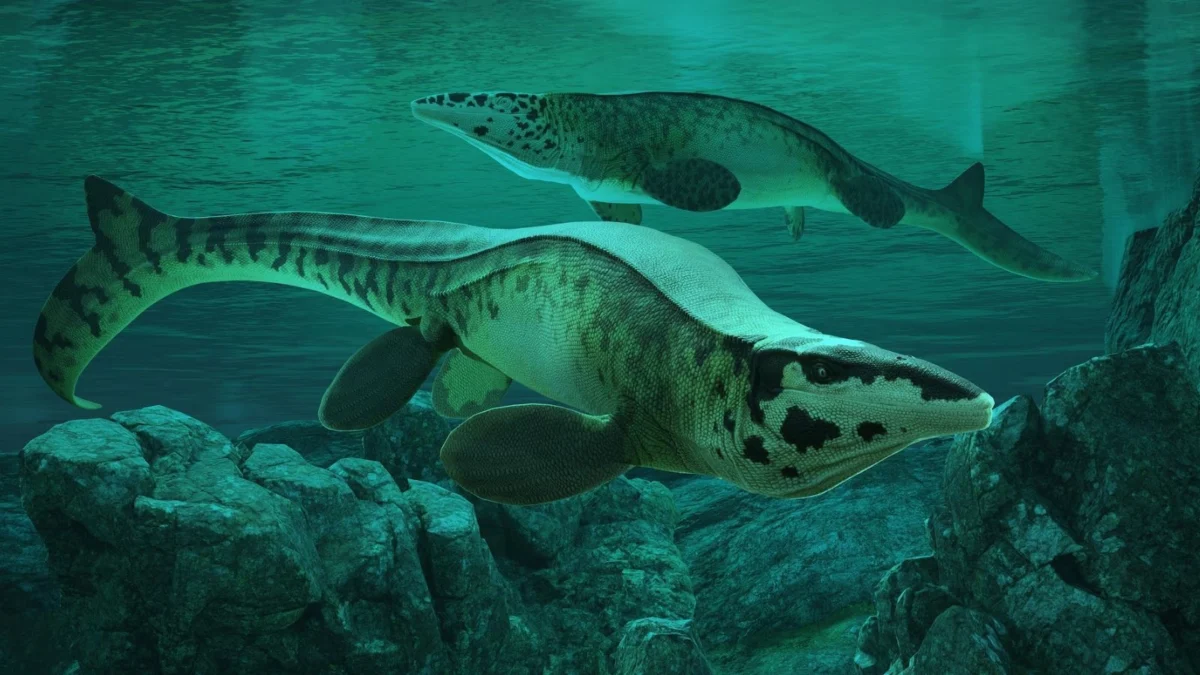
NEW YORK — In a discovery that reshapes our understanding of prehistoric marine dominance, paleontologists have officially identified a new species of mosasaur that once ruled the ancient oceans with the same unchallenged authority as its terrestrial namesake, Tyrannosaurus rex. Named Tylosaurus rex, this gargantuan marine reptile has been confirmed as one of the largest and most formidable predators to ever inhabit the Earth’s waters, according to a comprehensive study published in the scientific bulletin of the American Museum of Natural History (AMNH).
While the Tyrannosaurus rex has long held the crown as the "king of the dinosaurs" on land, Tylosaurus rex—whose name literally translates to "Knob-lizard King"—emerges as its aquatic counterpart. Living approximately 80 million years ago during the Late Cretaceous Period, this massive predator patrolled the Western Interior Seaway, a vast prehistoric ocean that effectively split North America into two distinct landmasses.
Main Facts: The Anatomy of an Aquatic Monarch
The identification of Tylosaurus rex as a distinct species is the result of an exhaustive re-examination of mosasaur remains housed in museum collections across the United States. For decades, many of these fossils were categorized under broader Tylosaurus classifications. However, recent advancements in morphometric analysis and dental pathology have allowed researchers to distinguish unique traits that set T. rex (the marine reptile) apart from its cousins.
Physical Dimensions and Scale
The most striking feature of Tylosaurus rex is its sheer scale. The largest known specimen of the species, nicknamed "Bunker," measures an astounding 43 feet (13.2 meters) in length. To put this into perspective, "Sue," the most complete and famous Tyrannosaurus rex ever discovered, measures approximately 40.5 feet (12.3 meters).
While the terrestrial T. rex was a heavy-set, bipedal powerhouse, Tylosaurus rex was a masterpiece of hydrodynamic engineering. It possessed a long, streamlined body, four paddle-like limbs for steering, and a powerful, fluke-like tail that provided immense thrust. Researchers describe the animal as resembling a cross between a modern Komodo dragon and a shark, scaled up to the size of a city bus.
Specialized Weaponry
The study highlights several anatomical specializations that made Tylosaurus rex the apex predator of its era:
- Serrated Teeth: Unlike many other marine reptiles that had smooth, conical teeth for gripping slippery fish, T. rex possessed finely serrated teeth. This suggests a diet consisting of large, fleshy prey, allowing the predator to slice through bone and muscle with ease.
- Kinetic Skull: The skull of the Tylosaurus rex was highly flexible. Similar to modern snakes, it possessed extra joints that allowed it to expand its gape and swallow large prey whole or deliver devastating "bite-and-shake" attacks to dismember victims.
- Reinforced Cranium: Despite its flexibility, the snout was tipped with a hardened, bony protrusion (the "knob" from which it gets its name), which scientists believe was used as a battering ram to stun prey or defend against rival mosasaurs.
Chronology: From Land-Dwellers to Ocean Rulers
The story of Tylosaurus rex is not just one of size, but of incredible evolutionary adaptation. The chronology of the species provides a window into how life responds to shifting global environments.
The Evolutionary Transition
Mosasaurs like Tylosaurus did not start in the water. Their ancestors were small, land-dwelling lizards—closely related to modern monitor lizards and snakes—that took to the seas roughly 100 million years ago during the mid-Cretaceous. Within a relatively short geological window of 20 million years, these creatures evolved from shore-dwelling foragers into the 40-foot leviathans that would eventually replace ichthyosaurs and pliosaurs as the dominant marine predators.
The Age of the Western Interior Seaway
Eighty million years ago, the Earth was a greenhouse world. Polar ice caps were non-existent, and sea levels were so high that a massive body of water, the Western Interior Seaway, stretched from the Gulf of Mexico to the Arctic Ocean. It was in this warm, shallow, and nutrient-rich environment that Tylosaurus rex rose to power.
The species flourished for several million years, during a time when the "biological arms race" in the oceans was at its peak. As prey grew larger and more armored, Tylosaurus evolved the size and weaponry necessary to remain at the top of the food chain.
The Fossil Timeline
The journey to identifying Tylosaurus rex involved tracing fossils found predominantly in the Niobrara Chalk of Kansas and various geological formations in Texas. The "Bunker" specimen was originally unearthed in the mid-20th century, but it has taken decades of comparative anatomy and the discovery of newer, better-preserved specimens to finally grant the species its own name and "kingly" status.
Supporting Data: Evidence of a Global Hunter
The researchers’ conclusions are backed by a wealth of fossil evidence that paints a vivid picture of the Tylosaurus rex’s lifestyle and environment.
Paleobiogeography
While the best-preserved fossils come from the American Midwest—specifically Kansas, which was the center of the Western Interior Seaway—evidence of Tylosaurus has been found globally. This suggests that while Tylosaurus rex was a specialist of the inland sea, the genus was highly successful in colonizing diverse marine environments, from deep-water basins to coastal estuaries.
Bite Force and Dietary Analysis
Biomechanical modeling suggests that the jaw muscles of Tylosaurus rex were capable of exerting several tons of pressure. This is supported by "stomach contents" found in various mosasaur fossils, which include remains of:
- Hesperornis: Large, flightless diving birds.
- Xiphactinus: Predatory fish that grew up to 20 feet long.
- Plesiosaurs: Long-necked marine reptiles that were once thought to be the masters of the sea.
- Smaller Mosasaurs: Evidence suggests that Tylosaurus rex was opportunistic and would engage in cannibalism or hunt smaller related species.
Comparative Morphology
The AMNH study utilized high-resolution CT scanning to compare the skull of Tylosaurus rex with other species like Tylosaurus proriger. The findings revealed that T. rex had a significantly broader snout and a different arrangement of the vascular openings in the bone, which may have supported a more complex sensory system for detecting vibrations in murky water.
Official Responses: Insights from the Lead Researchers
Amelia Zietlow, the lead researcher from the History Museum at the Castle in Wisconsin and a prominent voice in mosasaur paleontology, emphasized the gravity of this classification.
"The name rex is not chosen lightly," Zietlow stated during the announcement of the findings. "When you stand next to a skull of this animal, the sheer scale of it is humbling. The skull alone is as tall as an average human being. This was an animal that feared nothing in the water."
Zietlow explained that the study was born out of a need to clear up "taxonomic clutter." For years, many large Tylosaurus fossils were lumped together under a single species name. "By looking at the fine details of the dental serrations and the attachment points for the neck muscles, we realized we weren’t just looking at a larger version of a known animal; we were looking at a specialized apex hunter that occupied a unique ecological niche."
The American Museum of Natural History also released a statement regarding the publication, noting that the identification of Tylosaurus rex highlights the importance of museum archives. "Many of the world’s greatest discoveries are not made in the field, but in the drawers of museum collections where fossils wait for the technology and expertise to catch up with them," the statement read.
Implications: A New Icon of Prehistory
The formal naming of Tylosaurus rex has significant implications for both the scientific community and the public’s perception of the Cretaceous period.
Redefining the Cretaceous Ecosystem
For a long time, the public imagination of the Cretaceous has been dominated by land-dwelling dinosaurs. The identification of Tylosaurus rex provides a necessary "marine counterpart" to the T. rex. It reminds us that the oceans of the time were just as dangerous—if not more so—than the forests of Laramidia. This discovery helps scientists build a more holistic model of the Cretaceous biosphere, where apex predators on land and sea were reaching their maximum size and complexity simultaneously.
The "Rex" Branding and Public Interest
By choosing the species name rex, researchers are intentionally drawing a parallel to the most famous dinosaur in history. This move is expected to drive significant public interest in marine paleontology, an area of study that often receives less funding and attention than terrestrial dinosaur research.
"It gives the public a relatable anchor," says Zietlow. "People know what a T. rex is. By calling this animal Tylosaurus rex, we are immediately communicating its status. It was the king of its world, just as the dinosaur was the king of its own."
Future Research Frontiers
The identification of this species opens new doors for research into the "gigantism" of the Late Cretaceous. Scientists are now looking to understand why so many different lineages—from dinosaurs to mosasaurs to pterosaurs—evolved toward massive sizes during this specific window of time. Was it an abundance of oxygen? A surplus of high-calorie prey? Or a specific climate-driven evolutionary pressure?
Furthermore, the "Bunker" specimen and others like it will now undergo new rounds of isotopic analysis. By studying the oxygen isotopes in the teeth of Tylosaurus rex, researchers hope to determine the exact water temperatures it lived in and whether it was capable of maintaining a body temperature higher than the surrounding water—a trait known as regional endothermy, which is seen in modern great white sharks.
As we move forward, Tylosaurus rex stands as a testament to the mysteries still hidden within the Earth’s crust and museum vaults. It serves as a chilling reminder that while the land was ruled by "tyrant lizards," the depths of the ancient oceans belonged to a king of a different, more fluid, and equally terrifying variety.