

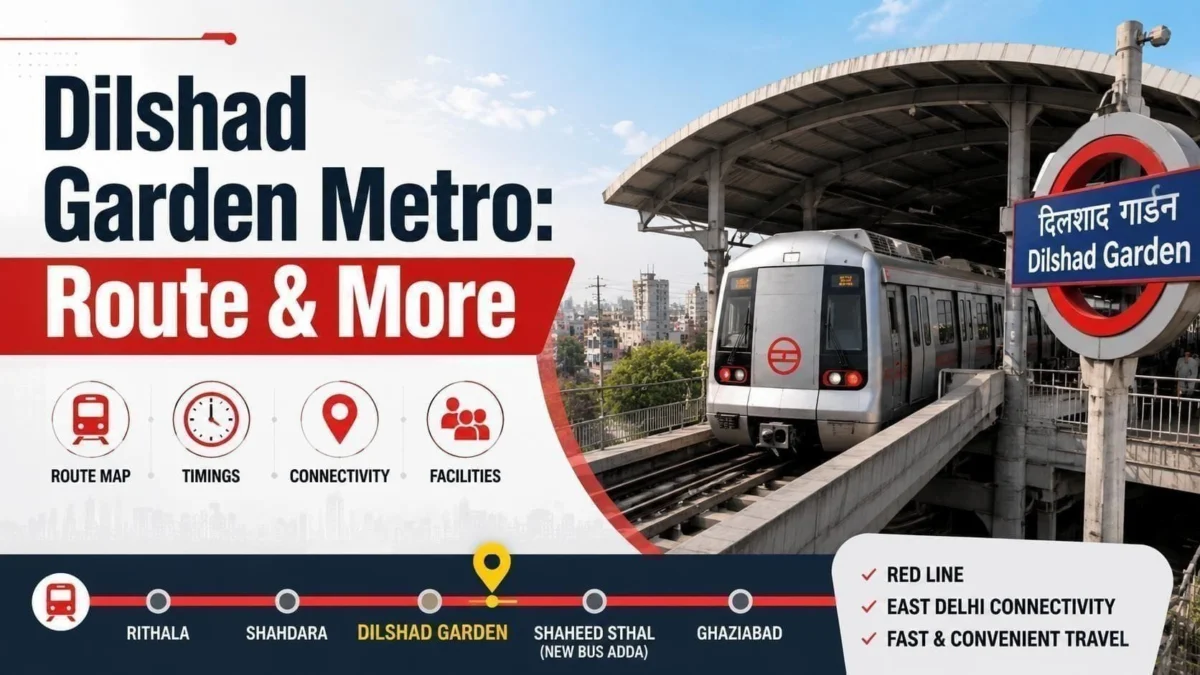
The Delhi Metro Rail Corporation (DMRC) has transformed the urban landscape of the National Capital Region (NCR) over the last two decades. At the heart of this transformation in East Delhi lies the Dilshad Garden Metro Station. As a vital cog in the Red Line—the city’s first-ever metro corridor—this station serves as more than just a transit point; it is a socio-economic lifeline for thousands of commuters and a primary catalyst for real estate development in the trans-Yamuna region.
This comprehensive report explores the multifaceted role of the Dilshad Garden Metro Station, examining its technical specifications, historical evolution, operational dynamics, and its profound impact on the local economy and property markets.
1. Main Facts: The Infrastructure of Connectivity
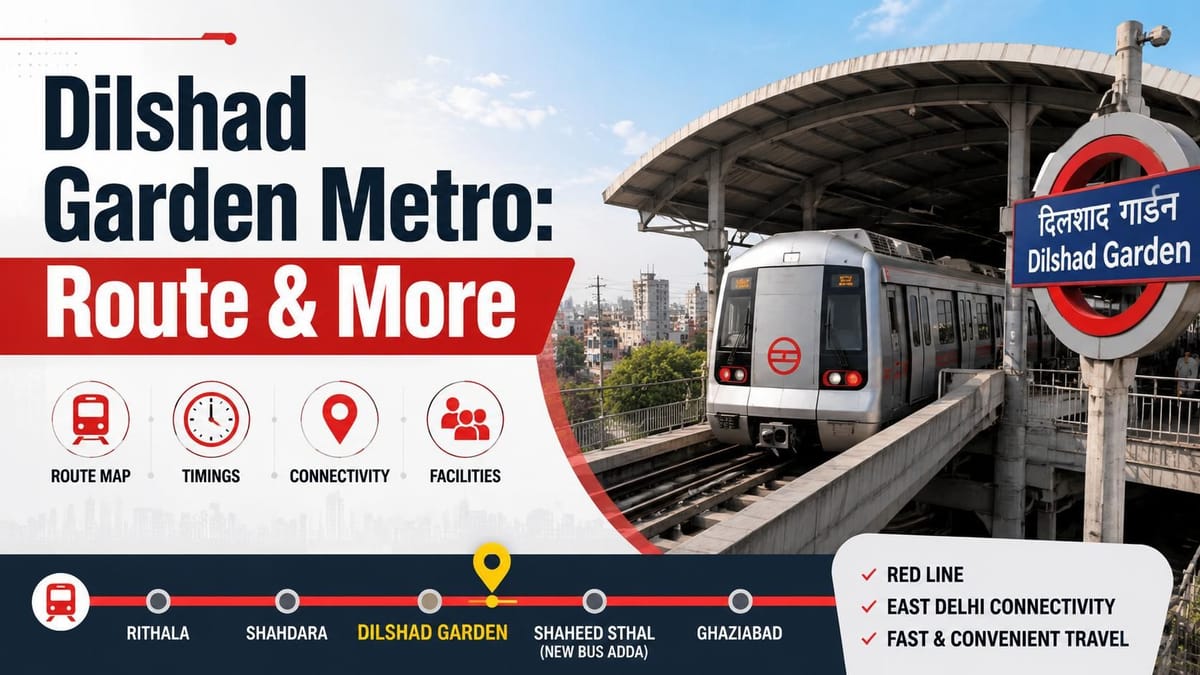
Dilshad Garden Metro Station (Station Code: DSG) is a prominent elevated station situated on the Red Line (Line 1) of the Delhi Metro network. Since its inception, it has served as a bridge between the bustling residential pockets of East Delhi and the industrial and commercial hubs of Ghaziabad in Uttar Pradesh.
Technical and Operational Overview
The station is designed with a modern architectural approach, utilizing an elevated structure to minimize the footprint on the congested GT Road. It features a side-platform arrangement, which efficiently manages the heavy influx of passengers during peak hours.
| Feature | Details |
|---|---|
| Station Name | Dilshad Garden Metro Station |
| Station Code | DSG |
| Metro Line | Red Line (Line 1) |
| Structure | Elevated |
| Platform Type | Side Platforms (2 Tracks) |
| Opened On | June 4, 2008 |
| Interchange | None (Direct Line) |
| Operated By | Delhi Metro Rail Corporation (DMRC) |
| Preceding Station | Jhilmil (Towards Rithala) |
| Succeeding Station | Shaheed Sthal (Towards Ghaziabad) |
Strategic Location
The station is positioned strategically on the Grand Trunk (GT) Road, one of India’s oldest and busiest highways. This location allows it to serve multiple neighborhoods simultaneously, including Dilshad Garden, Shahdara, Seemapuri, and Vivek Vihar. For over a decade, it served as the terminal station for the Red Line before the corridor was extended further into Ghaziabad.
2. Chronology: From Terminus to Transit Hub
The evolution of the Dilshad Garden Metro Station mirrors the growth of the Delhi Metro itself. Its history can be divided into three distinct phases:
Phase I: The Expansion of the Red Line (2008)
The station was officially inaugurated on June 4, 2008. At the time, it represented the easternmost tip of the Red Line. Its opening was a landmark event for East Delhi residents, who previously relied on overcrowded DTC buses and private vehicles to navigate the gridlocked GT Road. The station provided a direct, air-conditioned link to North and West Delhi, reaching destinations like Kashmere Gate and Netaji Subhash Place in a fraction of the previous travel time.
Phase II: Consolidation and Saturation (2008–2018)
For eleven years, Dilshad Garden functioned as the terminus of the Red Line. During this period, it became one of the highest-footfall stations in the entire network. It served as the primary entry point for commuters coming from Ghaziabad, Loni, and even parts of Meerut, who would travel by bus or auto to Dilshad Garden to catch the metro.
Phase III: The Ghaziabad Extension (2019–Present)
On March 8, 2019, the Red Line was extended by 9.63 kilometers from Dilshad Garden to Shaheed Sthal (New Bus Adda) in Ghaziabad. This extension transformed Dilshad Garden from a "dead-end" terminus into a mid-route transit hub. While this slightly reduced the "terminal rush," it increased the station’s importance as a transfer point for those accessing local markets and healthcare facilities in the immediate vicinity.
3. Supporting Data: Layout, Facilities, and Commuter Amenities
The Dilshad Garden Metro Station is designed to handle a massive daily throughput. The station layout is divided into two primary levels: the Concourse and the Platform.
Station Layout and Accessibility
- The Concourse Level: This area houses the ticket office, automated vending machines (TVMs), and security checkpoints. It also features retail outlets and ATMs to serve the needs of daily commuters.
- The Platform Level: Located above the concourse, the platforms are equipped with tactile flooring for the visually impaired and high-intensity lighting.
Entry and Exit Gate Management
To prevent bottlenecks, the DMRC has established two main entry/exit points:
- Gate No. 1: Provides direct access to GT Road and the Dilshad Garden residential blocks. This gate is the primary hub for last-mile connectivity, where e-rickshaws and buses congregate.
- Gate No. 2: Faces the Seemapuri side and provides closer access to local commercial offices and industrial units.
Essential Facilities
The station is equipped with several amenities designed for safety and convenience:
- Vertical Mobility: Multiple escalators and elevators cater to senior citizens and differently-abled passengers (Divyangjan).
- Security: The station is under 24/7 CCTV surveillance and is guarded by the Central Industrial Security Force (CISF).
- Parking: A dedicated parking lot is available for commuters who "Park and Ride," though it frequently reaches capacity due to high demand.
- First Aid: Basic medical assistance is available at the station controller’s office.
Connectivity Matrix
The station’s utility is magnified by its integration with other modes of transport:
- DTC & Cluster Buses: Frequent bus services connect the station to Noida, Central Delhi, and deeper pockets of Ghaziabad.
- E-Rickshaws: These have become the backbone of last-mile connectivity for the narrow lanes of Dilshad Garden and Jhilmil.
- App-based Cabs: Dedicated pickup points for Uber and Ola help streamline traffic flow outside the gates.
4. Official Responses and Operational Standards
The DMRC has frequently highlighted Dilshad Garden as a model for efficient suburban station management. According to various DMRC operational reports, the station maintains a high "On-Time Performance" (OTP) rate, consistent with the Red Line’s reputation for reliability.
DMRC’s Stance on Safety and Maintenance
Official statements from the DMRC emphasize that the Red Line stations undergo rigorous structural audits. Given that Dilshad Garden is an elevated station on a high-traffic corridor, maintenance crews perform track inspections and electrical overhead equipment (OHE) checks during non-operational hours (between 12:00 AM and 5:00 AM).
Commuter Experience Initiatives
In response to the growing heatwaves in Delhi, the DMRC has optimized the cooling systems in the concourse areas and ensured that drinking water facilities are regularly maintained. Furthermore, the "DMRC Momentum 2.0" app has been integrated to allow Dilshad Garden commuters to book lockers and buy digital QR tickets, reducing the queues at physical counters.
5. Implications: Real Estate and Socio-Economic Impact
The "Metro Effect" is perhaps nowhere more visible than in the neighborhoods surrounding Dilshad Garden. The station has acted as an economic engine, fundamentally altering the real estate dynamics of East Delhi.
Residential Real Estate Growth
Before the metro arrived, Dilshad Garden was considered a quiet, somewhat isolated residential colony. Post-2008, property valuations skyrocketed.
- Appreciation: Property prices in Dilshad Garden and neighboring Shahdara have seen a 150-300% appreciation over the last 15 years.
- Rental Demand: The area has become a preferred hub for healthcare professionals working at the nearby Guru Teg Bahadur (GTB) Hospital and University College of Medical Sciences (UCMS). The metro allows these professionals to live in a well-connected locality while maintaining easy access to North Delhi.
- Housing Diversity: The market offers a mix of DDA (Delhi Development Authority) flats, private builder floors, and independent houses.
Commercial and Institutional Expansion
The presence of the metro has encouraged the growth of private clinics, coaching centers, and retail showrooms along the GT Road. The station serves as the primary transit point for visitors to:
- GTB Hospital: One of East Delhi’s largest government healthcare facilities.
- Deer Park: A major green lung for the region.
- Vivek Vihar and Jhilmil Industrial Area: Facilitating the movement of workers and business owners.
Environmental and Social Implications
By providing a viable alternative to private transport, the Dilshad Garden Metro Station has played a crucial role in reducing the carbon footprint of the trans-Yamuna area. It has significantly lowered the volume of two-wheelers and cars on the GT Road, thereby mitigating local air pollution and noise levels.
Socially, the metro has empowered a diverse demographic. Students from East Delhi can now easily reach Delhi University’s North Campus (via an interchange at Kashmere Gate), and women commuters benefit from the safety and dedicated coaches provided by the DMRC.
6. Conclusion: A Pillar of Urban Mobility
The Dilshad Garden Metro Station is a testament to the power of well-planned transit infrastructure. It is not merely a stop on the Red Line; it is a vital artery that pumps life into the economy of East Delhi and Ghaziabad. From its early days as a terminal station to its current status as a bustling transit hub, it has consistently delivered on the promise of fast, reliable, and affordable transport.
For investors, the area remains a "buy" due to its mature infrastructure and sustained rental demand. For commuters, it remains a sanctuary from the chaotic traffic of the GT Road. As the Delhi Metro continues to evolve with Phase IV expansions, Dilshad Garden will remain a central pillar in the city’s quest for seamless urban mobility.
Disclaimer: This report is based on current DMRC data, real estate market trends, and historical records. While every effort has been made to ensure accuracy, schedules and property values are subject to change based on official policy and market fluctuations. Readers are advised to verify specific timings and investment details through official channels.
