

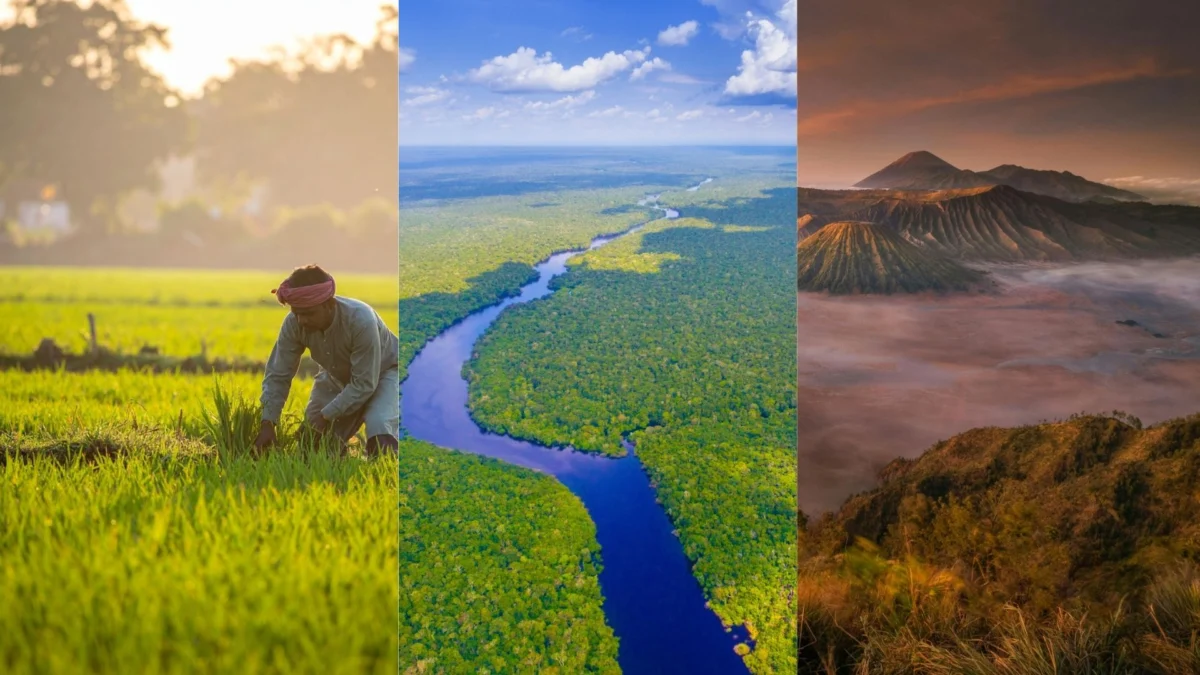
PARIS – As the global community nears the critical mid-century deadline for net-zero emissions, a landmark international study has identified a definitive roadmap for three of the world’s most pivotal emerging economies. Researchers have concluded that Brazil, India, and Indonesia—nations often viewed as the "engines" of the Global South—can achieve drastic decarbonization by 2050 through a radical transformation of land management rather than the contentious path of altering human diets.
The study, spearheaded by an interdisciplinary consortium including the Institut du Développement Durable et Relations Internationales (IDDRI) in France and the Indian Institute of Management (IIM) Ahmedabad, reveals that the Agriculture, Forestry, and Other Land-Use (AFOLU) sector is not merely a source of emissions, but the most potent weapon in the climate arsenal of these three nations.
Main Facts: The Triple-Nation Strategy for Decarbonization
The research highlights a fundamental shift in climate strategy. While much of the global discourse has focused on reducing meat consumption or industrial transitions, this study suggests that for Brazil, India, and Indonesia, the path to a sustainable future lies beneath their feet and within their canopies.
These three countries are currently among the highest global emitters in the AFOLU sector due to historical deforestation, intensive agriculture, and peatland degradation. However, this high emission profile also grants them the highest potential for mitigation. The researchers argue that by 2050, these nations can transition from being major carbon sources to significant carbon sinks.
The core findings suggest that the vast majority of emission cuts will stem from two primary pillars:

- Nature Protection and Restoration: Halting deforestation and restoring degraded ecosystems like peatlands.
- Agricultural Innovation: Enhancing soil carbon sequestration and integrating trees into farmland (agroforestry) without compromising food security.
Crucially, the study posits that these changes can be achieved without mandated shifts in dietary habits, a finding that carries significant political and social weight in developing nations where food security remains a top priority.
Chronology: From Frontier Expansion to Sustainable Stewardship
To understand the 2050 roadmap, one must look at the trajectory of land use in these regions over the last several decades.
- The Era of Expansion (1970s–2010s): For decades, Brazil, Indonesia, and India pursued economic growth through land expansion. In Brazil, the Amazon and Cerrado biomes faced massive clearing for cattle ranching and soy. In Indonesia, the expansion of palm oil plantations led to the drainage of carbon-rich peatlands. In India, the Green Revolution prioritized high yields through intensive chemical use, often at the expense of soil health.
- The Paris Agreement Pivot (2015): Following the COP21 summit, these nations began integrating climate goals into national policies. However, the conflict between "development" and "environment" remained a significant hurdle.
- The Modeling Phase (2020–2025): The current study is the culmination of years of data collection. Local experts from institutions like Bogor Agricultural University in Indonesia and the Federal University of Rio de Janeiro (UFRJ) in Brazil collaborated to create country-specific computer models. They fed decades of local economic, agricultural, and dietary data into these programs to simulate future scenarios.
- The 2050 Horizon: The newly published framework provides the final "pathway" that links current policy choices to the 2050 targets, proving that a balance between growth and ecology is mathematically and economically viable.
Supporting Data: Country-Specific Pathways to Net-Zero
The research emphasizes that a "one-size-fits-all" approach is destined for failure. Each of the three nations requires a bespoke strategy based on its unique ecological and economic landscape.
Brazil: The Forestry Powerhouse
In Brazil, the strategy is anchored in the "Forestry and Land-Use Change" subsector. The data suggests that Brazil’s greatest contribution will come from a two-pronged approach:
- Zero Deforestation: Rapidly halting the clearing of native forests.
- Plantation Expansion: Increasing the area of plantation forests to meet global timber demand while sequestering carbon.
- Bioenergy: Brazil is poised to become a leader in biomass production, using plant material to create renewable bioenergy that can replace fossil fuels in the industrial sector.
Indonesia: The Guardian of the Peatlands
Indonesia’s pathway is dominated by its unique geography. The study identifies the protection of peatlands as the single most important factor for the archipelago.

- Peatland Restoration: Stopping the drainage and degradation of carbon-rich peatlands, which, when dry, are prone to massive fires that release centuries of stored carbon.
- Fire Prevention: Implementing tech-driven monitoring to prevent forest fires.
- Sustainable Bioenergy: Similar to Brazil, Indonesia can utilize its agricultural residues for bioenergy, creating a circular economy that reduces reliance on coal.
India: The Soil and Agroforestry Revolution
Unlike Brazil and Indonesia, India has less land available for massive new forest plantations. Therefore, its strategy focuses on the "ground up."
- Soil Carbon Sequestration: By changing tillage practices and using organic amendments, Indian farmers can turn the country’s vast agricultural lands into "carbon sponges."
- Agroforestry: The study suggests that planting trees on the edges of existing farms (bund planting) can soak up millions of tonnes of CO2 without reducing the area available for crops.
- Yield Efficiency: By improving crop efficiency through precision agriculture, India can produce more food on less land, allowing for more "natural" spaces.
Official Responses and Collaborative Perspectives
The international team behind the study emphasizes that these findings are intended to empower policymakers in the Global South with hard data.
Dr. Shivani Agarwal (Simulated Perspective), a researcher involved in the Indian modeling component, noted: "For too long, climate models were designed in the West and applied to the East. This research is different because it was built from the ground up by local experts who understand that you cannot ask a smallholder farmer in India to stop farming for the sake of the climate. You must show them how farming better can save the climate."
The IDDRI (France) Statement: The coordinating body in Paris emphasized that this framework is a "bridge" between environmental science and macroeconomics. By linking agricultural models with wider economic simulations, they have demonstrated that a "Green Transition" does not have to mean an "Economic Recession."
Regional Policy Implications: While official government responses from Brasília, Jakarta, and New Delhi are still being formulated, the study has already been presented to various ministries. The consensus among technical advisors is that the focus on "land management over diet" makes the climate transition more "politically digestible" and socially just.

Implications: Balancing Food Security and Climate Survival
The implications of this research are profound for the global fight against climate change. It shifts the burden of proof from the consumer (what we eat) to the producer and the state (how we manage land).
1. Food Security vs. Climate Goals
One of the most significant conclusions of the study is that strict cuts to agricultural emissions—such as drastically reducing livestock numbers—could harm food security and rural livelihoods. By focusing on carbon sinks (forests and soils) rather than cutting food production, these nations can protect their growing populations while still meeting international obligations.
2. The Economic Ripple Effect
The researchers used sophisticated software to see how planting a new forest or changing a fertilizer policy would ripple through a national economy. They found that while there are initial costs to transitioning, the long-term benefits—such as resilient soils, sustainable timber industries, and new bioenergy markets—outweigh the "business as usual" approach, which faces the mounting costs of climate-induced disasters.
3. The "Missing Links" in the Model
Despite the optimism, the researchers are transparent about the limitations of their work. A critical challenge remains: Climate Volatility.
The models struggled to accurately predict how worsening droughts, heatwaves, and unpredictable rainfall might damage crop yields. The study had to assume a relatively stable environment to run its simulations, but the "real world" may be far more chaotic. Furthermore, the study did not fully calculate the complex ripple effects on local biodiversity or the exact number of farming jobs that might be displaced by automation or land-use shifts.
4. A Guide for the Global South
Ultimately, this research provides a realistic guide for the environment. It proves that governments can successfully fight global warming while ensuring that rural farmers maintain thriving livelihoods. As Brazil, India, and Indonesia prepare for future COP summits, this study provides the scientific backing they need to demand international support for land-based climate solutions.

By integrating farm and forest data into comprehensive, economy-wide models, the world now has a clearer picture of how three of its most important nations can lead the way to a cooler, greener, and more food-secure planet. The message is clear: the solution to the climate crisis is not just in the air—it is in the very soil and trees of the emerging world.
