

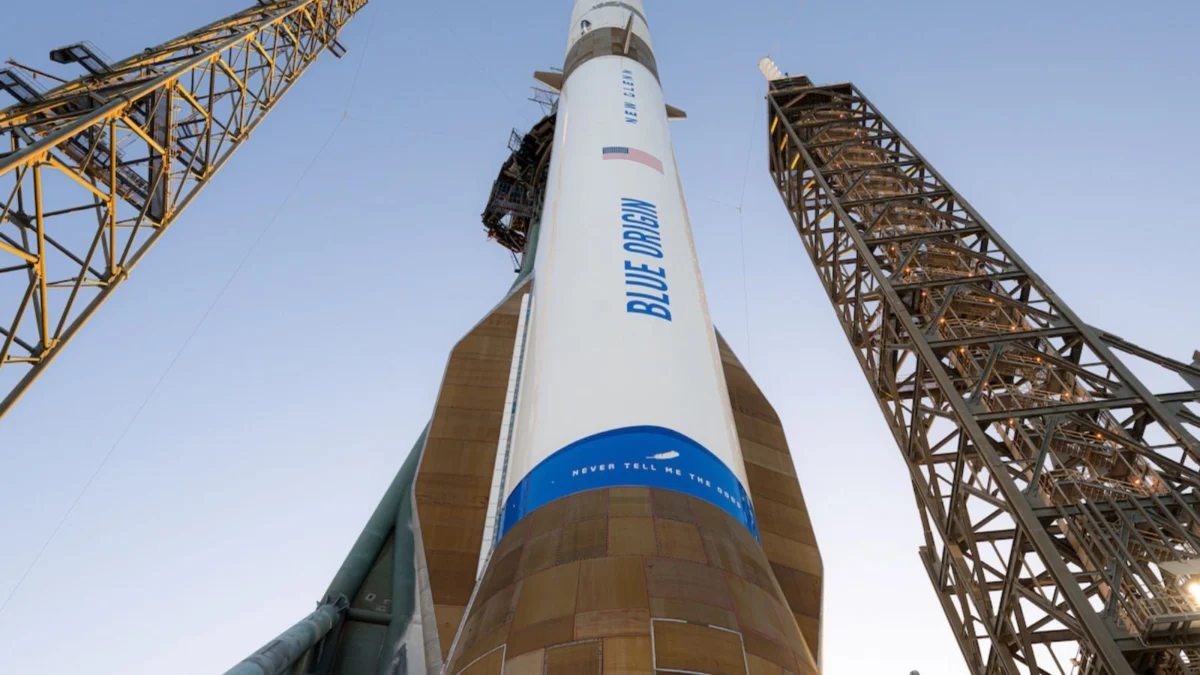
CAPE CANAVERAL, FL — The high-stakes race for orbital dominance has taken a dramatic and potentially era-defining turn. Blue Origin, the aerospace venture founded by billionaire Jeff Bezos, is grappling with a catastrophic hardware failure that has sent shockwaves through the aerospace industry. A massive explosion during a routine test fire has not only destroyed a flight-ready booster but has also "practically destroyed" the company’s primary launch infrastructure, according to sources familiar with the incident.
This development marks a significant hurdle for Blue Origin’s New Glenn rocket, a heavy-lift vehicle designed to challenge the hegemony of Elon Musk’s SpaceX. With a recovery timeline estimated at six months or longer, the incident threatens to derail Amazon’s ambitious satellite internet schedule, complicate NASA’s lunar roadmap, and further cement SpaceX’s position as the sole reliable provider for heavy-lift missions in the West.
I. Main Facts: The Destruction of "No, It’s Necessary"
The incident occurred during a static fire test of the New Glenn first-stage booster, an essential milestone ahead of the rocket’s long-anticipated debut flight. The booster involved in the mishap was affectionately named "No, It’s Necessary," a cinematic reference to a pivotal docking scene in Christopher Nolan’s Interstellar. However, the outcome was far from the precision depicted on screen.
The Scale of the Damage
Internal reports and industry insiders describe a scene of significant devastation at the launch complex. The explosion was not limited to the rocket hardware itself; the launch pad—the sophisticated "Stage 0" infrastructure required to fuel, hold, and release the massive vehicle—sustained "catastrophic" damage.
Key facts of the mishap include:
- Hardware Loss: Total loss of the "No, It’s Necessary" booster, which was slated for upcoming flight operations.
- Infrastructure Impact: The launch pad is reportedly "practically destroyed," with engineers anticipating a minimum six-month disruption for repairs and safety investigations.
- Operational Grounding: The Federal Aviation Administration (FAA) is expected to oversee a comprehensive mishap investigation, which historically prevents further flight activities until a root cause is identified and mitigated.
The timing could not be worse for Bezos. Blue Origin has spent years developing the New Glenn, a reusable heavy-lift rocket powered by seven BE-4 engines. The vehicle is the cornerstone of the company’s strategy to transition from suborbital tourism (via New Shepard) to a major player in the global orbital delivery market.
II. Chronology: From Anticipation to Catastrophe
The road to the New Glenn launch has been paved with years of delays, making this latest setback particularly painful for the Blue Origin workforce.
- 2012–2023: The Long Gestation: Blue Origin began work on a high-thrust orbital engine (the BE-4) and the New Glenn vehicle more than a decade ago. While SpaceX’s Falcon 9 became the industry workhorse, New Glenn faced repeated design shifts and manufacturing hurdles.
- Early 2024: Momentum Builds: Blue Origin successfully delivered BE-4 engines to United Launch Alliance (ULA) for their Vulcan rocket and began moving New Glenn hardware to the pad in Florida for final integration testing.
- The Week of the Incident: Blue Origin was preparing for a critical "hot fire" test. This test is designed to ignite the engines while the rocket is bolted to the pad, verifying that all systems—plumbing, software, and structural integrity—work in harmony.
- Thursday’s Explosion: During the test sequence, an unspecified failure led to a massive conflagration. Eyewitness accounts and sensor data confirmed the destruction of the booster and severe scorching and structural warping of the launch mount.
- Friday: The Fallout: As news of the destruction leaked to industry partners, the U.S. Space Force and NASA began immediate assessments of how the delay would ripple through their respective manifestos.
III. Supporting Data: The Stakes for Project Kuiper and NASA
The explosion is not merely a blow to Blue Origin’s pride; it is a mathematical crisis for its largest customer: Amazon.
The Project Kuiper Deadline
Amazon’s Project Kuiper, a planned constellation of 3,236 Low Earth Orbit (LEO) satellites, is under a strict regulatory clock. To maintain its FCC license, Amazon must deploy at least half of its constellation—roughly 1,600 satellites—by July 2026.
Before the explosion, the plan relied heavily on New Glenn’s massive payload fairing.
- Capacity Comparison: While a SpaceX Falcon 9 can carry approximately 20-22 Starlink-sized satellites, the New Glenn is designed to carry nearly double the volume of Amazon’s Kuiper satellites per launch.
- The Deficit: With New Glenn grounded for at least six months, Amazon faces a "mission count" crisis. Even if they shift more payloads to SpaceX, the sheer number of launches required to meet the 2026 deadline may exceed the available slots on the global market.
Impact on Lunar Ambitions
NASA is also a major stakeholder in Blue Origin’s success. The company was recently awarded a $3.4 billion contract to develop the "Blue Moon" lander for the Artemis V mission.
- Immediate Impacts: Blue Origin was scheduled to launch its first uncrewed lunar lander later this year as a precursor. That mission is now indefinitely postponed.
- The Artemis Timeline: NASA’s goal of establishing a permanent lunar base depends on a "multi-lander" strategy to ensure redundancy. If Blue Origin cannot fly New Glenn, NASA remains entirely dependent on SpaceX’s Starship, creating a single point of failure for the entire Artemis program.
IV. Official Responses: Rivalry and Resilience
The reaction from the space community has been a mix of professional sympathy and strategic calculation.
The Musk-Bezos Dynamic
Elon Musk, often a fierce critic of Bezos’s "slow" progress, took a surprisingly somber tone on social media. After expressing hope for a quick recovery, Musk posted the Latin phrase "Ad astra per aspera"—to the stars through hardships. While the sentiment appeared supportive, industry analysts note that the mishap significantly increases SpaceX’s leverage. Amazon, which had previously avoided using SpaceX to avoid funding its primary competitor, has already been forced to buy Falcon 9 slots. This explosion likely forces Amazon to further subsidize its rival to save its own satellite constellation.
Government and Regulatory Stance
Despite the catastrophe, the U.S. government appears committed to Blue Origin. The U.S. Space Force and the National Reconnaissance Office (NRO) affirmed their support for the company just hours after the explosion.
- National Security: "Long term, the market still needs viable alternatives," said Mark Boggett, CEO of Seraphim Space. The Pentagon is wary of a SpaceX monopoly and views Blue Origin as the only other entity with the potential scale to provide "assured access to space."
- NASA’s Assessment: A NASA spokesperson stated the agency would "assess the near-term impact" on the Artemis and Moon Base programs. While no contracts have been canceled, the agency is reportedly looking at contingency plans for its 2028 lunar rover missions.
V. Implications: A Monopoly Fortified
The broader implications of the New Glenn explosion reach far beyond the scorched pad in Florida. The incident highlights the "high-barrier-to-entry" nature of the heavy-lift market.
1. Strengthening the SpaceX Hegemony
With New Glenn sidelined, SpaceX’s Falcon 9 and Falcon Heavy remain the only operational high-cadence heavy launchers in the Western world. This allows SpaceX to maintain premium pricing for commercial slots and gives them first pick of lucrative government contracts. For at least the next year, the "multi-provider ecosystem" that the U.S. government desires remains a theoretical goal rather than a reality.
2. The Engineering "Test-to-Failure" Debate
The explosion reignites the debate over development philosophies. SpaceX famously "expects" explosions during its Starship development in Texas, using a "fail fast" approach. Blue Origin has traditionally followed a more conservative, "slow is smooth" philosophy (encapsulated by their motto Gradatim Ferociter). The fact that a catastrophic failure occurred during a late-stage test suggests that the conservative approach may not necessarily prevent the very disasters it seeks to avoid, potentially leading to a shift in how Blue Origin approaches future testing.
3. Financial Pressure on the Bezos Empire
While Jeff Bezos has the personal wealth to fund Blue Origin indefinitely, the company is under increasing pressure to transition from a "research and development" firm to a revenue-generating entity. Amazon shareholders are also wary of the billions being poured into Project Kuiper. A six-month delay in launch capability translates to hundreds of millions of dollars in lost potential revenue and increased storage costs for satellites that have no ride to orbit.
4. The Fragility of the Lunar Roadmap
Finally, this incident serves as a wake-up call for NASA. The Artemis program’s reliance on commercial partners is a double-edged sword. While it reduces the upfront cost to taxpayers, it hitches the nation’s prestige to the private sector’s technical hurdles. If Blue Origin cannot rectify the New Glenn issues by 2025, the dream of a "Blue Moon" may remain a distant, expensive prospect.
In the coming months, the focus will shift to the debris-clearing efforts at the launch pad. Whether Blue Origin can "recover quickly," as Musk hoped, or whether this explosion signals a deeper systemic issue within the New Glenn program, will determine the balance of power in the final frontier for the decade to come.
