

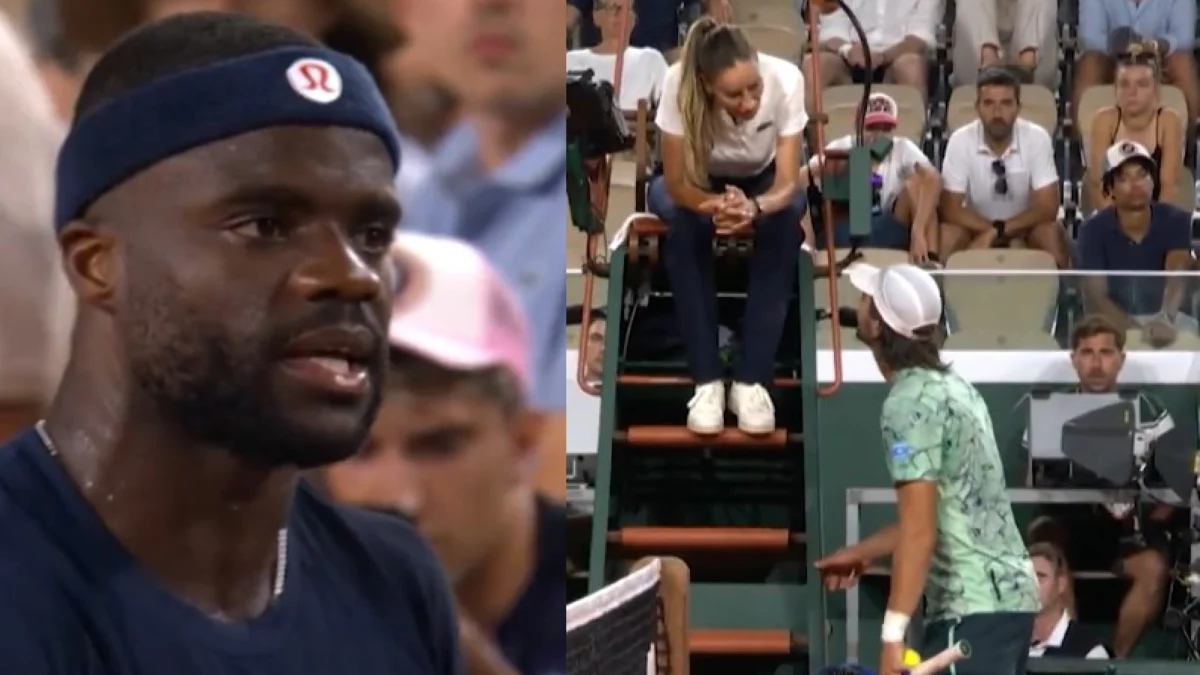
Paris, France – May 31, 2026 – The hallowed clay courts of Roland Garros were ablaze with tension and unexpected turns today, as American tennis star Frances Tiafoe ignited a fiery on-court confrontation during his third-round match, while defending women’s champion Coco Gauff crashed out in a stunning upset. These dramatic events, alongside a series of marathon five-set battles that pushed athletes to their physical limits, have irrevocably shaped the narrative of the 2026 French Open, promising an unpredictable and thrilling second week.
The most captivating moment of the day unfolded on Court 14, where the usually charismatic Tiafoe found himself embroiled in a heated exchange with Portuguese qualifier Jaime Faria. What began as a tightly contested five-set thriller escalated into a verbal sparring match, captivating spectators and online audiences alike. Tiafoe ultimately prevailed, but not before delivering a stern rebuke to his opponent, a moment that quickly became the talk of the tournament.
Meanwhile, on Court Philippe-Chatrier, a subdued atmosphere marked the premature end of Coco Gauff’s title defense. The American prodigy, who lifted the Suzanne Lenglen Cup just a year prior, succumbed to a determined Anastasia Potapova in a three-set encounter that left fans and pundits reeling. The match, notably played before a sparse crowd due to a conflicting major football final, added an unusual backdrop to one of the tournament’s biggest upsets.
Beyond these headline-grabbing incidents, the men’s draw saw a series of grueling encounters, with Argentina’s Juan Manuel Cerundolo etching his name into the tournament’s history books by winning the longest French Open match in six years, further highlighting the sheer endurance demanded by the Parisian red dirt.
Main Facts: A Day of High Stakes and Higher Tensions
The third round of the French Open delivered a cocktail of drama and athletic prowess, with several matches stretching beyond the four-hour mark, testing the physical and mental fortitude of the world’s elite tennis players.
At the epicenter of the day’s controversy was the clash between American world No. 25 Frances Tiafoe and Portuguese qualifier Jaime Faria. After dropping the first two sets, Tiafoe staged a remarkable comeback, eventually securing a hard-fought 4-6, 6-7 (2), 7-6 (4), 6-1, 6-2 victory over the unseeded Faria in a grueling four-hour encounter. The match, however, will be remembered less for its tennis and more for the fiery exchange that transpired in the decisive fifth set, where Tiafoe’s frustration boiled over into a direct verbal confrontation with his opponent.
On the women’s side, the biggest shock of the tournament thus far saw defending champion Coco Gauff, seeded third, fall to the 30th-ranked Anastasia Potapova. The Russian-born Austrian player delivered a masterful performance, overcoming Gauff 4-6, 7-6 (1), 6-4. Gauff’s exit marks a significant disruption to the women’s draw, leaving the path open for new contenders. The match was also notable for the conspicuously empty stands on the main show court, a rare sight for a Grand Slam featuring a defending champion, attributed to the simultaneous UEFA Champions League final.
Adding to the day’s narrative of endurance, Juan Manuel Cerundolo of Argentina followed up his sensational second-round upset of top seed Jannik Sinner with another epic five-set victory. He overcame Spain’s Martin Landaluce in a staggering 5 hours and 58 minutes, making it the longest French Open match in six years and underscoring his remarkable resilience. Compatriot Matteo Berrettini also demonstrated incredible stamina, requiring 5 hours and 13 minutes to dispatch Francisco Comesana in another five-set thriller.
Chronology: Unpacking the Day’s Defining Moments
The events of May 31, 2026, unfolded with a rhythm of escalating tension and unexpected outcomes, starting from the early matches and culminating in the day’s most talked-about incidents.
The Tiafoe-Faria Flashpoint
The match between Frances Tiafoe and Jaime Faria began as a testament to the unpredictable nature of Grand Slam tennis. Faria, a qualifier with nothing to lose, played inspired tennis, pushing Tiafoe to the brink by winning the first two sets. Tiafoe, known for his flamboyant style and ability to entertain, appeared increasingly frustrated as the match progressed, struggling to find his rhythm against the tenacious Portuguese.
As the match entered the fifth and final set, with Tiafoe having clawed his way back to level terms, the tension reached a boiling point. A line call dispute, common in high-stakes tennis, quickly morphed into a personal exchange. As the players approached the net during a changeover, their words became audible and heated. Tiafoe was heard telling Faria, with an intensity rarely seen from the usually jovial American: "Don’t act like you’re tough. You’re not hard, bro. Just play."
Faria, visibly taken aback and perhaps feeling unfairly targeted, immediately appealed to the chair umpire, gesturing towards Tiafoe and exclaiming, "You see what he’s saying?" The umpire, sensing the volatile atmosphere, intervened swiftly, instructing both players to "be quiet" and focus on the game. The exchange, though brief, injected an undeniable jolt of adrenaline into the match, galvanizing Tiafoe and seemingly unsettling Faria. From that point, Tiafoe’s game elevated, and he dominated the remainder of the set, closing out the match with renewed vigor.
Gauff’s Title Defense Derailed
Coco Gauff’s campaign to defend her French Open crown had been under scrutiny even before she stepped onto the court for her third-round clash against Anastasia Potapova. Earlier in the week, Gauff was involved in a minor car accident on her way to the tournament grounds, an incident that, while not resulting in injury, undoubtedly added an unforeseen layer of stress and disruption to her preparation. Though she had dismissed its impact, the psychological toll of such an event, even subtle, cannot be entirely discounted for an athlete performing at the highest level.
Against Potapova, Gauff started strongly, taking the first set with a display of powerful groundstrokes and athletic defense. However, Potapova, who has been enjoying a stellar clay season, refused to yield. The second set became a battle of wills, culminating in a decisive tie-break that Potapova dominated, winning 7-1. This momentum shift proved critical.
In the final set, Potapova maintained her aggressive play, consistently challenging Gauff’s serve and dictating rallies. Gauff, despite her characteristic fighting spirit, struggled to convert key break point opportunities and found herself increasingly on the defensive. Her post-match comments, "She was able to finish the points and I wasn’t. Just not capitalizing on certain shots," perfectly encapsulated her struggles. The 4-6, 7-6 (1), 6-4 defeat marked an unexpected and early exit for the defending champion, sending ripples of surprise through the tennis world.
Adding an unusual element to this major upset was the backdrop of Court Philippe-Chatrier. The iconic stadium, usually packed to the rafters for a defending champion’s match, was conspicuously half-empty. The French public, it appeared, had largely opted to watch the UEFA Champions League final, creating an eerily quiet atmosphere for such a high-stakes Grand Slam encounter.
Marathon Battles on the Men’s Side
The men’s singles draw was defined by tests of endurance. Juan Manuel Cerundolo, fresh off his stunning upset of world No. 1 Jannik Sinner, continued his improbable run with another monumental effort. His five-set victory over Martin Landaluce, lasting an astonishing 5 hours and 58 minutes, showcased an almost superhuman level of resilience. This match was a brutal exhibition of clay-court tennis, characterized by long rallies, numerous deuce games, and relentless scrambling. It became the longest match at Roland Garros since 2020, etching Cerundolo’s name into the tournament’s history for his sheer tenacity.
Similarly, 2021 Wimbledon finalist Matteo Berrettini demonstrated his own brand of grit, overcoming Francisco Comesana in 5 hours and 13 minutes. These back-to-back marathon matches highlight the extreme physical demands placed on players at the French Open, particularly on the slow clay surface which often necessitates longer points and extended rallies.
Other notable men’s results included Alejandro Tabilo ending the impressive run of 17-year-old Frenchman Moise Kouame, and Felix Auger-Aliassime, now the highest-seeded player remaining in the top half of the draw following Sinner’s early exit, overcoming American Brandon Nakashima in four sets. Flavio Cobolli and Zachary Svajda also advanced after tough battles, further thinning the field.
Supporting Data: Contextualizing the Day’s Events
The events of May 31, 2026, are not isolated incidents but rather reflective of broader trends and historical contexts within professional tennis.
The Psychology of On-Court Confrontations
Frances Tiafoe’s outburst, while rare in its directness, is not entirely unprecedented in the high-pressure world of Grand Slam tennis. Players often use various psychological tactics, both internal and external, to gain an edge. Tiafoe himself admitted after the match, "I needed that. Because I’m up at the time but I’m still a little nervous. And he was chirping. He definitely gave me a lot of lip. He thought he was (boxer) Ryan Garcia or something." This quote provides crucial insight into his mindset: the confrontation served as a release of tension and perhaps a self-inflicted spark to refocus his energy. While unsportsmanlike conduct is frowned upon, the competitive fire it ignited for Tiafoe was, in his view, a necessary catalyst for victory. Faria, as a qualifier, might have felt emboldened to engage, unaware of the psychological gamesmanship at play from a more seasoned tour veteran.
Gauff’s Defensive Battle and Potapova’s Ascent
Coco Gauff’s defeat underscores the immense pressure that comes with defending a Grand Slam title, especially for a young player. Her statistics from the match likely revealed a higher unforced error count and a lower break point conversion rate than typical for her dominant performances. Her comment about Potapova "finishing the points" suggests that despite her defensive prowess, Gauff struggled to translate rallies into winning shots, an area where Potapova excelled with 35 winners to Gauff’s 22.
Potapova’s victory is not an isolated fluke. The 30th seed has been steadily building momentum throughout the clay season, reaching a final in Linz, Austria, and the semifinals of the Madrid Open as a qualifier. Her improved clay-court game, coupled with a 3-2 career head-to-head advantage against Gauff following this match, indicates a player whose ranking belies her current form on this surface. Her recent nationality change, now representing Austria, also adds an interesting dimension to her profile.
The Demands of Clay Court Marathon Matches
The prevalence of extremely long matches, such as Cerundolo’s nearly six-hour epic and Berrettini’s five-hour battle, is a hallmark of the French Open. Clay courts are notoriously slow, leading to extended rallies and making it difficult for players to hit unreturnable winners. This translates into increased physical exertion and mental endurance. Historical data shows that the French Open consistently produces the longest average match times among the four Grand Slams. For Cerundolo, coming off another five-set win against Sinner, the combined time on court is a testament to extraordinary physical conditioning, but also raises questions about his recovery capabilities for subsequent rounds.
The Impact of External Events on Grand Slam Attendance
The sparsely populated stands on Court Philippe-Chatrier during Gauff’s match against Potapova highlighted a rarely discussed but significant issue: the clash of major sporting events. The UEFA Champions League final, a highly anticipated global spectacle, clearly drew a substantial portion of the French public’s attention away from Roland Garros. While Grand Slams typically command unwavering local support, the draw of a football final, especially one involving a French club or of high international interest, proved too strong. This incident may prompt future discussions among tournament organizers regarding scheduling strategies to avoid such direct competition.
Official Responses: Voices from the Court and Beyond
The day’s events elicited direct responses from the involved players, offering insight into their perspectives and the psychological aftermath of high-pressure tennis.
Tiafoe’s Candid Reflection
Frances Tiafoe’s immediate post-match comments to TNT Sports were remarkably candid, shedding light on the motivation behind his fiery exchange with Faria. Speaking to Sloane Stephens, Tiafoe stated, "I felt like I needed that… he thought he was Ryan Garcia or something." This self-analysis suggests that the altercation was not merely an uncontrolled outburst, but a deliberate act, or at least a welcome spark, to reignite his competitive fire when he felt himself faltering. By challenging Faria verbally, Tiafoe arguably tapped into a deeper well of aggression, using the perceived disrespect as fuel to complete his comeback. His reference to Ryan Garcia, a flamboyant boxer known for his confident persona, further underscores Tiafoe’s view of Faria’s perceived bravado and his desire to assert dominance. The chair umpire’s swift intervention, though brief, served its purpose in de-escalating the situation before any formal code violations for unsportsmanlike conduct were issued, maintaining the integrity of the match.
Gauff’s Self-Assessment
Coco Gauff’s press conference after her defeat was characterized by a composed, albeit disappointed, self-assessment. Her statement, "She was able to finish the points and I wasn’t. Just not capitalizing on certain shots," offered a clear, technical explanation for her loss. It reflected an understanding that while her effort was present, her execution in crucial moments—particularly on break points and in concluding rallies—was lacking. There was no blame placed on external factors like the car accident or the quiet crowd, indicating a professional athlete’s focus on her own performance. Her acknowledgement of Potapova’s ability to "finish points" also served as a respectful nod to her opponent’s superior execution on the day.
Tournament Officials and Media Scrutiny
While specific official responses from tournament directors regarding the player conduct or crowd attendance were not immediately available, the incidents undoubtedly generated internal discussions. The Tiafoe-Faria exchange, captured on camera and widely shared on social media, prompted a flurry of commentary from tennis pundits and former players, debating the line between competitive fire and unsportsmanlike behavior. The empty stands during Gauff’s match, meanwhile, likely raised questions about scheduling and audience engagement strategies for future Grand Slam editions. Media outlets widely highlighted both the dramatic confrontation and the unexpected upset, framing them as defining moments of the tournament’s early stages.
Implications: Shaping the Road Ahead
The events of May 31, 2026, carry significant implications for the remainder of the French Open and for the players involved.
For Frances Tiafoe: A Rejuvenated Campaign?
For Frances Tiafoe, the dramatic victory over Faria, fueled by the on-court spat, could prove to be a pivotal moment in his tournament. If his own assessment is accurate—that he "needed that" spark—then the confrontation might have provided the necessary jolt to push him deeper into the draw. This type of emotional release, while risky, can sometimes lead to an elevated level of play. His next match will be a crucial test of whether this fiery encounter has truly revitalized his campaign or if the emotional expenditure will eventually catch up with him. It also reinforces his persona as a passionate, often unpredictable, competitor.
For Jaime Faria: A Learning Experience
For Jaime Faria, despite the loss and the heated exchange, his run as a qualifier to the third round of a Grand Slam is a significant achievement. The confrontation with Tiafoe, while perhaps unsettling in the moment, serves as a harsh but valuable lesson in managing the psychological warfare that can occur at the highest levels of professional tennis. It will be an experience that defines his growth as he aims to establish himself on the main tour.
For Coco Gauff: A Setback and a Reassessment
Coco Gauff’s early exit is a major blow to her season and her quest for further Grand Slam glory. Defending a major title is notoriously difficult, and her experience highlights the immense pressure and the depth of talent on the women’s tour. This defeat will necessitate a period of reflection and reassessment for Gauff and her team. She will need to analyze what went wrong, particularly her ability to close out points and capitalize on opportunities. While her talent and mental toughness are undeniable, this setback could be a crucial learning curve, prompting adjustments in her game or preparation for future major tournaments. Her car accident earlier in the week, though downplayed, might also be considered in a broader retrospective analysis of her preparation.
For Anastasia Potapova: A Breakthrough Opportunity
Anastasia Potapova’s victory over the defending champion is undoubtedly a career-defining moment. It validates her strong clay-court season and positions her as a serious contender in the now wide-open women’s draw. Her confidence will be sky-high, and with Gauff eliminated, the path to the latter stages of the tournament appears less daunting. This win could be the catalyst for a deep Grand Slam run, elevating her profile significantly within the tennis world.
The Men’s Draw: Wide Open and Physically Demanding
With the early exit of top seed Jannik Sinner and the continuing physically demanding nature of the matches, the men’s draw at Roland Garros is increasingly open. Felix Auger-Aliassime, now the highest seed in his half, faces a significant opportunity. However, the sheer physical toll extracted by matches like those of Juan Manuel Cerundolo and Matteo Berrettini raises questions about the long-term stamina of players who have spent so many hours on court. The tournament’s second week promises to be a battle not just of skill, but of sheer endurance and recovery, as contenders navigate a landscape dramatically altered by early upsets and grueling contests.
The Tournament’s Overall Narrative
The 2026 French Open is rapidly solidifying its reputation as a tournament of drama, resilience, and unexpected twists. From fiery player confrontations to the fall of a defending champion and epic battles of endurance, the storylines are rich and compelling. These events underscore the unpredictable nature of Grand Slam tennis and ensure that the coming days at Roland Garros will be watched with heightened anticipation, as new narratives unfold and champions, perhaps unexpected ones, emerge from the red clay.
