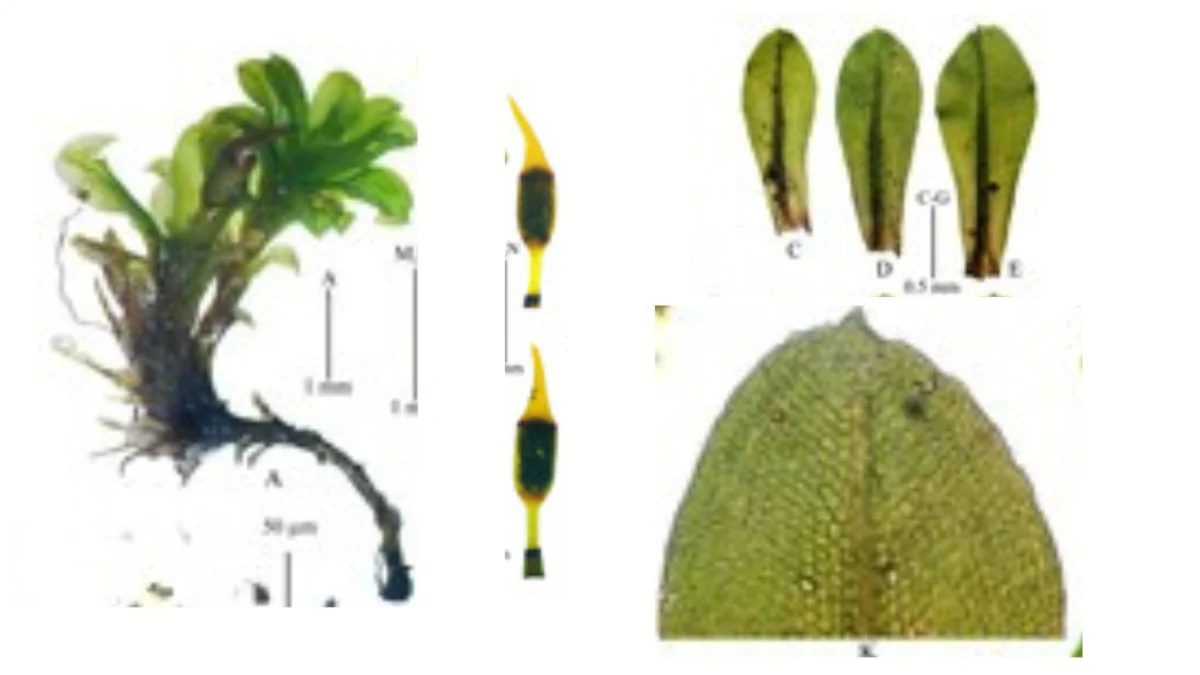
UTTARAKHAND — In a discovery that reshapes our understanding of ancient botanical migration and the hidden biodiversity of the Indian subcontinent, scientists from the Botanical Survey of India (BSI) have identified a new species of moss in the rugged, mist-shrouded terrains of the Western Himalayas. Named Indopottia himalayensis, this diminutive green plant represents only the third known species of its genus globally, providing a critical missing link in the study of plant dispersal across Asia.
The discovery, made in the Garhwal Region of Uttarakhand, underscores the ecological significance of high-altitude evergreen forests and suggests that the Himalayas served as a primary "biological highway" millions of years ago. As the world faces a mounting biodiversity crisis, the identification of Indopottia himalayensis offers a rare glimpse into a resilient lineage that has survived since the collision of the Indian and Eurasian tectonic plates.
Main Facts: A Rare Find in the Heart of the Garhwal
The discovery of Indopottia himalayensis is a significant milestone for bryology—the branch of botany concerned with mosses, liverworts, and hornworts. Until this find, the genus Indopottia was considered exceptionally rare, with only two other species documented: one in the Western Ghats of Southern India and another in the mountainous regions of Thailand.
The Location and Habitat
The new species was found in the Madhyamaheshwar area of Uttarakhand, a region known for its spiritual significance and its dense, undisturbed temperate forests. At an elevation of approximately 1,900 meters (6,233 feet), the environment is characterized by high humidity, frequent mist, and a canopy of evergreen trees that provides the cool, shaded conditions necessary for specialized bryophytes.
Unlike many of its relatives that are epiphytic—meaning they grow on the bark of trees or decaying logs—Indopottia himalayensis was found to be strictly terrestrial. It was discovered clinging to a thin layer of moist, nutrient-rich soil draped over ancient rock formations. This shift in habitat preference from wood to stone/soil is one of the primary indicators that this species has evolved independently to suit the specific alpine conditions of the Western Himalayas.
Distinguishing Features
While mosses may appear identical to the untrained eye, Indopottia himalayensis possesses several distinct morphological traits:
Size: It is slightly larger than its Southeast Asian counterparts, with stems reaching up to 13 millimeters in length.
Structure: It features a perfectly cylindrical stem and a single, upright spore-capsule (sporophyte).
Unique Lid: The capsule is capped with a lid that exhibits a peculiar sideways bend when dehydrated, a trait not seen in the Western Ghats species.
Cellular Composition: Under microscopic examination, the leaves lack the specific transparent, bulging cells (hyaline cells) found in its closest relatives, indicating a different strategy for water retention and light absorption.
Chronology: From Field Expedition to Laboratory Confirmation
The journey to identifying Indopottia himalayensis began as part of a multi-year, comprehensive survey of the flora of the Garhwal Region, conducted by the Botanical Survey of India.
The Expedition (Pre-2026)
During a rigorous field trek through the steep valleys surrounding Madhyamaheshwar, researchers were documenting the undergrowth of the region’s shady evergreen forests. The team was particularly interested in "cryptogams"—plants like mosses and ferns that reproduce via spores rather than seeds.
In the damp, low-light environment near a rocky outcrop, the team noticed a vibrant patch of moss that didn’t immediately match known regional records. Samples were carefully harvested using sterile tools, cataloged with GPS coordinates, and preserved for transport to BSI’s regional and central laboratories.
The Laboratory Phase
Once the specimens reached the laboratory, the slow process of taxonomic verification began. Researchers used high-resolution microscopy to examine the cellular structure of the leaves (the phyllids) and the anatomy of the reproductive capsules.
Over several months, the team compared their Himalayan specimen with the holotypes (original reference samples) of Indopottia dabhadei from the Western Ghats and the Thai species. By late 2025, the data confirmed that the Himalayan moss was a distinct species. The findings were peer-reviewed and officially published in June 2026, marking a major contribution to the Phytotaxa journal and the broader scientific community.
Supporting Data: Comparative Analysis of the Genus Indopottia
To understand the significance of Indopottia himalayensis, it is necessary to compare it with its two known "cousins." The divergence in their physical and ecological traits tells a story of adaptation over millions of years.
Feature
I. himalayensis (Himalayas)
I. dabhadei (Western Ghats)
Indopottia sp. (Thailand)
Habitat
Terrestrial (Soil on rocks)
Epiphytic (Bark/Wood)
Epiphytic (Bark/Wood)
Stem Length
Up to 13 mm
5–8 mm
8–10 mm
Capsule Count
Single, Upright
Paired, Drooping
Single, Upright
Dry Lid Shape
Bends sideways
Straight/Conical
Straight
Leaf Cells
Homogeneous
Transparent bulging cells
Transparent bulging cells
Ecological Significance of the Terrestrial Shift
The fact that the Himalayan species grows on soil-covered rocks rather than trees suggests a significant evolutionary adaptation. In the high-altitude Western Himalayas, temperature fluctuations are more extreme than in the tropical Western Ghats or Thailand. Soil and rock provide a more stable thermal mass than tree bark, potentially protecting the moss from the sharp frosts common at 1,900 meters. This data point suggests that Indopottia himalayensis may be more cold-hardy than its southern relatives.
Official Responses: Insights from the Scientific Community
The discovery has been met with enthusiasm from the botanical community in India and abroad. Lead researchers at the Botanical Survey of India emphasized that this discovery is not just about naming a new plant, but about understanding the "bio-heritage" of the Indian subcontinent.
Dr. A. Sharma, a senior bryologist at the BSI, commented:
"The discovery of Indopottia himalayensis is a testament to how much we still have to learn about the ‘lower’ plants. While mega-fauna like tigers and elephants capture the public’s attention, these tiny mosses are the foundation of forest ecosystems. They prevent soil erosion, retain moisture, and serve as indicators of environmental health. Finding a new species in such a well-traveled region as Garhwal proves that the Himalayas still hold many secrets."
Dr. Rajesh Kumar, a specialist in plant geography, noted:
"Taxonomically, this is a ‘bridge species.’ The geographical gap between the Western Ghats and Thailand is massive. To find a third member of this genus in the Himalayas provides the physical evidence we needed to support theories of ancient plant migration. It confirms that the Himalayas acted as a conduit for life moving between the Indian plate and the rest of Asia."
Officials from the Uttarakhand Forest Department have also expressed interest in the find, noting that the presence of such rare bryophytes could lead to increased protection for the Madhyamaheshwar forest tracts, potentially designating them as "Biodiversity Heritage Sites."
Implications: The Himalayan Corridor and Evolutionary History
The most profound implication of this discovery lies in the field of biogeography. Scientists have long hypothesized the existence of a "Himalayan Corridor"—an ancient biological highway that facilitated the movement of species across the Asian continent.
The Tectonic Connection
Roughly 40 to 50 million years ago, the Indian tectonic plate collided with the Eurasian plate, a cataclysmic event that raised the Himalayan mountain range. This collision did more than create mountains; it created a land bridge between the previously isolated Indian landmass (which had drifted from Gondwana) and the vast Asian mainland.
The distribution of the genus Indopottia—now spanning the Western Ghats, the Himalayas, and Thailand—serves as a map of this ancient movement. It is believed that as the mountains rose, they created a continuous belt of temperate and subtropical forests that allowed moisture-loving plants like mosses to migrate from the southern peninsula into the heart of Asia.
Climate Change and Sentinel Species
The discovery also has modern-day implications for climate science. High-altitude mosses are extremely sensitive to changes in moisture and temperature. As "sentinel species," they are often the first to show signs of distress as a result of global warming.
By documenting Indopottia himalayensis now, scientists have established a baseline. If the "misty" conditions of the Madhyamaheshwar forests begin to dry out due to changing monsoon patterns, the health and population of this moss will serve as an early warning system for the entire ecosystem.
Conclusion: The Value of the Small
The discovery of Indopottia himalayensis reminds us that grand scientific truths are often hidden in the smallest packages. A 13-millimeter moss, clinging to a rock in the shadow of the world’s highest peaks, has the power to validate theories of continental drift and ancient migration.
As researchers continue to explore the Garhwal Region, the focus remains on conservation. Protecting the "green skin" of the Himalayas—the mosses and lichens that carpet its rocks—is essential to preserving the integrity of the mountains themselves. This new species is not just a new entry in a botanical ledger; it is a living relic of Earth’s dynamic history, a green bridge across time and space.