

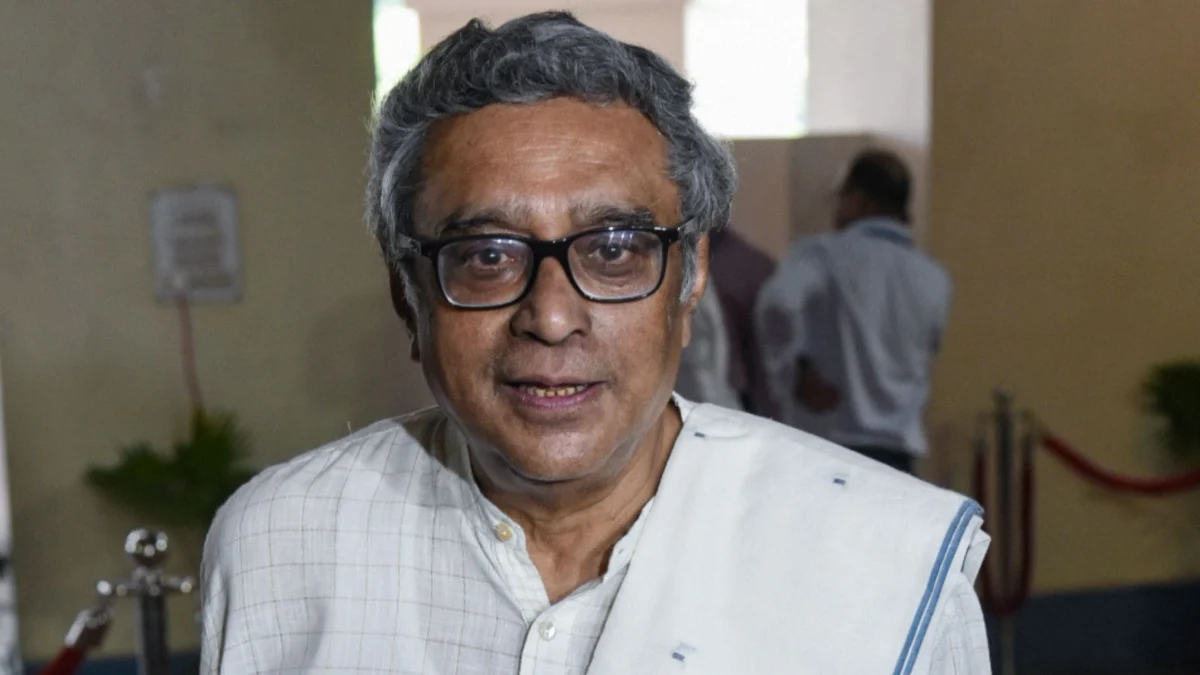
Kolkata, West Bengal – In a significant political development following the Bharatiya Janata Party’s (BJP) sweeping victory in the recent Bengal Assembly elections, veteran journalist, acclaimed political commentator, and newly-elected first-time MLA, Swapan Dasgupta, was sworn in as a minister in the West Bengal government this Monday. The induction of the 70-year-old intellectual into Chief Minister Suvendu Adhikari’s expanded Cabinet signals a strategic move by the BJP to infuse experienced national voices into the state administration, marking a pivotal moment in West Bengal’s political landscape.
Dasgupta was among 35 party legislators who took their oath of office, underscoring the BJP’s robust mandate and its intent to bring about comprehensive governance reforms in a state long dominated by the Trinamool Congress (TMC). His entry into the state cabinet is particularly noteworthy given his illustrious career spanning academia, journalism, and national politics, where he has consistently championed conservative and nationalist ideologies.
On being administered the oath of office by Governor R.N. Ravi at the historic Lok Bhavan, Dasgupta shared his sentiments on social media, reflecting the gravity and honour of his new role. He posted on X (formerly Twitter): "Honoured to be sworn in as a Cabinet member in the West Bengal government." (June 1, 2026, 9:30 AM IST). This statement, while succinct, captured the culmination of decades of intellectual engagement and political advocacy finally transitioning into direct administrative responsibility.
A Confluence of Experience and Mandate
Swapan Dasgupta’s journey to the West Bengal cabinet is a testament to perseverance and the shifting political sands of the state. His recent victory in the Rashbehari constituency in South Kolkata, where he defeated the incumbent Trinamool Congress’s Debasish Kumar by a significant margin of over 20,800 votes, was a highlight of the BJP’s performance. This win not only secured his maiden entry into the state assembly but also cemented his position as a key figure in the BJP’s vision for West Bengal.
The BJP’s triumph in the Bengal Assembly elections, leading to the formation of a government under Chief Minister Suvendu Adhikari, marks a profound departure from the political status quo. For years, West Bengal has been a bastion of the TMC, and before that, the Left Front. The BJP’s ability to "sweep" these elections, as described in party circles, speaks volumes about a deep-seated desire for change among the electorate and the effectiveness of the party’s grassroots mobilization combined with a strong national leadership narrative. Dasgupta, known for his close ties to the BJP central leadership and his articulate espousal of the party’s core principles, is now tasked with translating that mandate into tangible governance.
His induction is not merely about adding a number to the cabinet but strategically placing an intellectual heavyweight with a national profile and deep understanding of policy into a critical state administration. The cabinet expansion under CM Adhikari is seen as a deliberate move to bring in a mix of experienced politicians, fresh faces, and intellectual stalwarts to tackle the multifaceted challenges facing West Bengal.
A Distinguished Trajectory: From Academia to Activism
Swapan Dasgupta’s life has been a rich tapestry of academic pursuits, journalistic excellence, and political engagement, culminating in his current ministerial role. Born and raised in Kolkata, his early education laid the foundation for a brilliant academic career. He attended St. Paul’s School and La Martiniere, institutions renowned for fostering intellectual curiosity and critical thinking.
His higher education saw him graduate from St. Stephen’s College in Delhi in 1975, a period that often shapes the ideological inclinations of many future leaders. His academic prowess was further recognized when he was awarded the prestigious Inlaks scholarship, enabling him to pursue advanced studies abroad. He earned both his Master of Arts and PhD from the School of Oriental and African Studies (SOAS) at the University of London, specializing in South Asian politics and history. This rigorous academic background provided him with a profound understanding of India’s complex socio-political fabric, a knowledge base that would later inform his incisive commentary and political analyses.
Upon returning to India in 1979, Dasgupta briefly ventured into the corporate sector, taking up a management position at Calcutta Chemical Company. However, the allure of academia and intellectual discourse proved too strong, and within a year, he returned to the UK. He joined Nuffield College, Oxford, as a junior research fellow, where he taught and conducted extensive research on South Asian politics. This period solidified his reputation as a serious scholar and an astute observer of political dynamics.
His professional journey then transitioned into journalism, where he made an indelible mark on Indian media. Over the years, Dasgupta served in senior editorial positions at some of India’s most influential dailies, including The Indian Express, The Times of India, The Statesman, and India Today. In these roles, he became a prominent voice, known for his sharp editorials, analytical columns, and unwavering commitment to his stated ideological positions. His journalistic career was characterized by a clarity of thought and an ability to articulate complex political issues with accessible language, earning him a wide readership and considerable influence.
The Political Innings: A Steadfast Alliance with the BJP
Dasgupta’s alignment with the Sangh Parivar and the BJP has been a consistent thread throughout his public life. He has been a vocal supporter and defender of the BJP’s ideology and its leaders, particularly Prime Minister Narendra Modi, through his regular columns in newspapers and frequent appearances on television news channels. His intellectual contributions have provided a sophisticated articulation of conservative and nationalist viewpoints, making him a valuable asset to the party’s ideological discourse.
His close association with the BJP’s central leadership is well-documented. In 2015, just one year after the Narendra Modi-led BJP stormed to power at the Centre, the government recognized his contributions to public life by conferring upon him the Padma Bhushan, one of India’s highest civilian honours. This award underscored his intellectual eminence and his significant role in shaping public opinion.
In April 2016, the Modi government further acknowledged his standing by nominating him to the Rajya Sabha, the upper house of India’s Parliament, as an eminent personality in literature. This nomination was a testament to his intellectual prowess and his ability to contribute to legislative debates with a nuanced understanding of policy and history. His term in the Rajya Sabha was slated to continue until 2022.
However, Dasgupta’s commitment to active electoral politics led him to make a significant decision in 2021. He resigned from the Rajya Sabha to contest the Bengal Assembly elections from the Tarakeswar constituency on a BJP ticket. This move, while demonstrating his dedication to direct political engagement, proved challenging as he lost that election by approximately 7,400 votes. This defeat occurred in an election where the Mamata Banerjee-led TMC secured a landslide victory, returning to power with a resounding mandate.
A month later, in a move that sparked considerable debate and controversy, Dasgupta was renominated to the Rajya Sabha for the remainder of his original term. The legal sanctity of this renomination was questioned by the Opposition and some constitutional scholars, raising important discussions about parliamentary conventions and political appointments. Despite the controversy, Dasgupta completed his term, continuing his contributions to national legislative discourse.
His recent victory from Rashbehari in the current Bengal Assembly elections thus represents a triumphant return to direct electoral politics and a successful transition from a nominated parliamentarian to an elected state legislator and now, a cabinet minister. This journey highlights his unwavering resolve and the BJP’s continued faith in his abilities and influence.
Official Responses and the Roadmap Ahead
Upon taking his oath as a minister, Swapan Dasgupta did not shy away from outlining the formidable challenges and the ambitious agenda that lie ahead for the new BJP government in West Bengal. His statements provided a clear indication of the administration’s immediate priorities, which he framed as a comprehensive plan for state rejuvenation.
He began by sharply criticizing the legacy of the previous Trinamool Congress government, asserting that it had left West Bengal in a state of severe disrepair. "TMC has left Bengal a completely devastated area," Dasgupta stated unequivocally. He emphasized the immediate necessity to "remove the ‘kachra’ (garbage) and begin the process of reconstruction and planning." This powerful metaphor underscored the depth of the problems the new government believes it has inherited, from economic stagnation to pervasive corruption.
Dasgupta then elaborated on the specific areas of focus for the new administration. He highlighted education, the industrial sphere, infrastructure development, and the restoration of law and order as critical priorities. "The priorities have been set out in education, industrial sphere, setting up infra and getting law and order back," he affirmed, signaling a multi-pronged approach to state building.
Beyond these broad categories, Dasgupta stressed the importance of economic revitalization and governance reform. He emphasized that restoring investor confidence would be a major task, acknowledging the long-standing issues that have deterred investment in the state. "We also have to get back the confidence of the entire investor community," he said. This points to a strategic push for creating a more business-friendly environment, streamlining regulations, and ensuring a stable political climate conducive to economic growth.
Perhaps most critically, Dasgupta underscored the government’s commitment to tackling corruption, a pervasive issue that has plagued public administration in West Bengal. "It is going to be a big challenge trying to get a degree of honesty back into the system because there are so many areas of public life which have been badly corrupted," he asserted. This statement hints at a robust anti-corruption drive and a concerted effort to reform public institutions to ensure transparency and accountability.
Implications: Leveraging Expertise for State Transformation
Swapan Dasgupta’s induction into the West Bengal cabinet carries significant implications for the new BJP government and the state as a whole. Party sources suggest that his extensive expertise will be strategically leveraged in key sectors, particularly education. The previous Mamata Banerjee government faced severe criticism and scrutiny over alleged corruption and irregularities, most notably in the teacher recruitment scam. Dasgupta’s academic background, intellectual rigor, and national perspective are expected to be instrumental in reforming the state’s education system, restoring its credibility, and improving its quality.
Furthermore, his profound understanding of economic policy and industrial development will likely be utilized in improving the state’s finances and rejuvenating its stagnant industrial sector. West Bengal has historically struggled to attract large-scale industrial investment, leading to high unemployment and a reliance on agriculture and informal sectors. Dasgupta’s vision for restoring investor confidence and weeding out corruption aligns perfectly with the need to create a more robust and transparent economic ecosystem. His experience as a political commentator and policy analyst will undoubtedly inform strategic decisions aimed at fiscal prudence and industrial growth.
Dasgupta’s presence in the state cabinet also brings an intellectual gravitas and a strong communication voice. As a seasoned journalist and political commentator, he possesses a unique ability to articulate the government’s policies and vision to the public, counter misinformation, and engage in informed debates. This communication prowess will be crucial for a new government seeking to implement significant reforms and build public trust.
The challenges ahead for the BJP government in West Bengal are monumental. Rebuilding a "devastated area," as Dasgupta put it, requires not only political will but also meticulous planning, effective implementation, and sustained public support. Addressing issues such as political violence, corruption at various levels, economic stagnation, and the revitalization of public services will demand a coordinated and determined effort.
Dasgupta’s appointment is a clear signal that the BJP intends to bring its best minds and most experienced leaders to the forefront of state governance. His journey from an acclaimed academic and journalist to a Rajya Sabha MP, and now to an elected state minister, embodies a commitment to public service and a belief in the transformative power of good governance. As West Bengal embarks on this new political chapter under the BJP, the role of figures like Swapan Dasgupta will be critical in shaping its trajectory and fulfilling the mandate for change that the electorate has so decisively delivered. His tenure will be closely watched as a litmus test for the BJP’s promise of "Sonar Bangla" (Golden Bengal).
