

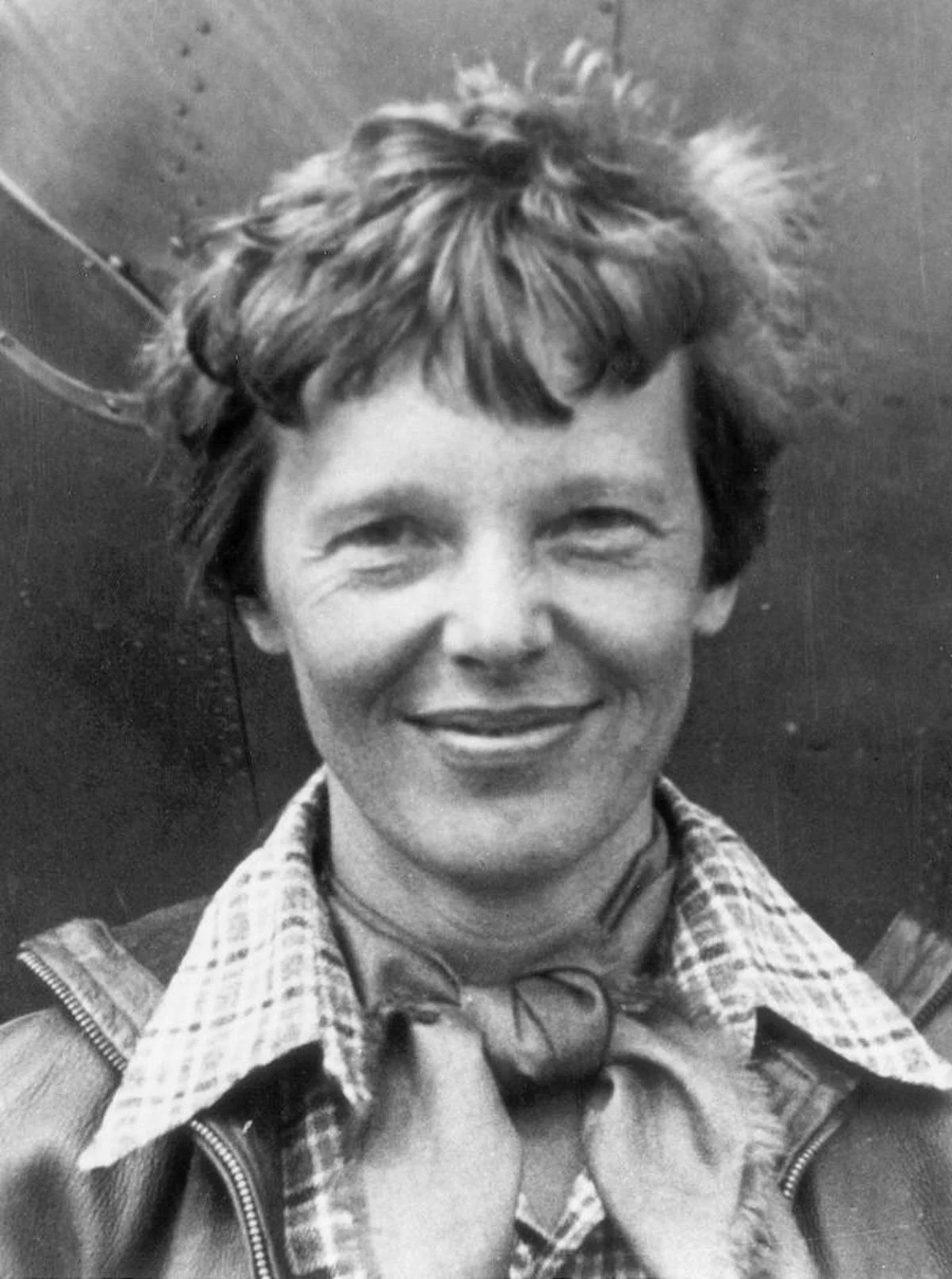
July 24, 1897, Atchison, Kansas. In a modest home, Edwin Stanton Earhart and Amy Otis Earhart welcomed a daughter into the world, a child whose name would soon become synonymous with courage, ambition, and the boundless possibilities of the sky. Amelia Mary Earhart, born into a nation still finding its footing after economic hardship, was destined to become a titan of aviation, a woman who defied gravity and societal expectations to etch her name in the annals of history. This is the enduring story of a pioneer, a record-breaker, and an icon whose disappearance remains one of aviation’s most enduring mysteries.
A Childhood of Unconventional Spirit
Amelia Earhart’s early years were marked by a peripatetic existence, a consequence of her father’s often-unstable employment. The family’s frequent relocations fostered a sense of independence and adaptability in young Amelia and her sister, Grace Muriel Earhart. Their mother, Amy Otis Earhart, played a pivotal role in nurturing their unconventional spirits. In an era when societal norms dictated a more demure upbringing for young girls, Amelia was a tomboy through and through. Her childhood was characterized by an insatiable curiosity and a zest for adventure. She reveled in exploring the neighborhood, scaling trees with fearless abandon, and hurtling down hillsides on makeshift sleds. These early displays of a daring and independent nature offered a subtle foreshadowing of the path she would eventually forge.
Interestingly, Amelia’s initial encounters with airplanes as a child did not ignite a spark of fascination. These "metallic birds," as they were then viewed by many, held little appeal for her young imagination. It would take a more profound experience to awaken her latent passion for flight.
The Unexpected Ascent: From Nurse’s Aide to Aviator
The crucible of World War I proved to be the unlikely catalyst for Amelia Earhart’s entry into the world of aviation. While volunteering as a nurse’s aide in Toronto, Canada, she dedicated herself to caring for the wounded soldiers returning from the brutal battlefields of Europe. Adjacent to the hospital, makeshift airfields served as training grounds for pilots. It was the sight and sound of these aircraft, practicing their maneuvers against the backdrop of the war effort, that began to stir a deep and abiding fascination within her. The roar of the engines, the graceful arc of the planes against the sky – these elements coalesced into a powerful allure that would soon consume her.
By 1920, Amelia took her first exhilarating airplane ride, a pivotal moment that solidified her burgeoning desire to become a pilot. The sensation of flight, the freedom from the earthbound constraints, resonated deeply with her adventurous spirit. However, the path to achieving this dream was fraught with financial challenges. Flying lessons were a luxury few could afford, especially in the post-war economic climate. Amelia, ever resourceful, took on a series of odd jobs, diligently saving every penny to fund her aspirations.
Her dedication paid off. Under the tutelage of pioneering aviator Anita “Neta” Snook, Amelia honed her flying skills. In 1923, she achieved a monumental milestone, earning her pilot’s license from the Fédération Aéronautique Internationale. This accomplishment placed her among a select group of approximately sixteen women worldwide who held an international pilot’s license, a testament to her exceptional talent and perseverance in a field overwhelmingly dominated by men. Her early aviation exploits were not merely about personal achievement; they were about dismantling the perception that flying was an exclusively male domain. By 1922, she had already set a women’s altitude record, reaching an impressive 4,300 feet. These initial triumphs served to establish her reputation as a skilled and fearless pilot, even as the general public still viewed aviation with a mixture of awe and apprehension, often deeming it both dangerous and impractical.
The Transatlantic Breakthrough and the Birth of a Star
The year 1928 marked a pivotal turning point in Amelia Earhart’s career, albeit one that initially placed her in a passenger seat rather than the cockpit. She was invited to join a transatlantic flight as a passenger, an expedition intended to be the first all-female crew to cross the Atlantic. While Amelia did not pilot the aircraft for the majority of the journey, her presence on this groundbreaking flight catapulted her into the international spotlight. Newspapers across the United States hailed her as "the first woman to cross the Atlantic by air," and she became an overnight media sensation.

Amelia, however, was keenly aware of the media’s tendency to exaggerate her role. She recognized that while the fame was a significant boon, it was essential to prove her own capabilities as a pilot. This newfound celebrity provided her with a platform, a powerful tool to advocate for women’s greater participation in aviation, a cause she championed with unwavering conviction.
Determined to silence any doubts and to truly earn her accolades, Amelia embarked on the arduous task of planning and funding her own solo transatlantic flight. The 1920s and 1930s presented immense challenges for women seeking to establish themselves in male-dominated professions, and aviation was no exception. Her solo flight would be a definitive statement of her skill and courage.
On May 20, 1932, Amelia Earhart took off from Harbour Grace, Newfoundland, in her single-engine Lockheed Vega 5B. The journey was a testament to her endurance and piloting prowess. After approximately 15 hours of relentless flight, battling the elements and navigating the vast expanse of the Atlantic, she landed safely in a pasture near Londonderry (now Derry) in Northern Ireland. This monumental achievement made her the first woman to fly solo across the Atlantic Ocean. The recognition was swift and profound. She was awarded the U.S. Distinguished Flying Cross, one of the nation’s highest honors in aviation, and the Gold Medal of the National Geographic Society. Furthermore, she cemented her place in aviation history as the first woman, and only the second person overall, to complete a solo, non-stop transatlantic flight.
A Cascade of Records and Advocacy for Women
Amelia Earhart’s transatlantic triumph was not an isolated event; it was the culmination of a relentless pursuit of excellence and a consistent drive to push the boundaries of aviation. Between 1930 and 1935, she set an astonishing array of at least five women’s speed and distance records. These feats were not merely statistical achievements; they served a vital purpose: to demonstrate unequivocally that women possessed the same physical and mental fortitude as their male counterparts to handle the demanding rigors of long-distance aviation. She consistently challenged the prevailing notions of what was considered achievable in the realm of flight.
Beyond her aerial accomplishments, Amelia Earhart was a fervent advocate for women’s advancement in both aviation and the broader professional landscape. Her influence extended far beyond the cockpit. In 1930, she assumed the role of the first female vice president of the National Aeronautic Association, a crucial organization responsible for awarding and certifying aviation records. Her commitment to fostering a community of female aviators led her to co-found "The Ninety-Nines," an international organization dedicated to supporting and promoting women pilots, and she proudly served as its inaugural president.
Recognizing the power of communication, Amelia actively sought to demystify aviation and inspire others, particularly young girls and women. She penned articles and books that offered readers an intimate glimpse into the exhilarating dangers and profound thrills of her flying experiences. Her contributions extended to journalism, where she edited the "Airwomen’s Association" column for Cosmopolitan magazine, providing a vital platform for female aviators. Further solidifying her commitment to education and empowerment, she joined the faculty of Purdue University as a career advisor and lecturer. In this capacity, she passionately encouraged women to pursue careers in science, engineering, and technical fields, areas where their talents were often overlooked.
The Final Flight: An Icon Lost to the Horizon
By 1937, Amelia Earhart had transcended the status of a mere aviator to become one of the most recognizable and admired women on the planet. Her fame, coupled with her insatiable desire for new challenges, propelled her towards her most ambitious undertaking yet: an attempt to circumnavigate the globe along an equatorial route. This monumental flight, spanning an estimated 46,000 kilometers, would be undertaken with the seasoned navigator Fred Noonan by her side.

On June 1, 1937, the twin-engine Lockheed Model 10-E Electra, bearing Amelia and Fred, lifted off from Miami, Florida. Their ambitious journey took them across continents, with planned stops in South America, Africa, India, and Southeast Asia. By June 29, they had reached Lae, in what is now Papua New Guinea, with approximately 7,000 miles remaining to complete their circumnavigation.
The fateful leg of their journey began on July 2, 1937. Their destination was Howland Island, a tiny, remote speck in the Pacific Ocean, designated as their crucial refueling point. As they navigated the vast Pacific, the pair made several radio calls, their voices tinged with growing concern. They reported difficulties with navigation and indicated that their fuel reserves were dwindling. Their final confirmed radio contact occurred around 8:00 a.m. local time, when they spoke with the U.S. Coast Guard vessel stationed near Howland Island, tasked with guiding them in. Tragically, after this last transmission, Amelia Earhart, Fred Noonan, and their iconic aircraft vanished without a trace.
The Enduring Search and a Legacy That Soars
The disappearance of Amelia Earhart sent shockwaves across the globe. President Franklin D. Roosevelt immediately authorized a massive search and rescue operation, involving naval ships and aircraft scouring thousands of square miles of the Pacific Ocean. Despite the exhaustive efforts, the search concluded on July 18, 1937, without yielding any definitive clues about the fate of Earhart, Noonan, or the Electra. In January 1939, with no evidence of survival, Amelia Earhart was declared legally dead.
In the decades that have followed, numerous theories have emerged, attempting to unravel the mystery of her final flight. From the plausible to the speculative, these hypotheses continue to fuel fascination and debate surrounding aviation’s most enduring enigma. However, regardless of the ultimate truth, the indelible legacy of Amelia Earhart remains.
Her life and career served as a powerful inspiration, opening doors for countless women aviators and paving the way for greater female participation in fields previously considered exclusive to men. Amelia Earhart’s story is a testament to the power of human ambition, the pursuit of dreams against all odds, and the enduring belief that women can, and indeed will, shine in any arena they choose, whether it be on land, at sea, or soaring amongst the clouds. Her spirit of adventure and her unwavering courage continue to inspire generations to reach for their own horizons, reminding us that the sky is not the limit, but merely the beginning.
