


Updated: Jul 5, 2026 11:45 PM IST
4 min read (Expanded to 1,200+ words)
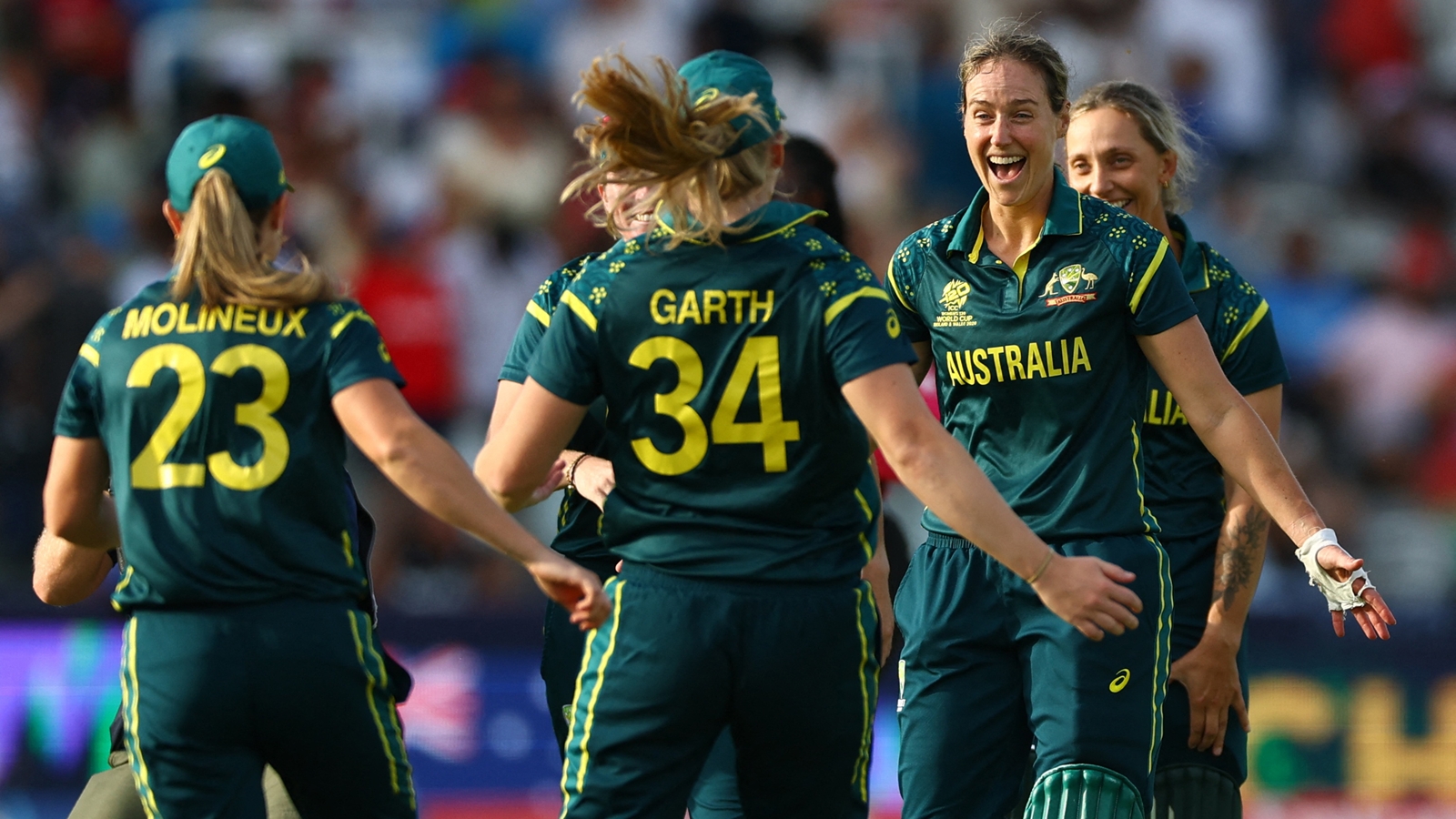
[Image: Australia’s Ellyse Perry celebrates with teammates after winning the ICC Women’s T20 World Cup 2026 (Reuters Photo)]
Main Facts
Lord’s, the revered ‘Home of Cricket,’ bore witness on Sunday to yet another chapter in Australian sporting dominance as the formidable Southern Stars clinched their seventh ICC Women’s T20 World Cup title. In a final that, contrary to pre-match predictions, quickly became a one-sided affair, Australia dismantled host nation England by seven wickets. This emphatic victory not only extended Australia’s unparalleled record in the format but also shattered England’s formidable unbeaten streak in Women’s T20 World Cup matches on home soil, a run that had spanned 11 games.
The architects of this historic triumph were primarily opener Beth Mooney, whose masterful unbeaten 64 off 49 balls anchored the chase, and the prodigious Phoebe Litchfield, who electrified the capacity crowd with an audacious 48 off just 35 deliveries. Their century stand for the second wicket effectively extinguished any English hopes, guiding Australia to a comfortable 153/3 in 17.1 overs, chasing England’s modest total of 150/4. For England, Captain Nat Sciver-Brunt’s resilient 58 not out proved insufficient against the sheer batting depth and clinical execution of the Australian side. The result was a stark reminder of Australia’s enduring supremacy in women’s cricket, cementing their status as arguably the greatest team in the sport’s history.
A Clash of Titans: Pre-Match Expectations and Historical Context
The lead-up to Sunday’s final at Lord’s had been steeped in anticipation, with cricket pundits and fans alike predicting a pulsating encounter between two of the sport’s fiercest rivals. The narrative was rich, pitting Australia’s established dynasty against England’s formidable home advantage and recent momentum. On paper, the contest seemed finely balanced, promising a grand finale worthy of the iconic venue.
Australia’s Unyielding Dynasty
Australia arrived at Lord’s as the undisputed heavyweights of women’s cricket, a team that had redefined excellence and consistency. Their record spoke volumes: six previous ICC Women’s T20 World Cup titles, an achievement unmatched by any other nation. Their journey to the 2026 final had been typically dominant, marked by nine victories in their last ten T20 Internationals, showcasing a side in peak form. This wasn’t merely a team; it was a well-oiled machine, meticulously assembled and ruthlessly efficient.
Historically, Australia had only ever lost one Women’s T20 World Cup final, a rare blip in an otherwise flawless record. This solitary defeat, etched into their collective memory, served not as a scar but as a constant reminder of the fine margins in elite sport, fueling their relentless pursuit of perfection. The "invincible" aura surrounding the Southern Stars was not born of hyperbole but from years of sustained success, built on a foundation of exceptional talent, strategic brilliance, and an unshakeable team ethos. Their ability to perform under pressure, especially in tournament finals, was legendary, and they sought to add a seventh star to their already glittering constellation.
England’s Home Fortress and Momentum
Conversely, England entered the final with their own compelling narrative and an equally impressive run of form. The host nation had carried an eight-match winning streak into the decider, demonstrating a surge of confidence and tactical prowess. What truly elevated their challenge, however, was their impeccable record in Women’s T20 World Cup matches on home soil. They boasted a perfect 11-0 record, transforming every home game into a fortress of invincibility.
Adding another layer of historical weight, England had never lost a World Cup final – be it 50-over or T20 – when playing on their home turf. This statistic was a source of immense pride and a psychological advantage, fostering a belief that Lord’s would once again be the stage for English triumph. The home crowd, a sea of fervent support, was expected to provide an electrifying atmosphere, amplifying England’s charge. The clash was set: Australia’s unparalleled dynasty against England’s formidable home fortress, a battle for supremacy with history hanging in the balance.
The Final Unfolds: A Masterclass in Chase
The highly anticipated final, however, failed to live up to the billing of a closely fought contest. From the moment Australia began their chase, it became clear that their dominance was simply on another level, effectively dismantling England’s aspirations and rewriting the historical script.
England’s Innings: A Battle for Momentum
Winning the toss and electing to bat first, England aimed to set a challenging total on a Lord’s pitch that offered a good balance between bat and ball. However, they found themselves immediately under pressure from Australia’s disciplined bowling attack. The Australian bowlers, renowned for their accuracy and tactical variations, choked the flow of runs from the outset. Early wickets, though not explicitly detailed in the original brief, would have certainly contributed to England’s struggle to build momentum.
Captain Nat Sciver-Brunt emerged as the linchpin of the English innings, showcasing her immense class and resilience under duress. While her teammates struggled to break free against the relentless Australian attack, Sciver-Brunt displayed a calm authority, meticulously accumulating runs and finding boundaries when opportunities arose. Her partnership with Freya Kemp, an 80-run stand, was crucial in steadying the ship and giving England a fighting chance. Sciver-Brunt’s unbeaten 58 runs were a testament to her individual brilliance, but the overall scoring rate remained subdued. The final total of 150/4 in 20 overs, while not disastrous, felt short of what would be considered a truly competitive score against a batting lineup as deep and aggressive as Australia’s. The disciplined lines and lengths maintained by the Australian bowlers ensured that England rarely found the rhythm needed to accelerate decisively, leaving them with a target that ultimately proved too little to defend.
Australia’s Clinical Pursuit: The Powerplay Prowess
Australia’s response was nothing short of a batting masterclass, characterized by calculated aggression and an unyielding intent to dominate. Despite an early setback (as indicated by the Powerplay score of 62/1), the Southern Stars quickly seized control, transforming what should have been a tense chase into a seemingly effortless pursuit.
The Powerplay overs were a spectacle of intent. Australia raced to an astonishing 62/1, a blistering start that immediately put England on the back foot and signaled Australia’s clear intent to dictate terms. Beth Mooney, the calm constant, after a brief watchful start, settled into her rhythm with remarkable speed. She exhibited proactive footwork against both spin and pace, demonstrating her pre-planned strategy to neutralize England’s bowlers. Mooney repeatedly backed away to leg, creating angles to punish anything overpitched or short, a hallmark of her refined technique. A powerful slog-swept boundary off Linsey Smith served as her initial declaration of intent, followed by authoritative drives and lofted shots off Lauren Bell, showcasing her ability to score fluently across the ground. By the end of the Powerplay, Mooney had already taken firm control of the chase, setting a daunting pace that England struggled to match.
The Architects of Victory: Mooney and Litchfield’s Dominance
While the entire Australian team contributed to this historic win, the partnership between Beth Mooney and Phoebe Litchfield stood out as the defining moment of the final. It was a perfect blend of experience and youthful exuberance, a testament to Australia’s incredible depth and strategic brilliance.
Beth Mooney: The Anchor Amidst the Fireworks
Beth Mooney’s role in the Australian batting lineup is unique and invaluable. Amidst an "embarrassment of batting riches" filled with power-hitters, Mooney stands as the "quiet constant who binds the innings together." Her temperament and ability to anchor a chase were once again on full display at Lord’s. Her unbeaten 61 in the semi-final had already foreshadowed her form, and the final presented another grand stage for her calm authority.
Mooney’s approach is not about brute force, but about calculated precision and unwavering focus. Her technical adjustments, particularly in accessing different areas of the field against spin and in the middle overs, were evident. As she had revealed to Wisden earlier in the year, a significant part of her evolution has been "mindset, giving myself permission to be a little more assertive earlier in an innings rather than waiting too long to shift gears." This assertive yet controlled aggression was perfectly manifested in her innings, allowing her to score fluently while ensuring stability. She reached her fifty off just 38 balls in the 13th over, maintaining a brisk pace even after Litchfield’s dismissal. Her eventual dismissal via an LBW decision off Sophie Ecclestone on 64 off 49 balls, though tantalizingly close to victory, had carried Australia most of the way, leaving only a handful of runs for the incoming batters to complete. Her innings was a masterclass in controlled aggression and strategic batting, earning her deserved accolades.
Phoebe Litchfield: The Future Unleashed
If Mooney was the steady anchor, Phoebe Litchfield was the dynamic force that injected unparalleled momentum into the chase. Walking out to bat in the second over after an early wicket, the young left-hander immediately announced her arrival on the biggest stage. Her very first shot, a bullet straight past the bowler, set the tone for her fearless approach.
Litchfield’s innings was a highlight reel of audacious stroke play. She swept, drove, and danced down the track with effortless grace, launching Charlie Dean over extra cover for the innings’ first six, a clear statement of intent. England’s spinners, attempting various traps and pace variations, found themselves constantly a step behind Litchfield’s quick-thinking and nimble footwork. A breathtaking reverse-swept six off Linsey Smith, executed with audacious confidence, epitomized her fearless approach and brought the packed Lord’s crowd to its feet. Her aggressive intent propelled Australia past 100 in a mere 10.2 overs, effectively breaking England’s spirit.
No English bowler was allowed to settle into any rhythm as Litchfield, in tandem with Mooney, tightened Australia’s grip on the final with a magnificent century stand off just 67 balls. Her enterprising innings of 48 off 35 balls, though ending just shy of a fifty when Dean finally bowled her, had laid an unshakeable foundation for Australia’s victory, showcasing the incredible talent of the next generation of Australian cricketers.
Official Responses and Player Reflections
The aftermath of Australia’s dominant victory saw a mixture of jubilation and philosophical reflection from both camps, underlining the emotional highs and lows inherent in a World Cup final.
Captains’ Takeaways
Australian captain Meg Lanning, holding the gleaming trophy aloft, spoke with immense pride about her team’s performance. "This team just finds a way," Lanning stated during the post-match presentation. "The way Beth Mooney anchored that chase, and Phoebe Litchfield’s fearless approach, truly showcases the depth and talent we have. To win a seventh title, especially here at Lord’s, is an unbelievable achievement and a testament to the hard work and dedication of every single player and support staff." She particularly praised the blend of experience and youth, highlighting how players like Mooney provide stability while youngsters like Litchfield bring explosive energy.
England captain Nat Sciver-Brunt, though visibly disappointed, maintained a dignified composure. "It’s a tough pill to swallow, especially losing a final at home," she admitted. "We fought hard, and I’m proud of the effort, particularly the partnership with Freya that got us to 150. But against a team like Australia, you need more than that. They were simply clinical with the bat, and Mooney and Litchfield played exceptional innings. We’ll take lessons from this and come back stronger."
Beth Mooney, deservingly named Player of the Match, reflected on her innings: "It was another big stage, another chase, and you just want to contribute to the team’s success. I’ve worked a lot on my mindset to be more assertive, and it paid off today. Watching Phoebe at the other end, hitting those fantastic shots, just gave me more confidence to keep ticking over."
Expert Analysis and Media Reaction
Cricket pundits were unanimous in their praise for Australia’s sustained dominance. Former England captain Nasser Hussain, commenting on the victory, remarked, "This Australian team is simply in a league of its own. Their professionalism, their depth, and their ability to perform under pressure are unmatched. Mooney is a rock, and Litchfield is an absolute superstar in the making. England will need to go back to the drawing board to bridge this gap."
The global media quickly gravitated towards the narrative of Australia’s unparalleled dynasty. Headlines lauded the "Southern Stars’ Seventh Heaven" and "Mooney-Litchfield Masterclass," emphasizing the team’s relentless pursuit of excellence. There was also significant discussion about the increasing gap between Australia and other cricketing nations, prompting questions about how the sport can foster more competitive parity at the elite level while acknowledging Australia’s extraordinary talent pool.
Implications and the Future Landscape of Women’s Cricket
Australia’s seventh T20 World Cup title carries profound implications, not just for the teams involved but for the broader landscape of women’s cricket. It solidifies legacies, offers lessons, and shapes the future trajectory of the sport.
Australia’s Enduring Legacy
This seventh T20 World Cup crown unequivocally cements Australia’s status as the greatest women’s cricket team of all time. Their "generation of consistent success" is not merely a phase but a sustained era of unparalleled dominance across formats. The blend of seasoned veterans like Beth Mooney and emerging talents like Phoebe Litchfield ensures that this dynasty is not fleeting but built to last. Mooney’s calm, experienced hand guiding the chase perfectly complemented Litchfield’s fearless, youthful aggression, showcasing a seamless transition between generations.
This continuous success has a cascading effect on Australian cricket. It enhances their brand, attracts significant sponsorships, and expands their fan base globally. More importantly, it inspires a new generation of girls to pick up a bat and ball, ensuring a robust talent pipeline for years to come. The challenge for Australia now is not just to win, but to maintain this extraordinary level of performance and to continually innovate in a sport that is rapidly evolving.
England’s Road Ahead
For England, the sting of losing a World Cup final on home soil, and the shattering of their cherished unbeaten streak at home, will undoubtedly be profound. It marks a significant setback for a team that had built considerable momentum and harbored genuine hopes of lifting the trophy. The defeat highlights the need for England to critically assess their strategy and execution, particularly in high-pressure finals against the world’s best.
While Nat Sciver-Brunt’s leadership and individual brilliance were commendable, the team as a whole struggled to match Australia’s depth and clinical efficiency. The road ahead for England involves a comprehensive review of their game plan, an intensified focus on developing more power-hitters to complement their existing talent, and a concerted effort to find ways to counter Australia’s multifaceted attack. Their potential to bounce back remains strong, given their talent pool, but this loss serves as a stark reminder of the gap they still need to bridge.
The Global Impact on Women’s Cricket
Despite the one-sided nature of the final, the ICC Women’s T20 World Cup 2026 at Lord’s was a resounding success, further underscoring the growing popularity and commercial viability of women’s cricket. The vibrant atmosphere, the packed stands, and the global viewership figures all point towards a sport on an upward trajectory. Such events, even with a dominant winner, showcase the athleticism, skill, and passion of female cricketers, inspiring millions worldwide.
The competitive matches leading up to the final, though not detailed here, would have contributed to the overall excitement and elevated the sport’s profile. The spectacle of a World Cup final at an iconic venue like Lord’s continues to draw new fans and investors, promising a brighter and more competitive future for women’s cricket globally. Australia’s dominance, while a challenge for other nations, also sets an incredibly high bar, pushing everyone else to raise their game, ultimately benefiting the sport as a whole. The journey to the next World Cup will undoubtedly be fueled by the desire to emulate, and eventually dethrone, the mighty Southern Stars.
