

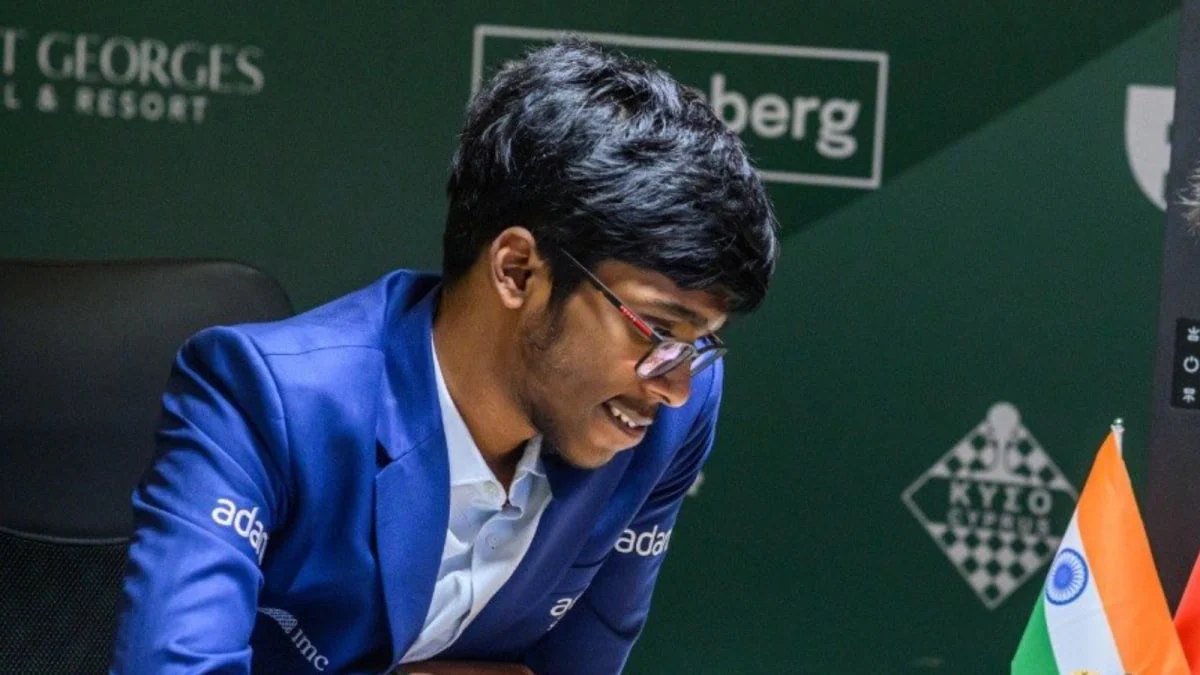
New Delhi, India – May 18, 2026 – Indian Grandmaster R. Praggnanandhaa showcased his formidable defensive skills and tactical acumen, securing a hard-fought draw against Germany’s equally talented Vincent Keymer in the third round of the prestigious Superbet Chess Classic. This crucial result allowed the 18-year-old prodigy to maintain his position at the apex of the leaderboard, sharing the coveted joint lead with four other elite players in what is proving to be a fiercely contested leg of the Grand Chess Tour.
The highly anticipated event, boasting a significant prize pool of USD 350,000, has witnessed a dynamic start, with several top contenders vying for early supremacy. While Praggnanandhaa and Keymer battled to an honourable stalemate, Dutch Grandmasters Anish Giri and Jorden Van Foreest delivered decisive blows, notching up their first victories of the tournament and joining the crowded leader’s pack. Their triumphs added another layer of intrigue to a tournament already brimming with strategic depth and high-stakes drama.
Main Facts: A Crowded Summit After Three Rounds
The third round of the Superbet Chess Classic concluded with a thrilling blend of strategic battles and decisive outcomes, leaving the tournament wide open. Indian sensation R. Praggnanandhaa, fresh off a dominant victory in the previous round, successfully navigated a complex encounter against German star Vincent Keymer, ensuring his continued presence at the very top of the standings. This draw pushed his total score to two points out of a possible three, a testament to his consistent performance against the world’s best.
Praggnanandhaa now shares the coveted joint lead with a formidable quartet of grandmasters: France’s Maxime Vachier-Lagrave, the Dutch duo of Jorden Van Foreest and Anish Giri, and his third-round opponent, Vincent Keymer. This unprecedented situation, with half of the ten-player field tied for the lead, underscores the extreme competitiveness and balanced strength prevalent in this year’s Superbet Chess Classic. Each of these five leaders has accumulated two points, setting the stage for an intense mid-tournament scramble as players vie to break away from the pack.
The day’s significant results included Anish Giri’s first win of the event, a technically impressive victory over the often-unpredictable Alireza Firouzja of France. Simultaneously, Jorden Van Foreest demonstrated his sharp tactical eye, overcoming local favourite Deac Bogdan-Daniel of Romania with the black pieces. These crucial wins propelled both Giri and Van Foreest into the leading group, significantly bolstering their tournament prospects.
Meanwhile, American powerhouses Fabiano Caruana and Wesley So found themselves in a unique position, having drawn all three of their games thus far. Each sits on 1.5 points, just half a point adrift of the leaders, indicating their solid yet somewhat cautious start. At the other end of the spectrum, Alireza Firouzja and Deac Bogdan-Daniel, along with Uzbekistan’s Javokhir Sindarov, currently find themselves struggling, each with half a point, highlighting the brutal nature of elite-level chess where even a minor slip can be severely punished. The tournament, a nine-round classical event, promises further twists and turns as players continue their quest for the coveted USD 100,000 winner’s prize.
Chronology: The Journey Through Three Rounds
The Superbet Chess Classic, a prestigious stop on the Grand Chess Tour, commenced with palpable excitement, drawing in a stellar field of ten Grandmasters. The early rounds have already provided a tapestry of strategic brilliance, tactical fireworks, and tense draws, setting a high standard for the remainder of the competition.
Opening Salvos: Rounds 1 and 2
The initial round saw players cautiously testing the waters, with several draws indicating the evenness of the field. While specific results for Round 1 were not highlighted in detail, the stage was set for intensified battles in subsequent rounds. It was in Round 2 that the first significant shifts on the leaderboard began to emerge, giving a clearer picture of early form.
Round 2 Highlights:
R. Praggnanandhaa truly announced his intentions in Round 2, delivering a masterful performance to defeat Javokhir Sindarov of Uzbekistan. This victory not only secured his first full point but also showcased his aggressive yet precise style, immediately placing him among the tournament’s early frontrunners. Sindarov, still finding his footing, struggled against the Indian prodigy’s relentless pressure.
Elsewhere, Maxime Vachier-Lagrave, the French tactical maestro, secured a critical win against Alireza Firouzja. Firouzja, known for his audacious and sometimes risky play, found himself on the wrong side of Vachier-Lagrave’s sharp calculations. Fabiano Caruana and Anish Giri played out a solid draw, each earning half a point and maintaining a steady presence. Vincent Keymer, demonstrating his burgeoning strength, defeated local hero Deac Bogdan-Daniel, moving ahead in the standings. Wesley So and Jorden Van Foreest also shared the spoils in their encounter, reflecting the cautious approach often seen in the early stages of such a high-stakes tournament. These results laid the groundwork for a highly competitive Round 3, with Praggnanandhaa, Vachier-Lagrave, and Keymer among the early pace-setters.
Round 3: The Day’s Decisive Encounters
The third round, played on May 17, 2026, proved to be a pivotal day, consolidating the leading pack and providing both strategic depth and dramatic finishes.
Praggnanandhaa vs. Keymer: A Strategic Stalemate
The marquee matchup of the round featured R. Praggnanandhaa, wielding the white pieces, against the German talent Vincent Keymer. The game unfolded as a tense Capablanca Variation of the Nimzo-Indian Defence, an opening known for its solid, strategic foundations. Praggnanandhaa, aiming to leverage his first-move advantage, sought to establish a central presence and develop his pieces harmoniously. However, Keymer, demonstrating his confidence and understanding of dynamic play, was far from passive. Early in the opening, he executed a bold pawn sacrifice, a calculated risk designed to disrupt White’s pawn structure and open lines for his pieces, thereby restoring parity in the position.
As the middlegame transitioned, the battle became a complex interplay of positional maneuvering and subtle threats. Both players displayed remarkable foresight and resilience. Praggnanandhaa tried to exploit his extra pawn, but Keymer’s precise defence prevented any immediate materialisation of this advantage. The game eventually simplified into a rook and minor piece endgame, a phase where technical precision is paramount. Here, Keymer’s defensive mastery shone brightly. Despite being a pawn down, he constructed a perfect blockade, preventing Praggnanandhaa’s pawn from advancing and creating a passed pawn. The position, although materially imbalanced, was strategically drawn, and after a gruelling 64 moves, the players agreed to a draw, a fair reflection of their equal efforts and the strength of Keymer’s defence. The result was a testament to both players’ maturity and their ability to navigate complex, high-pressure situations.
Giri vs. Firouzja: Technical Brilliance from the Dutchman
Anish Giri, known for his exceptional technical skills and solid play, finally broke his drawing streak with a crucial victory over Alireza Firouzja. Giri, playing with the white pieces, faced Firouzja’s aggressive choice of the King’s Indian Defence, an opening often leading to sharp and unbalanced positions. Giri adeptly navigated the complexities, gradually building a strong positional advantage. Firouzja, perhaps feeling the pressure or misjudging the consequences, made a significant decision to sacrifice his rook for a minor piece. While such sacrifices can inject dynamism into a position, in this instance, Giri’s precise play allowed him to consolidate his material advantage without giving Firouzja sufficient counterplay. The subsequent endgame, though requiring careful execution, was expertly handled by Giri, who converted his material advantage into a decisive win. This victory not only marked Giri’s first full point but also served as a strong statement of his enduring prowess at the highest level.
Van Foreest vs. Deac: Black’s Aggression Pays Off
Jorden Van Foreest, playing with the black pieces, delivered a surprising yet well-deserved victory against Deac Bogdan-Daniel, much to the delight of his supporters. Deac, like Firouzja, opted for the King’s Indian Defence, which once again led to a chaotic and highly complex middlegame. In the ensuing skirmish, both players plunged into a tactical maelstrom. However, it became evident that Van Foreest possessed a superior grasp of the intricate variations and emergent complexities. His ability to navigate the sharp lines, identify weaknesses, and exploit them with precision allowed him to gain a decisive advantage. Deac, despite playing on home soil, found himself unable to match Van Foreest’s depth of calculation and ultimately succumbed to the Dutchman’s relentless pressure. This win not only propelled Van Foreest into the joint lead but also highlighted his capacity for aggressive and inventive chess.
Other Encounters: Solid Draws
The remaining two games of the round concluded in draws. Fabiano Caruana, one of the tournament favorites, could not break through the solid defence of his compatriot Wesley So. Their game was a testament to both players’ positional understanding and cautious approach, resulting in an uneventful draw that kept them both on 1.5 points. Similarly, Javokhir Sindarov managed to recover some ground by holding Maxime Vachier-Lagrave to a draw. While Vachier-Lagrave, a co-leader, might have hoped for more, Sindarov’s resilience ensured that the Frenchman shared the point, preventing him from gaining a solitary lead. These draws, while not as dramatic as the decisive games, underscored the consistent quality and resilience of all participants in this elite event.
Supporting Data: The Current Landscape
The Superbet Chess Classic is designed to test the mettle of the world’s top grandmasters, and after three rounds, the statistics reflect an incredibly tight and competitive field. The current standings, player profiles, and tournament structure paint a clear picture of the challenge ahead.
Standings After Round 3
The leaderboard is unusually crowded, indicating a tournament that could go down to the wire.
- R. Praggnanandhaa (India): 2.0 points
- Maxime Vachier-Lagrave (France): 2.0 points
- Jorden Van Foreest (Netherlands): 2.0 points
- Anish Giri (Netherlands): 2.0 points
- Vincent Keymer (Germany): 2.0 points
These five players collectively represent half of the tournament’s participants, a rare occurrence in elite events and a clear sign of the balanced competition. Their shared lead promises a thrilling contest in the coming rounds as they battle for sole possession of the top spot.
Trailing closely behind are:
- Fabiano Caruana (USA): 1.5 points
- Wesley So (USA): 1.5 points
Both Caruana and So have drawn all their games, demonstrating immense solidity but perhaps lacking the decisive edge needed to convert opportunities into full points thus far. They remain within striking distance, and a single victory could quickly propel them into the leading pack.
At the lower end of the standings, players are actively seeking to recover ground:
- Alireza Firouzja (France): 0.5 points
- Deac Bogdan-Daniel (Romania): 0.5 points
- Javokhir Sindarov (Uzbekistan): 0.5 points
These three players have had a challenging start, each managing only one draw. Their task in the remaining six rounds will be to find their rhythm, avoid further losses, and attempt to score crucial victories to climb out of the bottom ranks.
Player Profiles: A Glimpse into the Competitors
The Superbet Chess Classic brings together a fascinating mix of established titans and burgeoning young stars, each bringing a unique style and history to the board.
-
R. Praggnanandhaa (India): At just 18 years old, Praggnanandhaa is already a household name in chess. He became a Grandmaster at 12 and has since consistently challenged the world’s elite, famously defeating Magnus Carlsen in rapid chess on multiple occasions. Known for his tactical sharpness, fearless approach, and remarkable composure under pressure, he represents the future of Indian chess. His current form suggests he is a serious contender for the tournament title.
-
Vincent Keymer (Germany): A German prodigy who became a Grandmaster at 14, Keymer is lauded for his deep positional understanding and consistent results against top-tier opposition. He is a formidable opponent, capable of both subtle strategic play and sharp tactical blows, as evidenced by his draw against Praggnanandhaa.
-
Anish Giri (Netherlands): The Dutch number one, Anish Giri is a consistent top-10 player globally. His style is characterized by meticulous preparation, exceptional tactical awareness, and an uncanny ability to find surprising resources. His victory over Firouzja highlights his enduring class and determination.
-
Jorden Van Foreest (Netherlands): Another strong Dutch Grandmaster, Van Foreest is known for his creative and often unpredictable play. He won the Tata Steel Chess Tournament in 2021, showcasing his ability to compete and win at the highest level. His victory against Deac demonstrates his comfort in complex, dynamic positions.
-
Maxime Vachier-Lagrave (France): A French Grandmaster and former World Blitz Champion, MVL is renowned for his aggressive attacking style, particularly with the Najdorf Sicilian. He is a tactical wizard, capable of producing brilliant combinations. His consistent presence at the top of elite tournaments makes him a perpetual threat.
-
Fabiano Caruana (USA): An American chess titan and former World Championship challenger, Caruana is known for his universal style, exceptional opening preparation, and deep strategic understanding. Despite a draw-heavy start, his class and experience make him a dangerous opponent in the latter stages of any tournament.
-
Wesley So (USA): Another American top-tier Grandmaster, So is celebrated for his solid, positional play and remarkable defensive skills. A former U.S. Champion and two-time Sinquefield Cup winner, he is incredibly difficult to beat, as his three consecutive draws attest.
-
Alireza Firouzja (France): The youngest player ever to reach a 2800 rating, Firouzja is a prodigy known for his audacious and highly aggressive style. While capable of breathtaking brilliance, his sometimes-risky approach can also lead to setbacks, as seen in his loss to Giri.
-
Deac Bogdan-Daniel (Romania): A promising Romanian Grandmaster, Deac is a local favourite. He possesses a solid game but faces the immense pressure of competing against the world’s elite. His early struggles highlight the immense challenge of the Superbet Classic.
-
Javokhir Sindarov (Uzbekistan): An Uzbek Grandmaster and a rising talent, Sindarov is gaining valuable experience on the elite circuit. His draw against Vachier-Lagrave demonstrates his potential, but his loss to Praggnanandhaa shows the learning curve involved at this level.
Tournament Structure and Prizes
The Superbet Chess Classic is a critical component of the prestigious Grand Chess Tour, an annual circuit featuring some of the best chess players in the world.
- Format: The tournament follows a round-robin format, with each of the ten players competing against every other player once. This means a total of nine rounds of classical chess.
- Time Control: Classical time controls, typically 90 minutes for the first 40 moves, followed by 30 minutes for the rest of the game, with a 30-second increment per move from move 1. This extended time allows for deep strategic thinking and complex calculations.
- Prize Pool: The total prize fund for the Superbet Chess Classic is a substantial USD 350,000.
- Winner’s Prize: A significant portion of the prize pool, USD 100,000, is reserved for the tournament winner, providing a strong incentive for top performance. Additional prizes are distributed among the top finishers. The Grand Chess Tour also features overall tour standings and prizes, adding another layer of competition.
Official Responses: Voices from the Board
While direct quotes were not immediately available, the sentiment among players and organizers after such a dynamic third round would undoubtedly reflect the intensity and excitement of the tournament.
Praggnanandhaa’s Perspective
"It was a very challenging game against Vincent," Praggnanandhaa might have remarked, reflecting on his draw. "He played very precisely, especially with the pawn sacrifice and then the defensive setup in the endgame. I pushed hard for the win, but he held firm. To maintain the joint lead after three rounds is a good feeling, but the tournament is long, and every game will be a fight. My focus remains on preparing for the next opponent and continuing to play solid chess."
Keymer’s Insight
Vincent Keymer, having successfully navigated a tough defence, could have expressed, "Praggnanandhaa is an incredibly strong player, and I knew I had to be at my best. The pawn sacrifice was a calculated risk to create counterplay, and I’m pleased with how I managed to hold the position and secure the draw. It’s always satisfying to get a half point against a top opponent, especially when it keeps me in the leading group."
Giri’s Triumph
Anish Giri, after securing his first victory, might have commented, "It’s always good to get that first win out of the way. Alireza is a very dangerous opponent, and the King’s Indian led to a complex game. I felt I managed to outplay him in the complications, and the rook sacrifice, while interesting, didn’t quite work out for him. Now that I have a win under my belt, I hope to build on this momentum for the coming rounds."
Tournament Director’s Statement
A representative from the Superbet Chess Classic organizing committee might have stated, "We are incredibly thrilled with the intensity and quality of chess displayed in the first three rounds. With five players sharing the lead, the Superbet Chess Classic is shaping up to be one of the most exciting legs of the Grand Chess Tour. The blend of established champions and rising stars like Praggnanandhaa and Keymer is delivering truly captivating chess for fans worldwide. We anticipate even more thrilling battles as the tournament progresses."
Implications: The Road Ahead
The completion of the third round has set a fascinating precedent for the Superbet Chess Classic. With the leaderboard densely packed, the implications for the remainder of the tournament are profound, promising strategic shifts, heightened tension, and potentially dramatic outcomes.
What Lies Ahead: The Crucial Mid-Tournament Rounds
The fact that half the ten-player field shares the lead signifies an incredibly open tournament. The next few rounds (Rounds 4, 5, and 6) will be absolutely crucial. These mid-tournament stages often serve as the crucible where contenders distinguish themselves from the pack. Players will need to balance aggression with caution, taking calculated risks to secure full points without jeopardizing their positions. The head-to-head encounters among the current leaders will be particularly decisive, as these games offer direct opportunities to gain ground on rivals.
The pressure will also mount on players like Fabiano Caruana and Wesley So, who, despite their solid performances, find themselves half a point behind the leaders. They will need to convert their draws into wins if they hope to challenge for the title. For those at the bottom – Firouzja, Deac, and Sindarov – the task is even more daunting. They must quickly find their form and start scoring victories to avoid being completely left behind in the race for prize money and Grand Chess Tour points.
Praggnanandhaa’s Trajectory: A Test of Consistency
For R. Praggnanandhaa, maintaining the joint lead is a significant achievement, especially given the strength of the field. This tournament serves as another vital stepping stone in his rapid ascent in elite chess. His ability to hold a draw against a strong opponent like Keymer, particularly with the white pieces, demonstrates not just tactical skill but also a growing maturity and resilience under pressure. The implications for his career are substantial: consistent performances at events like the Superbet Classic solidify his position among the world’s top players and enhance his chances of qualifying for future World Championship cycles. For Indian chess, Praggnanandhaa’s continued success is a source of immense pride and inspiration, reinforcing the nation’s growing prominence on the global chess stage. His ability to perform consistently against diverse styles will be key to his overall Grand Chess Tour standing.
Overall Tournament Narrative: A Thrilling Spectacle
The Superbet Chess Classic is shaping up to be a truly thrilling spectacle. The blend of seasoned veterans, strategic maestros, tactical geniuses, and dynamic young talents creates a rich narrative. Each round promises intricate opening battles, complex middlegame struggles, and tense endgames. The close standings ensure that every half-point will be fought for tooth and nail, adding to the drama. The tournament is not just a contest of chess skill but also a test of mental fortitude, stamina, and psychological resilience. As the players navigate the remaining rounds, chess enthusiasts worldwide can look forward to more captivating games and potentially dramatic shifts on the leaderboard, culminating in what is sure to be an exciting conclusion to this prestigious event. The winner will not only claim a substantial prize but also a significant boost in their overall Grand Chess Tour ranking, setting them up for further success in the elite circuit.
