

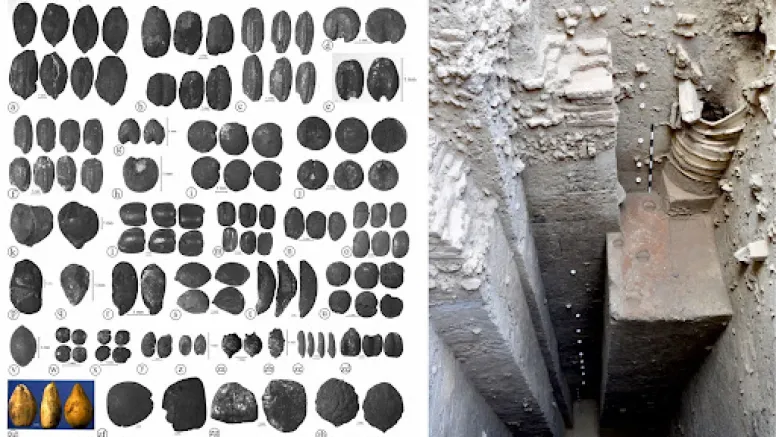
BENGALURU – In the quiet village of Uren, nestled within the fertile expanses of Bihar’s Lakhisarai district, archaeologists have unearthed what is being described as a "botanical time capsule." A monumental study, led by a collaborative team from the Birbal Sahni Institute of Palaeosciences (BSIP) and the Archaeological Survey of India (ASI), has recovered over half a million charred seeds. This discovery provides an unprecedented, continuous 3,000-year record of farming, tracing the evolution of Indian agriculture from the dawn of the Iron Age in 1300 BCE to the Early Medieval period in 1200 CE.
For decades, the story of India’s agricultural origins was largely centered on the Indus Valley and the Upper Ganga Plain. However, this new research shifts the spotlight eastward, revealing how ancient communities in the Middle and Lower Ganga regions didn’t just survive—they innovated, traded globally, and engineered their way through catastrophic climate shifts.
The Discovery: A Half-Million Grain Archive
The excavation at Uren has yielded a staggering volume of data. By analyzing microscopic plant remains, researchers have been able to reconstruct the dietary habits and economic priorities of a civilization that spanned thirty centuries. Unlike organic matter that rots away, these seeds were "carbonized"—partially burned during cooking or grain processing—turning them into charcoal. In this state, they become nearly indestructible, preserved within the soil layers like biological fossils.
The sheer scale of the find—exceeding 500,000 specimens—allows for a statistical depth rarely seen in Indian archaeology. It provides a year-by-year, century-by-century account of what was on the dinner plates of ancient Indians and how those choices were dictated by the rise of empires and the whims of the monsoon.
Chronology: From Iron Age Diversity to Imperial Rice
The 3,000-year timeline uncovered at Uren reveals a fascinating shift in human strategy, moving from survivalist diversity to imperial-scale intensification.

The Iron Age Foundation (c. 1300 BCE – 600 BCE)
In the earliest layers of the site, dating back to the Iron Age, the inhabitants of Uren practiced a balanced form of "subsistence multi-cropping." The data shows a roughly equal reliance on summer (Kharif) and winter (Rabi) crops. Farmers grew a diverse array of small millets, pulses, and indigenous rice alongside winter staples like wheat, barley, and lentils. This diversity acted as a natural insurance policy; if the monsoon failed, the winter harvest could sustain the community.
The Era of Empires: Mauryan and Gupta Intensification (c. 300 BCE – 600 CE)
As the region transitioned into the period of the great Mahajanapadas and the subsequent Mauryan and Gupta Empires, the botanical record shows a dramatic "Rice Revolution." By approximately 200 BCE (the Sunga-Kushana period), rice had become the undisputed staple.
Researchers believe this shift was not accidental. The rise of large, centralized states required a surplus of food to feed growing urban centers and standing armies. Rice, being a high-yield crop in the humid Ganga Plain, was the perfect engine for imperial growth. This period saw the introduction of sophisticated irrigation techniques, better iron plows, and a systematic focus on maximizing output, marking the birth of intensive agriculture in Eastern India.
The Medieval Transition (c. 600 CE – 1200 CE)
Following the Gupta period, the agricultural record shows further complexity. While rice remained dominant, the diversity of pulses and oilseeds increased, reflecting a more sophisticated culinary culture and a highly organized market economy that catered to varied tastes and nutritional needs.
Supporting Data: The Science of Archaeobotany
To extract these secrets from the earth, the research team employed a rigorous multi-disciplinary approach. The methodology serves as a blueprint for modern archaeological investigation.

The Flotation Method
The recovery of half a million seeds was made possible through "flotation." Because charred seeds are lighter than the surrounding mineral soil, researchers placed excavated earth into specialized water tanks. As the soil sank, the ancient botanical remains floated to the surface. These "light fractions" were then skimmed off, dried, and prepared for microscopic analysis.
Morphometrics and Radiocarbon Dating
Once recovered, the seeds underwent morphometric analysis—the precise measurement of shape and size. This allowed scientists to distinguish between wild varieties of plants and their domesticated counterparts. To ensure the timeline was accurate, the team used Accelerator Mass Spectrometry (AMS) radiocarbon dating. By measuring the decay of Carbon-14 within the seeds themselves, they could pin specific agricultural shifts to exact centuries with high confidence.
Global Trade Indicators
Perhaps the most surprising data point was the presence of "exotic" species. The team identified the remains of garlic (Allium sativum), which originated in Central Asia, and tamarind (Tamarindus indica), which is native to Africa. The presence of these plants in an ancient Bihar village proves that even 2,000 years ago, rural India was part of a sprawling international trade network, likely connected via the Silk Road and maritime Indian Ocean routes.
Official Responses and Scientific Significance
The scientific community has hailed the Uren study as a landmark achievement. Dr. Anil K. Pokharia of the Birbal Sahni Institute of Palaeosciences, a lead author on the study, emphasized that the site fills a critical "knowledge gap."
"For a long time, we lacked a continuous, high-resolution record of agriculture in the Eastern Ganga Plain," researchers noted in their findings. "Uren provides us with a rare, uninterrupted sequence. It tells us that these ancient farmers were not just passive observers of nature; they were active managers of their landscape."

Representatives from the Archaeological Survey of India (ASI) added that the findings underscore the importance of "micro-archaeology." While large monuments like stupas and palaces catch the public eye, it is the microscopic seeds that provide the most accurate data regarding the daily lives, health, and economic resilience of the common people who built those empires.
Implications: Lessons in Climate Resilience
The most poignant aspect of the Uren discovery is what it teaches us about climate adaptation—a lesson of immense relevance in the 21st century.
Approximately 1,300 years ago, the data suggests the region faced a significant climatic crisis. The Indian Summer Monsoon weakened, leading to a prolonged period of aridity. In many parts of the world, such shifts have led to the collapse of civilizations. However, the people of Uren did not flee.
Instead, the botanical record shows a strategic pivot. They restructured their cropping systems, placing a higher emphasis on drought-resistant millets and pulses. Simultaneously, archaeological evidence near the site suggests the construction of massive irrigation tanks and reservoirs to capture what little rain did fall.
A Blueprint for the Future
The implications of this study extend far beyond history. As modern agriculture faces the dual threats of climate change and soil degradation, the 3,000-year record at Uren offers a "manual for resilience."

- Crop Diversity: The ancient reliance on a mix of Rabi and Kharif crops suggests that modern monoculture (growing only one crop) may be more vulnerable to climate shocks than ancient multi-cropping systems.
- Water Management: The ability of ancient farmers to sustain intensive rice cultivation during dry spells through local irrigation highlights the need for decentralized water storage today.
- Indigenous Wisdom: The study proves that "traditional" farming was actually a highly sophisticated, evolving technology that successfully managed the environment for three millennia.
Conclusion
The charred remains found at Uren are more than just burnt seeds; they are the fingerprints of ancestors who navigated the complexities of empire-building and environmental change. By tracing the 3,000-year journey of agriculture in Bihar, researchers have not only rewritten the history of the Ganga Plain but have also provided a testament to human ingenuity. As we look toward an uncertain climatic future, the half-million seeds of Uren remind us that resilience is rooted in diversity, innovation, and an intimate understanding of the land.
